

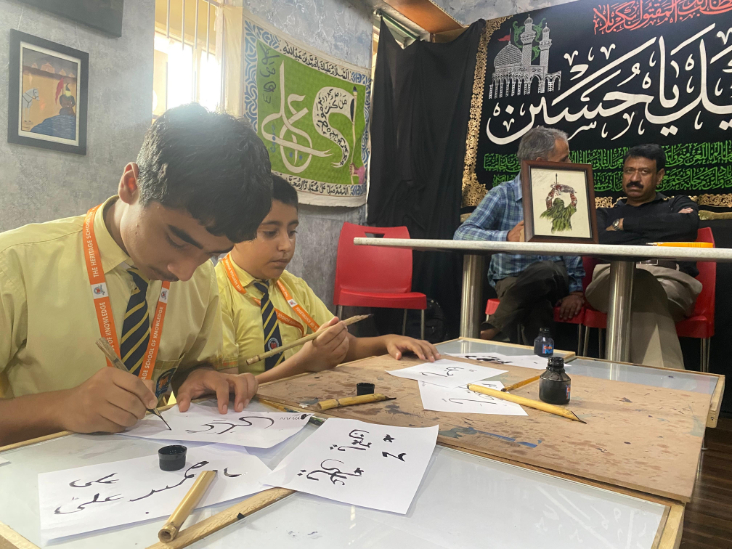
SRINAGAR, AUGUST 20: The 13th edition of Mashq-e-Arba’een concluded on Tuesday with children taking centre stage in art, photography, filmmaking and literature. This year’s edition was designed as a “Children’s Special,” with young participants given wider space to create, express, and engage with professionals across creative disciplines.
Organiser and Curator of the Exhibition and Founder of Educational Revival through Arts and Aesthetics (EdRAAK), Iliyas Rizvi, said the focus was deliberate. “We wanted to open up a space where children could use creativity to explore emotions, history and culture. It is refreshing to see students step away from passive screen time and immerse themselves in meaningful expression,” he said.
The exhibition featured striking works by schoolchildren. A short film ‘Hussain in Kashmir’ by Class 12 student Marzia Aga of Kothibagh School combined visual storytelling with Kashmiri marsiya and nouha, tracing the architectural and cultural heritage of Azadari in the Valley. In photography, Class 10 student of Standard School, Danish Ali Mir presented a collection capturing Kashmiri symbols of mourning, including a bird’s-eye view of the annual Majlis-e-Asad.
The art section drew major participation from girls, each piece telling its own narrative. A standout work was Safar-e-Arba’een by Akeel Manzoor, a Class 7 student of Imamia School, Zadibal, portraying the annual pilgrimage to Karbala. Live art demonstrations by younger children, such as Farman Ali and Mansha Zehra from Class 7 of Heritage School of Knowledge, added to the atmosphere of exploration and engagement.
Teachers also joined in discussions about the role of creative activities in shaping personality development. Consultant Sabahat Nazir and Irfan Hussain delved on the importance of such initiatives at a time when children face growing exposure to artificial intelligence and constant screen engagement. “These sessions remind us that the imagination of a child can never be replaced by algorithms,” she said.
Workshops were also led by experts including Yousef Naqshbandi, Rashid Maqbool, Mubashir Hussain Mir and Dr. Manzoor. Their interactions gave students first-hand exposure to different creative practices.
Rizvi further stated that the exhibition also sought to connect children to the deeper traditions of Karbala and Azadari. “The idea was not about polishing skills for a competition. It was about giving space to express emotions tied to memory, community, and spiritual journeys. What we saw were young voices speaking with originality,” he said.