

Syed Aaliya
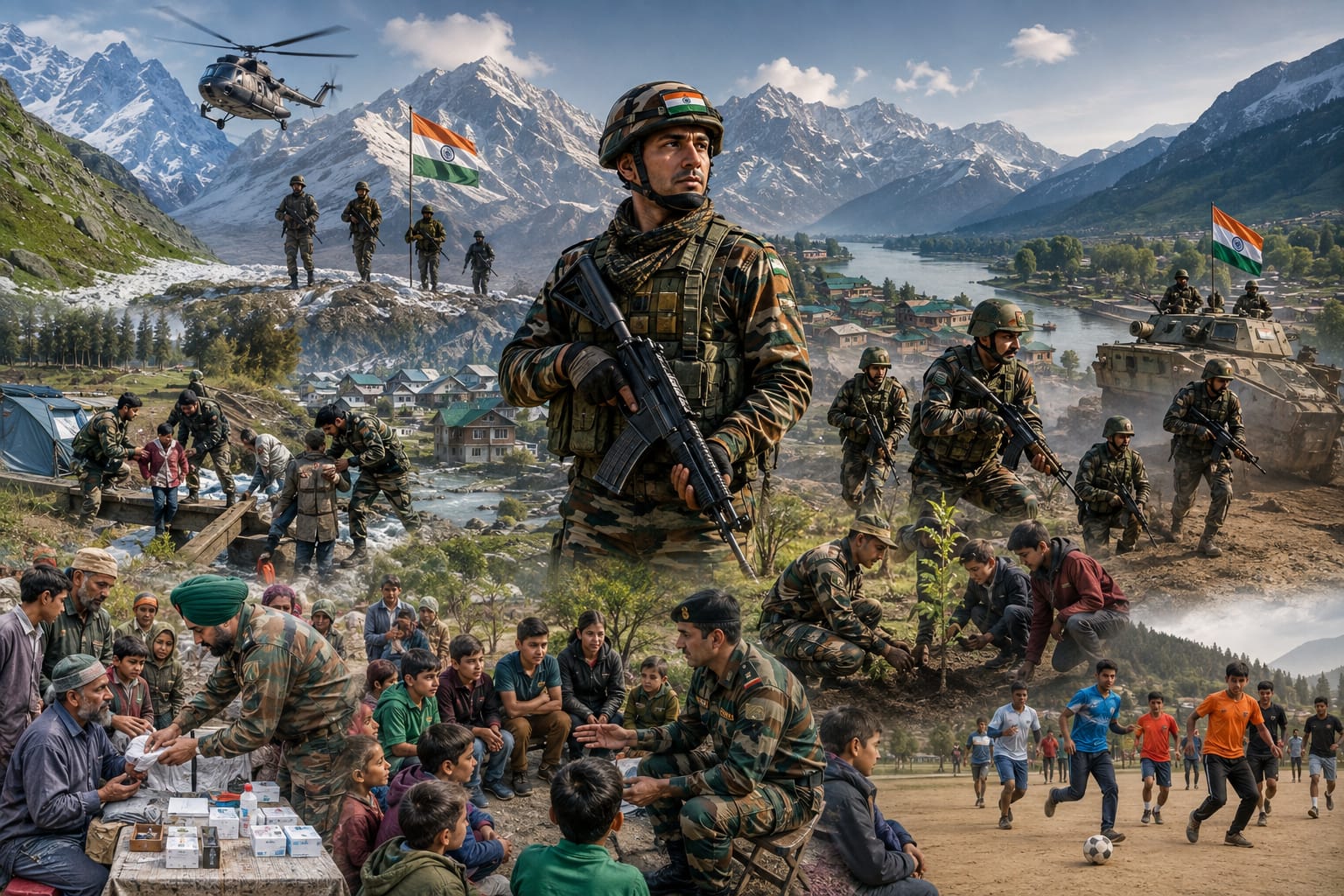
The moment we hear the word “Army,” images of soldiers in uniform, weapons, courage, and sacrifice come to mind. While these qualities define the Army, its contribution goes much further. Beyond safeguarding the nation’s borders, the Indian Army promotes compassion, civic responsibility, youth empowerment, leadership, and collective participation, making it a powerful force in the process of nation-building. Talking about India’s youth demographics, it roughly accounts for 65% of the total population. As is well known, the youth are the greatest strength of any nation. Their energy, creativity, discipline, and determination shape the future of society. A country’s progress depends on how effectively it nurtures and guides its young population, and our robust youth is the future of our vibrant country, which needs proper channelling and nourishment; that is where the Indian Army plays a vital cog in nurturing India’s future. I am from Kashmir, and I have personally seen how the Indian Army has won the hearts of millions of Kashmiris through its helping nature and nation-building initiatives. I am sure such a pattern of nation-building is replicated in the rest of the country.
If we talk about education, the Indian Army has made tremendous efforts to make quality education affordable and accessible. Army Public Schools, Sainik Schools, and Kendriya Vidyalayas continue to provide quality education to thousands of students at affordable fees. These institutions not only focus on academic excellence but also emphasize co-curricular activities and the overall development of students by nurturing leadership, decision-making abilities, discipline, teamwork, and civic values. Under the guidance and ethos of the Indian Army, these schools instill dedication, selfless service, integrity, and commitment in their students, who are the future leaders of the nation. In addition, educational welfare initiatives such as Operation Sadbhavana and various scholarship schemes help provide quality education and financial assistance to students from economically weaker sections of society. The Army’s contribution is not limited to institutions under its direct management. Many government and private schools also benefit from the Army’s outreach programmes, including career counselling, motivational lectures, educational tours, skill development initiatives, and youth engagement activities. Through these efforts, the Indian Army continues to play a vital role in promoting youth leadership and nation-building.
One of the most important youth development programmes is the National Cadet Corps (NCC), which witnesses participation from across India. It serves as the first step in introducing young people to the values and discipline of the Indian Army. Over the years, the NCC has emerged as a platform for nurturing leadership, discipline, teamwork, and a spirit of selfless service among the youth. It encourages youngsters to become responsible citizens and inspires them to contribute actively to nation-building. By instilling qualities such as responsibility, patriotism, confidence, and leadership, the NCC plays a vital role in shaping the future leaders of India.
In sports, the story is no different. Army-backed sports tournaments, talent hunts, and coaching programmes have brought countless talented youngsters to bigger stages. The Indian Army identifies promising talent, provides professional training, and offers young athletes a platform to showcase their abilities. In my valley, Kashmir, I have personally witnessed numerous talent search programmes, sports competitions, and youth engagement events organised by the Indian Army. These initiatives have helped many young people discover their potential and pursue their dreams with confidence. The Army’s contribution extends beyond sports. It has also played an important role in promoting music, art, and cultural activities. Through cultural festivals, competitions, and talent development programmes, the Army provides aspiring artists and musicians with opportunities to showcase their skills and preserve the rich cultural heritage of their regions. By encouraging creativity alongside discipline and leadership, the Indian Army contributes significantly to the holistic development of the nation’s youth.
In the field of humanitarian service and compassion, the Indian Army has consistently set an inspiring example. In my homeland of Kashmir, the Army has played a vital role in helping people during times of crisis. Whether it is floods, earthquakes, landslides, avalanches, or heavy snowfall, the Indian Army is often among the first responders, carrying out rescue and relief operations in the most difficult conditions. Its swift action has saved thousands of lives over the years. Beyond disaster response, the Army regularly conducts blood donation drives, free medical camps, relief distribution, and evacuation operations in remote and inaccessible areas. It also extends assistance to civilians during emergencies by providing food, medicines, shelter, and essential supplies. These humanitarian efforts not only save lives but also strengthen public trust and reinforce the values of compassion, selfless service, and national unity.
In border areas, the role of the Indian Army goes far beyond defending the nation’s frontiers. For the people living in these remote regions, the Army is often a lifeline. During harsh winters, it clears snow from roads, restores connectivity, and ensures the supply of essential goods. It provides medical assistance through health camps and emergency evacuations, especially where healthcare facilities are limited. The Army also creates opportunities for the youth by organizing career counselling, skill development programmes, educational tours, and recruitment awareness drives. It promotes local culture through community events and supports border tourism by ensuring security and improving connectivity. In times of natural disasters and even during incidents involving wild animals, the Army stands with the local population, protecting lives and livelihoods. Through these efforts, it strengthens the border economy, creates employment opportunities, improves living standards, and contributes significantly to nation-building.
India is home to people belonging to different religions, languages, cultures, and traditions. The Indian Army reflects this diversity while functioning as one united force. Soldiers from every state, community, and background serve together with a single mission to protect the nation. This unity sends a powerful message to the youth that national identity rises above regional, linguistic, or religious differences.
Youth exchange programs and educational tours organized by the Army allow students from remote regions to visit different states, interact with people from diverse backgrounds, and develop a deeper understanding of India’s cultural richness. These experiences strengthen national integration and mutual respect.
The Indian Army also contributes significantly to research, science, and healthcare. Army hospitals provide quality medical care to serving personnel, veterans, and their families while generating employment for thousands of healthcare professionals. In defence research, the Army works closely with DRDO by providing operational feedback that helps develop modern indigenous defence technologies, strengthening India’s goal of self-reliance in defence.
This is only a surface-level mention. Even highlighting half of the Army’s role in nation-building would require an entire book. From empowering youth through leadership programmes, skill development, sports initiatives, education support, and exposure opportunities, to strengthening communities in remote and border areas, the Army has played a significant role in shaping young minds and contributing to national development.
(The author can be reached at aaliyasyed119@gmail.com)