

Syed Aaliya
Women self-help groups in Jammu and Kashmir have seen a new dawn over the years. Women Self-Help Groups (SHGs) have emerged as an important force for social and economic transformation in rural Jammu & Kashmir. By bringing women together around savings, credit, entrepreneurship, and collective economic activities, SHGs are helping rural women become financially independent and more confident in participating in household and community decision-making. Beyond providing opportunities for income generation, these groups are creating a culture of cooperation, entrepreneurship and self-reliance across villages. For many years, women in rural areas faced challenges such as limited access to formal employment, financial resources, markets, and skill-development opportunities. Household responsibilities and geographical constraints further restricted their participation in economic activities. The growth of SHGs has helped address some of these barriers by creating a platform where women can work collectively,
develop skills, and build sustainable livelihoods.
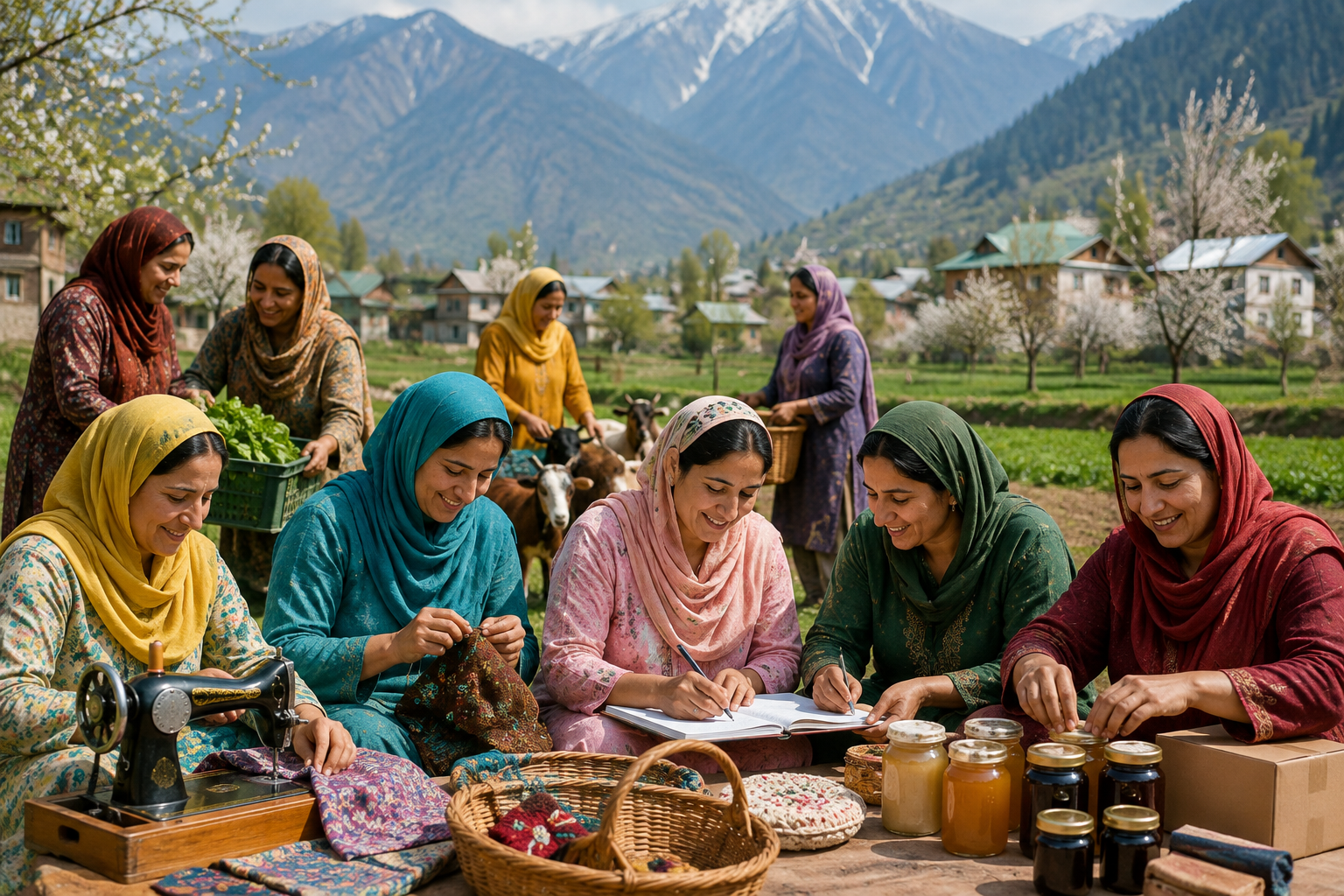
The expansion of women-led Self Help Groups under schemes such as the Jammu and Kashmir Rural Livelihoods Mission (JKRLM) and Deendayal Antyodaya Yojana-NRLM has been one of the significant signs of change. In Jammu & Kashmir, women associated with SHGs are engaged in a wide range of activities according to local resources and market demand. Agriculture, horticulture, dairy farming, poultry, handicrafts, food processing, tailoring, embroidery, beekeeping, and small-scale retail are among the activities that can provide rural women with regular sources of income. In areas known for traditional crafts, SHGs can also help preserve local skills while connecting artisans with wider markets.
Going into numbers: Jammu and Kashmir has 96,637 women Self Help Groups (SHGs) under the Centre’s Deendayal Antyodaya Yojana-National Rural Livelihoods Mission (DAY-NRLM. Jammu and Kashmir participated in national-level SARAS Melas organised in the Delhi-NCR during the financial year 2025-26. Sixty-seven members from SHGs/FPOs and other rural producer groups from JK participated and recorded sales of Rs 1.34 crore. 8,10,276 SHG women members in J&K benefited under DAY-NRLM over the last five years. As of 31 January 2028, SHGs in J&K cover 8,10,805 households; the number has since increased.
The real achievement is not the numbers, to me and many others, but what truly matters is that women who were isolated from economic opportunities have found a new source of hope. They can feed their children, pay their bills, and build a better life. A widow who might otherwise struggle to survive now has a source of income and hope through these SHGs. The rural economy is witnessing growth, lifestyles are improving, living standards are rising, and poverty is gradually decreasing. One of the most significant contributions of SHGs is the creation of entrepreneurship at the grassroots level. A woman who may previously have depended entirely on her family for income can, through collective support and training, start a small enterprise. Even a modest business can make a meaningful difference to household finances. When several women undertake such activities together, the combined economic impact can extend across an entire village.
These SHGs help relieve the financial burden on families. If a man is the sole breadwinner of a family, SHGs allow women to double or even triple the household’s income, bringing greater financial security to the family and improving women’s lives. These SHGs have not only impacted those directly associated with them; even young women have found inspiration in the SHG framework. Many have started online businesses, bakeries, cloud kitchens, apparel ventures, and more, indirectly bringing countless women under a more secure economic cover. This has created economic opportunities and employment for several others who run these small digital businesses and manage their online pages. I myself have seen countless online pages offering bakery products, apparel, cosmetics, artwork such as calligraphy and painting, and several other products and services, with some of these entrepreneurs drawing inspiration from the SHG framework.
This would never have been possible without government-supported schemes and initiatives such as Lakhpati Didi, UMEED, the Know Your Artisan initiative, SHG-friendly melas, and buyer-seller meets organised by JKTPO. Promotional stalls and platforms provided by the government have further strengthened the SHG initiative by increasing sales opportunities and allowing buyers to directly connect with sellers. These initiatives have helped women showcase their products to a wider market, gain confidence, and develop a stronger sense of financial independence and institutional support. They have also encouraged more women to explore entrepreneurship and turn their skills into sustainable sources of income. Digital promotions and providing e-commerce platforms like e-SARAS and other logistics-enabled e-commerce websites have further strengthened the sales of SHG products by expanding their market reach, improving visibility, and connecting rural producers with customers across the country.
Women’s Self-Help Groups are more than financial collectives; they are platforms for empowerment, entrepreneurship, and community transformation. Across rural Jammu and Kashmir, they are helping women move from being beneficiaries of development programmes to active participants in economic growth. With stronger market linkages, better skills, easier access to finance and continued institutional support, SHGs can play an even greater role in building prosperous, self-reliant and economically vibrant rural communities. Empowering rural women ultimately means empowering families, strengthening villages and contributing to the broader development of Jammu & Kashmir.
(The author can be reached at aaliyasyedkmr@gmail.com)