

Darakshan Hassan Bhat
Political empowerment is women’s empowerment. Political upliftment provides the true platform for women to lead on genuine issues and policies. Legislative reservations empower women in the political field, which in turn enhances their presence in social, economic, and other sectors. This serves as an inspiration for women. In Kashmir, given its historical context with women, reservation for them becomes essential. Decades of unrest and violence in Kashmir have victimized women. Their rights and social existence were curtailed. Political engagement was minimal, and social and economic opportunities were largely missed. Over the last 36 years of violence, women’s rights in Kashmir have been severely violated. The truth is that not only were women’s rights restricted, but also their movements, making development nearly impossible.
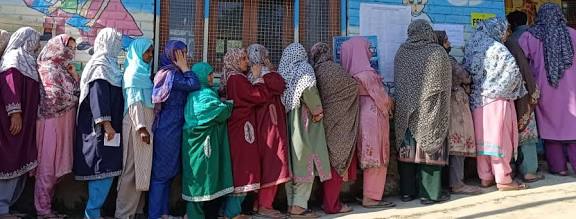
After 36 years, Kashmiri women got a chance to participate in politics in 2020 when the decentralization of power through the three-tier system of elections was held in Kashmir. For the first time, we saw women elected as Panch, Sarpanch, BDC, and DDC members. Many Kashmiris, for the first time, realized that women could also take part in elections, reflecting the previously strange perception of female participation in Kashmiri society.
This change happened after due deliberations and campaigns for women’s upliftment at the grassroots level, advocating for human rights, justice for victims of violence, and peace. Women’s groups and organizations have emerged as important voices demanding accountability and political reforms. They are often involved in protests, awareness campaigns, and community mobilization.
This way, the political participation of women in Kashmir changed the old-aged perception that women can’t fight elections. At the same time, this empowerment or political participation of Kashmiri women has opened doors for them in sports, business, and other sectors. The win of women was celebrated enthusiastically in Kashmir, and this was something new. Making it more convenient, women have become leaders and nation builders. Moreover, it was seen that women public representatives became more effective than men. The first experience of a few women has created new hopes for others, and today we are seeing a huge surge of women-led participation in politics across different political parties and positions.
Why is the political participation of Kashmiri women a must? The simple answer is equal participation in legislation. Lawmaking requires the equal role of women as participants in society. With women involved, laws will be made more equally, and women participants will take care of issues affecting their counterparts. This is because only women can truly understand other women, their issues, and the ways to address them. The dream of Viksit Bharat is to achieve equal participation in every sector, and initially, the political participation of women is essential to open the gates to all other sectors.
Political empowerment means developing leadership qualities in women, which boost their confidence and provide them with space to participate actively. However, the long turmoil in Kashmir has created a hostile and dangerous environment for women activists. Threats, harassment, and violence against women involved in political movements are common, significantly limiting their participation and freedom of expression.
In legislation, women not only learn how to address problems but also how to resolve them effectively. Providing women with leadership qualities ensures they do not lose their courage and motivates them to inspire others in various sectors by showcasing their innate abilities. Nothing empowers women more than political will and political empowerment, emphasizing their crucial role as lawmakers who shape policies and drive change.
Political emancipation among Kashmiri women will not only empower them politically but also help reduce their economic dependence. It will open new economic opportunities and enable women to participate more fully in social and economic activities. By gaining leadership roles and confidence through political empowerment, women can challenge existing restrictions and contribute to the overall development of their communities.
However, economic challenges such as unemployment and poverty continue to disproportionately affect women in Kashmir, making many reliant on male family members and limiting their independence. Additionally, the lack of gender-sensitive policies and weak enforcement of laws protecting women’s rights further hinder their political participation. Institutional support like training, mentorship, and safe platforms for women’s political involvement remains insufficient, creating ongoing obstacles to their full empowerment.
Political space for women will also help in peacebuilding, dialogue, debate, conflict resolution, crisis management, and family disputes, including those affecting families impacted by violence, community leaders, and government representatives. Many women campaign for justice for victims of enforced disappearances, extrajudicial killings, and sexual violence, demanding accountability and reparations. They also support networks for trauma counselling, education, and economic empowerment to help rebuild communities affected by conflict.
At the end of the day, men without women are incomplete, and the roles of women are greater than those of men. Therefore, women need to be more empowered and equipped with knowledge and training for the betterment of families, society, and largely the nation. Political emancipation of women is a must for Viksit Bharat.