

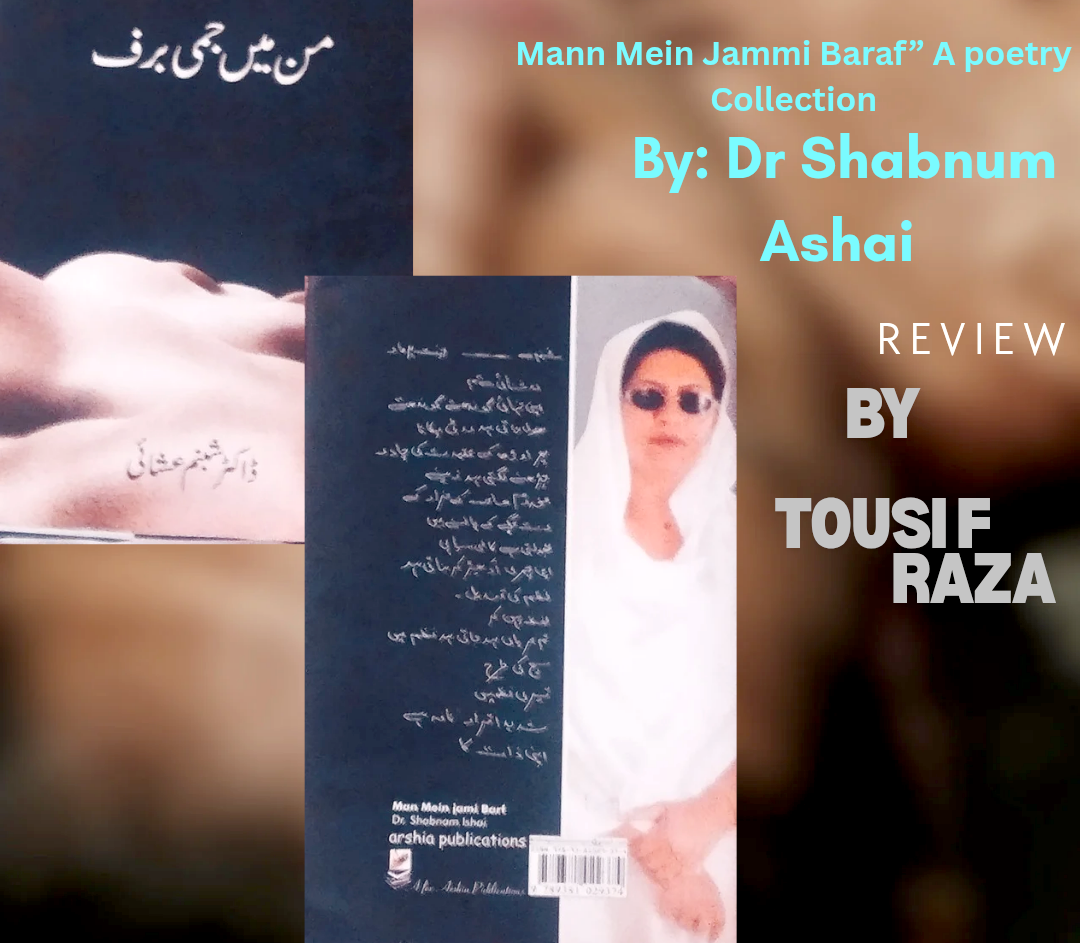
BY – Tousif Raza
Dr. Shabnam Ashai, born on April 12, 1962, in Srinagar, is among the most distinguished contemporary voices in Urdu poetry. Having pursued her Ph.D. at Aligarh Muslim University with a focused study on existentialism, she has contributed significantly to literary and philosophical thought. Her works, such as Camus Concept of Alienation and Existentialistic Concept of Alienation, testify to her engagement with the philosophy of being, estrangement, and identity. Served as a broadcaster at All India Radio, Srinagar, and continued to enrich both the literary and cultural spheres for more than two decades.
Her oeuvre comprises six poetic collections: Akeli, Main Sochti Hoon, Manbani, Catharsis, Manbavath (a Kashmiri translation of Manbani), Mann Mein Jammi Baraf, Barf ka Lihaaf, Muhabat Makoof Hein, ishiq khawb khusbboo, ishiq Tanhaayi, and between two stations. Unlike traditional Urdu poets who often remain bound within the classical framework of ghazal its lovers, its metaphors, and its centuries-old imagery Shabnam Ashai has consistently broken free from these inherited conventions. Her poetry is not confrontationist but reflective; it is woven with questions, meditations, and revelations that explore the inner landscapes of being, especially through a woman s experiential lens.
Mann Mein Jammi Baraf: A Journey Into Stillness and Sensation
The collection Mann Mein Jammi Baraf is a testimony to Ashai s ability to articulate the silence and turbulence of human emotions. The very title evokes a metaphor of existential stasis snow not on the earth but frozen within the self. One of her poems strikingly begins:
Barf baari / jaise dharti par nahin / mere man mein ho rahi hai
Here, snow becomes an inward phenomenon, a metaphor for numbness and inner paralysis. The question that follows Kya tum ne barf ko / kisi man mein jamte dekha hai? is not just rhetorical but deeply philosophical, pointing to a lived existential crisis where the external world mirrors inner desolation. In another poem, she speaks through the voice of loneliness:
Main aur tanhai / so rahe the / tumhara khat aaya
The intrusion of a letter into solitude becomes an allegory for memory, intimacy, and disturbance. The way loneliness reacts angry, hurt, yet inseparable demonstrates how Ashai treats emotional states as living entities. This anthropomorphism of tanhai (solitude) is not ornamental but experiential, a way of narrating the inner dialogue of existence. Her work is not merely a catalog of emotions; it is an exploration of the fragile intersection between relationships, identity, and silence. For instance, in another piercing verse, she writes:
Dard ki aankh se tapka hua / main woh aansu hoon / jo zindagi ke chehre se utar kar / shah-rag par ka / thanda pad raha hai
The existential anguish here is palpable. Pain is not abstract it materializes into a teardrop sliding from the face of life itself, settling coldly upon the jugular vein. Such imagery powerfully conveys the precariousness of life and selfhood.
A Woman s Narrative Beyond Feminism
Shabnam Ashai s voice is deeply rooted in the feminine experience, but it resists easy classification under the banner of feminist poetry. She herself insists: Koi feminism nahin / bas / be-haisiyati hai. This rejection is not a denial of gendered struggle but an affirmation that her poetic project is wider, existential, and humanistic. It is about being rather than gender alone. Her reflections on relationships are imbued with honesty and a refusal to conform to clich d confrontations. Instead, they open a dialogue, weaving narratives of intimacy, estrangement, and self-discovery.
Language and Style
The hallmark of Mann Mein Jammi Baraf lies in its striking linguistic freshness. Dr. Shabnam Ashai s poetic voice is remarkable for its ability to draw from the ordinary and transform it into the extraordinary. She takes everyday metaphors letters, kitchens, rivers, walls, snow and invests them with an unexpected philosophical depth. For instance, the snow in her verse is never just a seasonal occurrence; it becomes an emblem of inner paralysis, of silence settling heavily upon the self. Similarly, a kitchen, often considered a mundane domestic space, emerges in her poetry as a site of existential reflection, where grinding spices or kneading dough becomes symbolic of the grinding weight of memory or the shaping of selfhood.
Her diction is simple, free from ornamentation, yet carries within it a layered subtlety that invites repeated readings. This simplicity does not compromise depth; rather, it enhances immediacy, making her imagery accessible while still profound. The cadence of her poetry is modern measured, conversational, and often fragmentary mirroring the ebb and flow of thought itself.
Unlike many poets who either remain entrapped in the exaggerated laments of the classical ghazal tradition or drift into the obscurity of dense modernist experimentation, Ashai strikes a delicate balance. She avoids the clich s of conventional romanticized sorrow, and at the same time, resists the temptation to bury her meanings under opaque abstraction. The result is a language that feels fresh, authentic, and deeply reflective, capable of capturing both the subtle tremors of inner life and the larger metaphysical questions of existence. Let’s clearly say that her style creates a unique space in contemporary Urdu poetry at once intimate and philosophical, immediate and timeless.
Conclusion
Mann Mein Jammi Baraf is not just a poetic collection; it is a chronicle of existence written in snow and silence, pain and enlightenment. Through her reflective verse, Dr. Shabnam Ashai emerges as one of the most original voices in contemporary Urdu poetry. Her work situates itself between personal confession and universal meditation, where every poem resonates with a question: How does one live with the snow frozen within?
(The author is an English literature student and hails from Tangmarg. He can be reached at tousifeqbal555@gmail.com)