

Fida Firdous
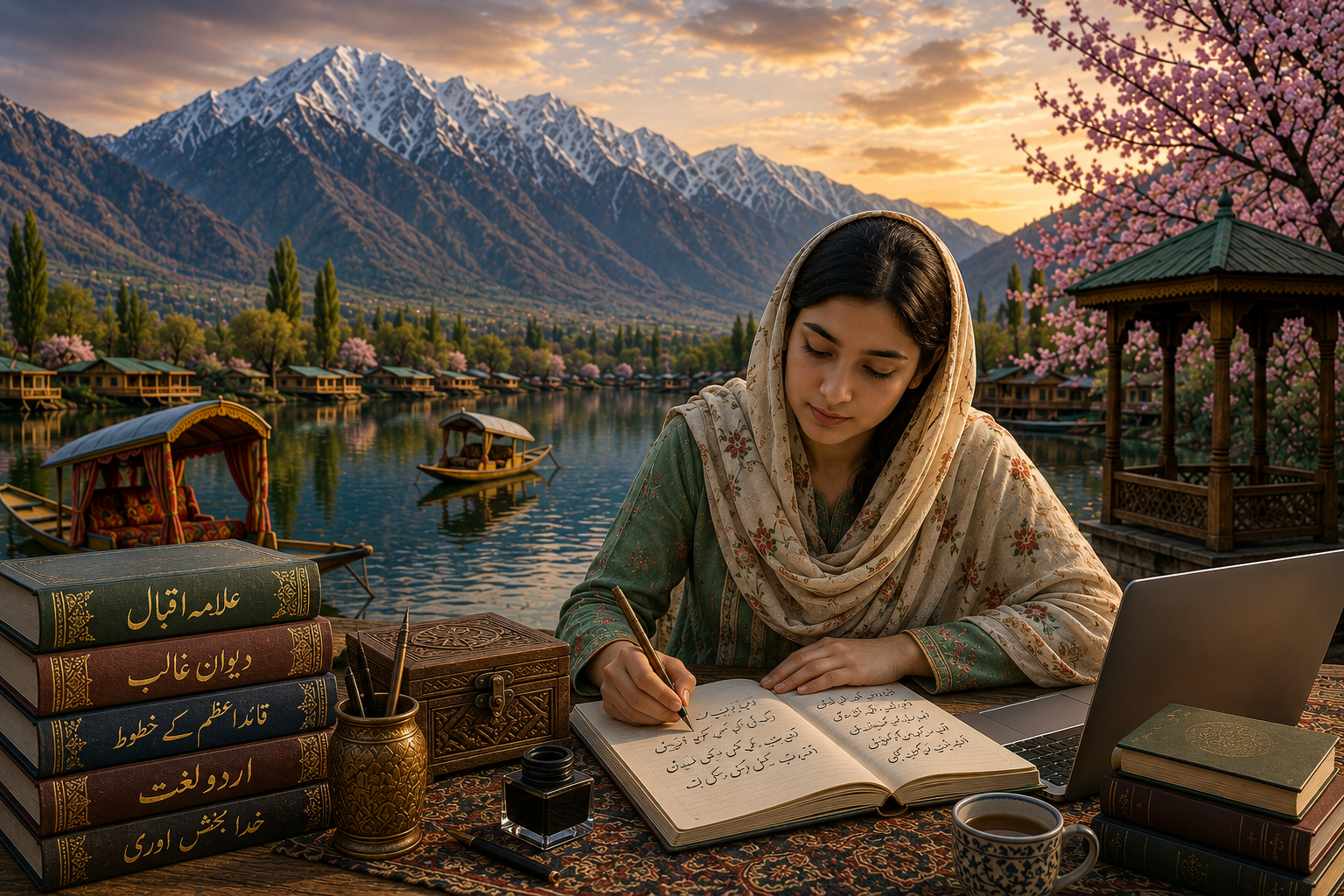
Urdu is not merely a communication tool; it has been used in all official capacities and is deeply linked to history. It is the custodian of civilization, culture, emotion, and heritage. Renowned for its inherent sweetness, sophistication, and profound depth, Urdu has historically held a sovereign sway over hearts. However, as we navigate the twenty-first century, the digital age, a question frequently arises: can Urdu sustain its relevance amidst the relentless pace of digital spaces, artificial intelligence, and evolving technology?
The answer is both resoundingly positive and fascinating. Urdu has not only adapted to the contemporary landscape but has emerged in a vibrant avatar across modern digital platforms. In today’s fast-paced life, where audiences rarely have the luxury of time to engage with long-form prose, Urdu has become a highly sought-after language precisely due to its poetic expansiveness and unparalleled conciseness.
The contemporary era is indisputably driven by social media. Platforms like Facebook, Instagram, and X (formerly Twitter) have fundamentally altered human reading habits. The patience required to consume lengthy essays or books has dwindled, superseded by a pervasive “scrolling culture.” Within this high-speed environment where time is premium, Urdu poetry serves as a magical catalyst—a phenomenon we can rightly term “Urdu Micro-Poetry.”
Modern audiences may bypass extended speeches, yet their need to articulate complex emotions, political ideologies, social grievances, and personal reflections remains urgent. In this scenario, a couplet or two from the masters of Urdu literature accomplishes what hours of oratory or pages of text fail to deliver.
Mir Taqi Mir: His verses are invoked to articulate the most delicate nuances of human emotion and the bittersweet pangs of separation (Hijr).
Mirza Ghalib: His philosophical poetry encapsulates the profound depths of existence, life’s existential dilemmas, and human psychology within a single, striking distich.
Daagh Dehlvi: Characterized by wit, linguistic flair, and romantic playfulness, his verses seamlessly transition into sophisticated Instagram captions for the younger generation.
Habib Jalib & Faiz Ahmed Faiz: When confronting social injustice, tyranny, or political systemic flaws, users on X instantly turn to these revolutionary icons. Couplets like “Lazim haike hum bhidekhenge” (It is certain that we too shall witness) are dynamically posted by today’s youth as anthems of protest and empowerment.
Ahmad Faraz: His poetry captures the delicate dynamics of pride, grievance, and longing in romance so beautifully that modern readers are instinctively compelled to hit the ‘like’ and ‘share’ buttons.
This trend highlights how an idea requiring an extensive lecture can be elegantly reduced into a single Urdu couplet, effectively arresting the attention of a scrolling public. This brilliance lies in Urdu’s innate capacity for Eijaz-o-Ikhtisar (conciseness and brevity), rendering it uniquely user-friendly for the modern digital consumer.
The magic of Urdu is equally pronounced in contemporary pop culture and global music. A prime example is Coke Studio, a world-class musical franchise that has masterfully synthesized classical Urdu ghazals, Sufi couplets, and nazms with Western instrumentation, such as electric guitars, synthesizers, and drums.
When Faiz’s Bol Ke Lab Azaad Hain Tere, or the timeless verses of Amir Khusrau and Bulleh Shah, are reimagined through the lens of modern rock and pop, the youth connect with them instantly. This musical fusion has successfully reintroduced classical literature to a generation that was otherwise drifting away from traditional mushairas or qawwalis.
Furthermore, Urdu metaphors have dynamically permeated Rap music—one of the most popular genres of the modern era. Young rappers across the subcontinent are increasingly relying on the heavy diction, rich allegories, and nuanced metaphors of Urdu to narrate raw street realities, systemic struggles, and youth angst. This proves that Urdu is no longer confined to the elite courts of the past; it is pulsating at the very heart of contemporary street culture.
Expressing love, romance, separation, or fidelity, Urdu remains the premier choice. When a modern user seeks to express affection via WhatsApp or process heartbreak through an Instagram story, dry English phrases often fall short. Urdu possesses an extensive emotional vocabulary, offering a distinct word, hue, and cadence for every heartbeat, tear, and smile. To decipher the highs and lows of relationships, the modern world naturally returns to Urdu.
A deeply encouraging and transformative shift in this modern era is the evolving landscape of mushairas (poetry symposiums) in India. Historically, these platforms were predominantly male-dominated, with limited representation for women. Today, however, women are the defining stars of these gatherings.
Educated, articulate, and fiercely contemporary female poets are taking center stage. They are not only giving voice to distinct feminine sensibilities but are also mesmerizing massive audiences with their resonant delivery and stellar craft. Their performances routinely garner millions of views on YouTube and Instagram. Notable pioneers include: Himanshi Babra; Monika Dubey; and Ambreen Haseeb, etc.
The soaring popularity of these poets proves that Urdu is no longer restricted by gender or archaic social constructs. It provides women with a dignified, formidable platform to assert their voice, autonomy, and emotional truth. Ultimately, the future of the Urdu language in the modern era is exceptionally bright. Far from fading into obsolescence, it is continuously refining itself to match the cadence of time.
Ultimately, the future of the Urdu language in the modern era is exceptionally bright. Far from fading into obsolescence, it is continuously refining itself to match the cadence of time. It has gracefully adapted to technological evolution; if it once thrived in handwritten letters and bound volumes, it now breathes dynamically in tweets, Instagram reels, Coke Studio tracks, and digital mushairas. While its micro-poetry solves the modern crisis of time, its innate lyricism infuses pop culture with newfound dignity. As long as human emotions, love, and the ache of longing exist, Urdu will continue to rule human hearts in this modern era and beyond.
(The author can be reached at fidafirdous8@gamil.com)