

Syed Aaliya
October 22, 1947 remains one of the most historically significant events in the history of Jammu and Kashmir. It recalls the invasion by armed tribal raiders from the direction of Pakistan, the suffering inflicted on civilians, and the crisis that threatened Kashmir, especially Baramulla. Perhaps this was the turning point that changed the course of Kashmir’s history and its relationship with India.
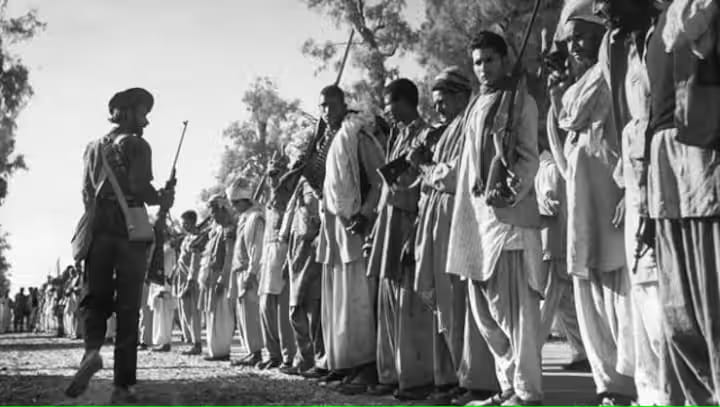
In October 1947, Jammu and Kashmir was passing through a period of political uncertainty following the Partition of British India. Maharaja Hari Singh had not yet acceded to either India or Pakistan when armed tribal raiders entered through the Muzaffarabad sector on 22 October and advanced towards Srinagar. Historical accounts describe killings, looting, and attacks on civilians along their route. Baramulla became one of the most tragic symbols of the invasion. Residents experienced violence, displacement, and the destruction of their livelihoods. The attack on St Joseph’s Convent and Hospital remains a painful reminder of the human cost of armed conflict. For ordinary Kashmiris, the invasion was not merely a struggle over territory; it was a direct threat to their lives, homes and future.
The events exposed the vulnerability of the princely state and created an urgent need for military assistance. On 26 October 1947, Maharaja Hari Singh signed the Instrument of Accession to India. Their arrival marked a decisive moment in the effort to prevent the raiders from capturing the Valley. India’s intervention helped defend Srinagar at a critical moment. Indian soldiers fought under difficult conditions, while local defenders, volunteers and ordinary residents also contributed to efforts to protect communities and maintain order. The defence of Kashmir was therefore shaped by both military action and the determination of people who feared the consequences of the invasion.
The Instrument of Accession remains central to India’s historical and constitutional understanding of Jammu and Kashmir. From the Indian perspective, the invasion and accession must be understood together: the first created an immediate security emergency, while the second provided the formal basis for India’s military assistance. In the decades that followed, cross-border infiltration, militancy and terrorism became major challenges, particularly from the late 1980s onwards. Targeted killings, displacement, attacks on security personnel and civilians, and the recruitment of young people into terrorism inflicted enormous suffering. These experiences reinforced the importance of border security, counter-terrorism measures, peacebuilding and opportunities for young people. However, lasting peace cannot depend on security measures alone. Education, employment, responsible governance, tourism and public participation are equally important to ensuring that future generations do not experience the violence and uncertainty that shaped earlier decades.
Today, Jammu and Kashmir has opportunities to build a future centred on development, connectivity, education, healthcare and tourism. Investment in roads, medical institutions, vocational training and tourism infrastructure is intended to improve public services and expand economic opportunities. The Jammu and Kashmir Economic Survey 2025–26 highlights tourism infrastructure, emerging destinations, improved connectivity and initiatives to extend tourism beyond established centres. Government health-sector figures also point to the expansion of medical education and healthcare facilities.
These developments should ultimately be measured by tangible improvements in people’s lives. Better roads, reliable electricity, quality schools, accessible healthcare, sustainable tourism and meaningful employment are essential, particularly for rural and border communities. Jammu and Kashmir continues to face challenges, including unemployment, security concerns and demands for effective democratic representation. Its development journey must therefore remain inclusive, accountable and responsive to local aspirations.
A comparison with Pakistan-occupied Jammu and Kashmir (PoJK) and Gilgit-Baltistan raises serious questions about political representation, public services and economic opportunity. Residents have repeatedly protested over electricity prices, flour subsidies, governance and the privileges enjoyed by political and administrative elites. Freedom House has also documented limitations on political activity, expression and association in Pakistan-occupied Kashmir.
PoJK recently faced renewed unrest over political representation and electoral arrangements. Reporting in 2026 has described deadly clashes, communications restrictions and disruptions to everyday life. Amnesty International has raised concerns about arrests, internet shutdowns and the use of force against protesters. These reports underline the importance of protecting peaceful assembly, investigating deaths transparently and addressing public grievances through dialogue.
Gilgit-Baltistan faces additional challenges associated with geographical isolation, harsh winters and access to essential services. Residents of both territories deserve reliable electricity, quality education, healthcare, economic opportunity, and meaningful political participation. Their concerns should not be overlooked simply because the region occupies a
strategically important place in the politics of South Asia.
The comparison is not a claim that every challenge has been resolved in Jammu and Kashmir or that every experience in Pakistan-occupied territories is identical. Rather, it highlights the importance of examining governance through its effects on ordinary people: the quality of public services, the protection of rights, the availability of employment and the freedom to express grievances.
For Kashmiris, the greatest tribute to those who suffered in 1947 would be a future in which violence, terrorism and displacement give way to peace, education, prosperity and dignity. India’s responsibility is to continue strengthening security while ensuring inclusive development, effective governance and opportunities for all communities. The people of PoJK and Gilgit-Baltistan, too, deserve peace, accountable institutions and a better standard of living. Their hardships should inspire concern for human dignity rather than become instruments of political hostility.
(The author can be reached at aaliyasyedkmr@gmail.com)