

Ghulam Quadir Kamran
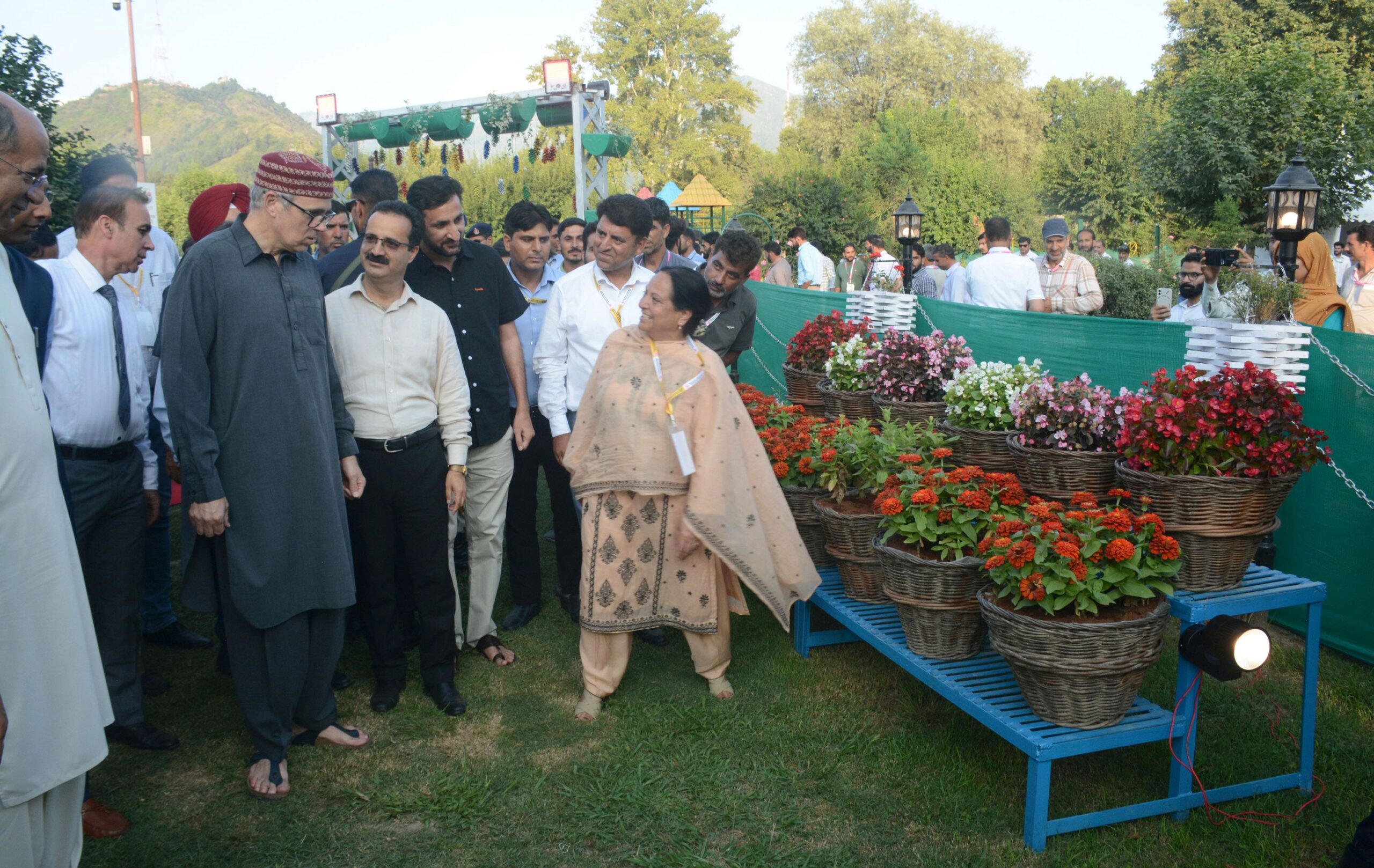
Jammu and Kashmir Chief Minister Omar Abdullah inaugurated the innovative ‘Waste to Wonder Flower Garden and Floriculture Mela’ at the Polo Ground Park in Srinagar on 21st August 2026. This initiative stands as a powerful testament to how discarded scrap can be transformed into a valuable public asset. Dismissing materials simply because they have outlived their original value is a grave environmental oversight. This new park serves as a living example in sustainability, proving that when creativity and innovation are given space, the principles of reduce, reuse, and recycle can effectively tackle solid waste management while creating something that is visually appealing, purposeful, and environmentally friendly.
More than just a conventional floral attraction, the garden combines creativity with environmental awareness . It is specially designed to inspire the youth and visiting tourists to embrace sustainable practices. Through its innovative use of discarded material, it highlights the critical importance of conservation, proving how waste can be turned into something purposeful and visually appealing.
Spread across 16 kanals of land, the park is a true masterpiece in repurposing and sustainability. 90% of the materials used in its construction consist entirely of discarded waste, while the remaining 10% comprises fallen wood collected from government offices and public parks. The park is entirely illuminated by a solar-powered lighting system provided by Orion Powers, ensuring a zero-carbon footprint after dusk. The sheer scale of this transformation was made possible through inter-departmental collaboration, breathing new life into decades-old scrap . The Protocol Department provided old refrigerators and washing machines while the Star Motor Garages provided jeeps, gypsys, and Ambassador cars.
The equipment that was lying with the Floriculture Department for four decades has also been converted into beautiful installations. The park features 60 distinct installations, with every single piece ingeniously crafted from repurposed scrap. Beyond its environmental message, the space serves as a vibrant homage to Kashmir’s rich traditional heritage. The park also showcases several elements of Kashmir’s traditional culture, including kangris, willow-woven phatus (baskets), and seed bins, creatively installed into the landscape. The most striking highlight of the park is a 1980s Ambassador car. Once destined for the scrapyard, it has been completely reimagined and now blooms as a massive, colorful flower pot-a perfect metaphor for a garden that turns discarded materials into beautiful installations.
Director Floriculture Kashmir, Mathoora Masoom, emphasized that the core philosophy driving this three-month project was the transformative power of repurposing. Instead of looking outward, the department utilized materials lying idle within their own offices and parks. Old tyres, fallen wood, rusted seed bins, and broken tractor parts were meticulously transformed into beautiful, living planters. Mathoora Masoom also highlighted the extraordinary dedication of her staff to make this possible. She noted that officers, officials, and gardeners stepped far outside their traditional roles, taking on the grueling work of blacksmiths, carpenters, and painters to bring the vision to life.
“In alignment with the Swachh Bharat Mission’s core principles of Reduce, Reuse, and Recycle, we wanted to play our humble part in showing the country the value of reusing materials, “Mathoora Masoom stated.
The Floriculture Department remains highly optimistic that this innovative garden will soon become a must-visit tourist destination, further enriching Srinagar’s esteemed portfolio of recreational gardens.
During the inauguration, Chief Minister Omar Abdullah praised the Floriculture Department for proving that with a spark of innovative thinking, trash can indeed become treasure. He pointed out that the park serves as a timely response to the escalating crisis of solid waste management currently plaguing both rural and urban areas. Who could have imagined these discarded items could be converted into such valuable assets?” the Chief Minister remarked. “This garden delivers a crucial message to all of us: before throwing anything away, we must think seriously if it can be repurposed into something meaningful and purposeful.
Chief Minister Omar Abdullah urged citizens to internalize the park’s message in their daily routines. While not everyone can build a public art installation, everyday actions-such as reusing plastic bags instead of mindlessly discarding them-can make a massive collective difference. He expressed his sincere hope that visitors will not only enjoy the garden’s visual appeal but also carry its profound lesson back into their homes.
The time has come to shift our perspective: waste is no longer a burden, but an untapped economic resource. Everyday kitchen and organic waste can easily be diverted to community composting units or biogas plants, generating clean energy and rich organic manure for our orchards and fields. While the government has already provided a number of compost pits under the Swachh Bharat Mission, the households currently practicing these sustainable methods and practices must be heavily encouraged across the region.
The scale of the crisis is alarming. Currently, the region generates over 1,500 tonnes of municipal solid waste every single day, alongside thousands of tonnes of electronic and construction debris annually. Tragically, much of this ends up choking landfills, polluting water bodies, or piling up in illegal dumping sites. We are literally throwing away recyclable materials and recoverable resources worth crores of rupees.
There is a profound lack of public awareness regarding waste segregation at the source, coupled with a severe shortage of recycling infrastructure. However, recognizing a problem is the first step toward solving it, and thankfully, new government initiatives are acknowledging these shortcomings rather than hiding them. The proposed Circular Economy Policy 2026 marks a pivotal moment in environmental governance. It represents a significant departure from the outdated “collect and dump” approach. Instead, the policy seeks to recover value from every single stream of waste-from household garbage and horticulture residue to wastewater and e-waste. The policy is not just a vision; it sets measurable targets and proposes vital institutional reforms and inter-departmental convergence. Its core focus is integrating informal waste workers into the formal economy, encouraging local recycling industries, promoting large-scale composting, and creating sustainable “green livelihoods.”If implemented effectively, this policy has the power to transform our biggest environmental liabilities into a powerful engine for green economic growth.
To understand the practical challenges of this transition, I spoke with Mandeep Kaur, Commissioner Secretary of J&K Housing and Urban Development. She noted that while the department has successfully established numerous waste processing units in urban areas, keeping them operational is the current hurdle, primarily because Urban Local Bodies (ULBs) lack trained waste management officers. To bridge this gap and build capacity, the department has devised an interim solution, outsourcing the operation of these centers to the local youth. This approach has twin benefits,” Mandeep Kaur explained. “First, it provides direct employment to our local youth. Second, it generates greater public awareness and cooperation, as people are naturally more supportive of young entrepreneurs from their own localities. The department is actively tying up with professional agencies that have successfully executed large-scale waste processing projects. These experts will train the youth in the complete lifecycle of waste management-how to properly collect it, process it, and forward it to the right recycling industries.
Commissioner Secretary Mandeep Kaur expressed strong optimism about the initiative, stating that while the department will provide initial financial and logistical support, these young operators will soon become self-sustaining and highly profitable, ultimately helping the department in return. She also issued an open invitation, urging any interested local youth to contact the department to receive specialized training in waste processing.
While the proposed Circular Economy Policy 2026 and the proactive efforts of the Housing and Urban Development Department are highly commendable, infrastructure alone cannot deliver a true circular economy. For these initiatives to succeed, we must simultaneously cultivate robust markets for recycled products, ensure consistent waste segregation at the source, and strictly enforce uniform environmental regulations.
The growing realization that waste is no longer a burden to be discarded, but a valuable resource waiting to be recovered, is perhaps our greatest strength. However, there remains a vast distance between aspiration and achievement. Ultimately, the success of this vision will not be measured by the tonnes of waste we generate, but by the tonnes we actively reduce, recycle, reuse, and transform into valuable assets. While numerous policies and schemes exist on paper, the true need of the hour is the execution of a seamless, functioning circular economy-one that practically and profitably turns today’s waste into tomorrow’s wealth.
(The author is an educator at Government Model Higher Secondary School, Zoohama. He can be reached at gulamqadirjeelani786@gmail.com