

Fida Firdous
Kashmir is very rich in resources. One of the best resources is our traditional crafts, which are very popular around the world and can connect Kashmir with the rest of the world. Kashmiri handicrafts are deeply linked with the culture, history, traditions, and identity of Kashmir.
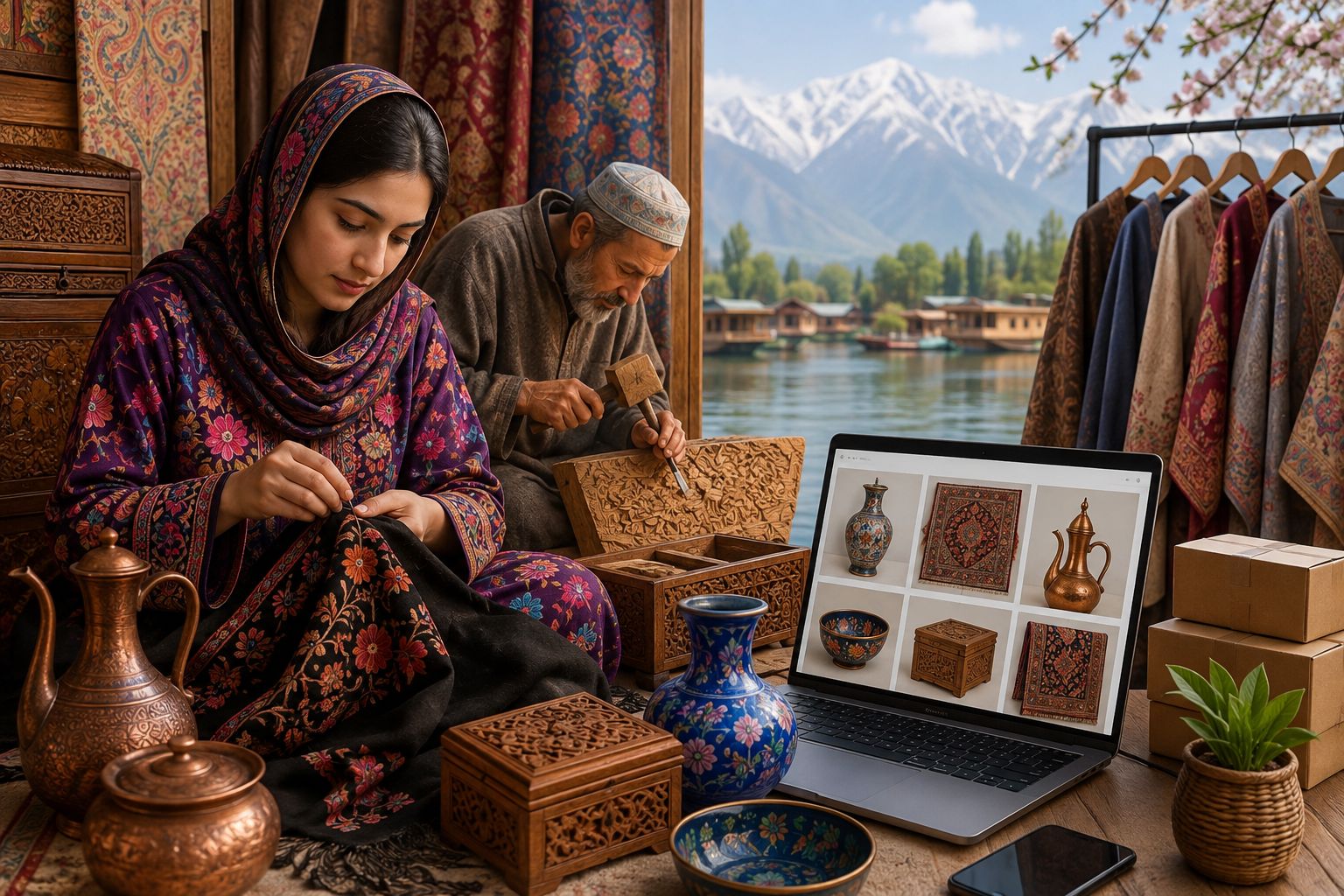
For centuries, the craftsmanship of Kashmir has attracted people from all over the world who have visited the region. Pashmina shawls, Kani shawls, Khatamband, papier-mâché, carpets, Sozni, wood carving, copperware, and other traditional crafts are not merely articles of trade; they are expressions of Kashmiri culture and the skills passed down from one generation to another. The beauty of these crafts lies in the patience, precision, and dedication of the artisans, who transform simple materials into objects of remarkable artistic value.
The revival of this craftsmanship is somehow challenged by technological mechanisation and mass production. Changing markets and consumer preferences also matter greatly. Perhaps Kashmiri crafts are not yet adapting sufficiently to what the modern market requires. Traditional crafts, therefore, need not abandon their identity, but they must adapt their presentation, marketing, and applications to the demands of the modern age. The survival of Kashmiri craftsmanship depends on its ability to combine tradition with innovation, heritage with modern markets, and artisanship with technology.
Pashmina remains one of the most precious symbols of Kashmiri craftsmanship. Derived from the fine undercoat of Himalayan goats, the fibre is exceptionally soft, warm, and delicate. Kashmiri artisans transform this precious material into shawls that have historically been associated with royalty, elegance and prestige. The value of an authentic Pashmina shawl lies not only in the material but also in the labour involved in spinning, weaving, embroidery and finishing.
The revival of Pashmina requires stronger protection of authenticity. Machine-made and imitation products can damage the reputation of genuine artisans. GI recognition, certification, traceability and consumer awareness can help distinguish authentic products from imitations. Every genuine product should ideally provide information about its origin, artisan, material, and authenticity. Modern branding and digital platforms can further take Kashmiri Pashmina to premium national and international markets.
Khatamband is another remarkable example of Kashmiri craftsmanship. Traditionally used for decorating ceilings, Khatamband involves carefully shaped wooden pieces arranged in intricate geometric patterns. The craft demands exceptional patience and precision, and its beauty can be seen in traditional homes, shrines, and other important structures.
The challenge is to ensure that Khatamband does not remain limited to traditional buildings and elite households. Its designs can be introduced into contemporary architecture, hotels, restaurants, offices, homes and interior décor. Modern designers can work with traditional artisans to develop new applications while preserving the original technique. Vocational centres and specialised training programmes could help attract young people to the craft and ensure the transfer of knowledge from experienced Najjars to the next generation.
Papier-mâché occupies a special place in Kashmir’s artistic heritage. Its two important stages, Sakhtsazi and Naqashi, demonstrate the combination of craftsmanship and artistic imagination. The making of the basic form and the subsequent delicate decoration require patience, skill, and years of experience. Floral, natural and traditional motifs give papier-mâché products their distinctive character.
Yet this craft faces the challenge of declining demand and changing consumer preferences. Its revival requires taking it beyond conventional decorative articles. Contemporary designers and artisans can develop papier-mâché products for modern interiors, home décor, stationery, corporate gifts, fashion accessories and tourism souvenirs. Its traditional designs can be retained while its product range is modernised. This can create new markets without compromising its cultural character.
One of the most important instruments for the revival of Kashmiri crafts is Geographical Indication (GI) recognition. GI protection can strengthen the connection between a product and its geographical identity and help consumers distinguish authentic Kashmiri products from imitations. But registration alone is not sufficient. GI recognition must be accompanied by proper certification, testing, labelling, awareness, and enforcement.
A modern Kashmiri craft product should ideally allow the consumer to know who made it, where it was made, what material was used, and whether it is genuinely handmade. QR-based authentication and digital traceability can make this process easier. Such measures can increase consumer confidence and enhance the market value of genuine products.
At the same time, greater emphasis should be placed on artisan-owned brands, cooperatives, and Self-Help Groups so that artisans receive a fairer share of the final price. The objective should be to reduce the distance between the creator and the consumer and ensure that the person preserving the tradition also benefits economically from it.
Tourism can become one of the strongest markets for Kashmiri handicrafts. Visitors should not only purchase finished products but also experience the process through craft villages, live demonstrations, artisan workshops, craft museums and “meet the artisan” programmes. Such experiences can transform handicrafts from ordinary souvenirs into meaningful cultural products.
GI-certified craft centres at important tourist destinations could provide visitors with reliable access to authentic products while simultaneously promoting the stories and traditions behind them.
The greatest long-term challenge is the transfer of traditional skills to younger generations. If crafts do not provide sustainable livelihoods, young people will naturally look for other occupations. Craft revival therefore requires apprenticeships, vocational training, design education, entrepreneurship programmes, digital marketing skills and easier access to finance.
Women, particularly those involved in embroidery, Sozni, weaving and other home-based crafts, can also benefit greatly from digital markets. Technology can enable women artisans to sell beyond their local communities while continuing to work within their traditional settings.
Revival does not mean keeping traditional crafts exactly as they were centuries ago. It means preserving the soul of the craft while adapting its form to contemporary needs. Traditional papier-mâché can enter modern interior design; Khatamband can become part of contemporary architecture; walnut wood carving can be used in modern furniture; Sozni can be incorporated into contemporary fashion; and Pashmina can be presented through modern luxury branding.
The emphasis must remain on authenticity. Modernisation should strengthen craftsmanship, not replace it with mechanisation.
The revival of Kashmiri traditional crafts requires a comprehensive approach involving artisans, government institutions, designers, tourism stakeholders, educational institutions and the private sector. There is also a need to document traditional techniques, motifs, tools, artisan histories and knowledge before they disappear.
Kashmir’s handicrafts can become an important part of the region’s creative economy if heritage is connected with modern markets. The objective should not merely be to preserve the craft; it should be to preserve the artisan, improve the artisan’s income, attract the younger generation and make Kashmiri craftsmanship competitive in India and the global market.
The real revival of Kashmiri handicrafts will occur when a traditional artisan can look at his or her craft not as a dying occupation but as a respected, profitable and sustainable profession. Kashmir’s crafts have already earned recognition for their elegance and excellence. What they now need is a modern ecosystem that gives this heritage the market, protection, technology, and economic value it deserves.
(The author can be reached at Fidafirdous8@gmail.com)