

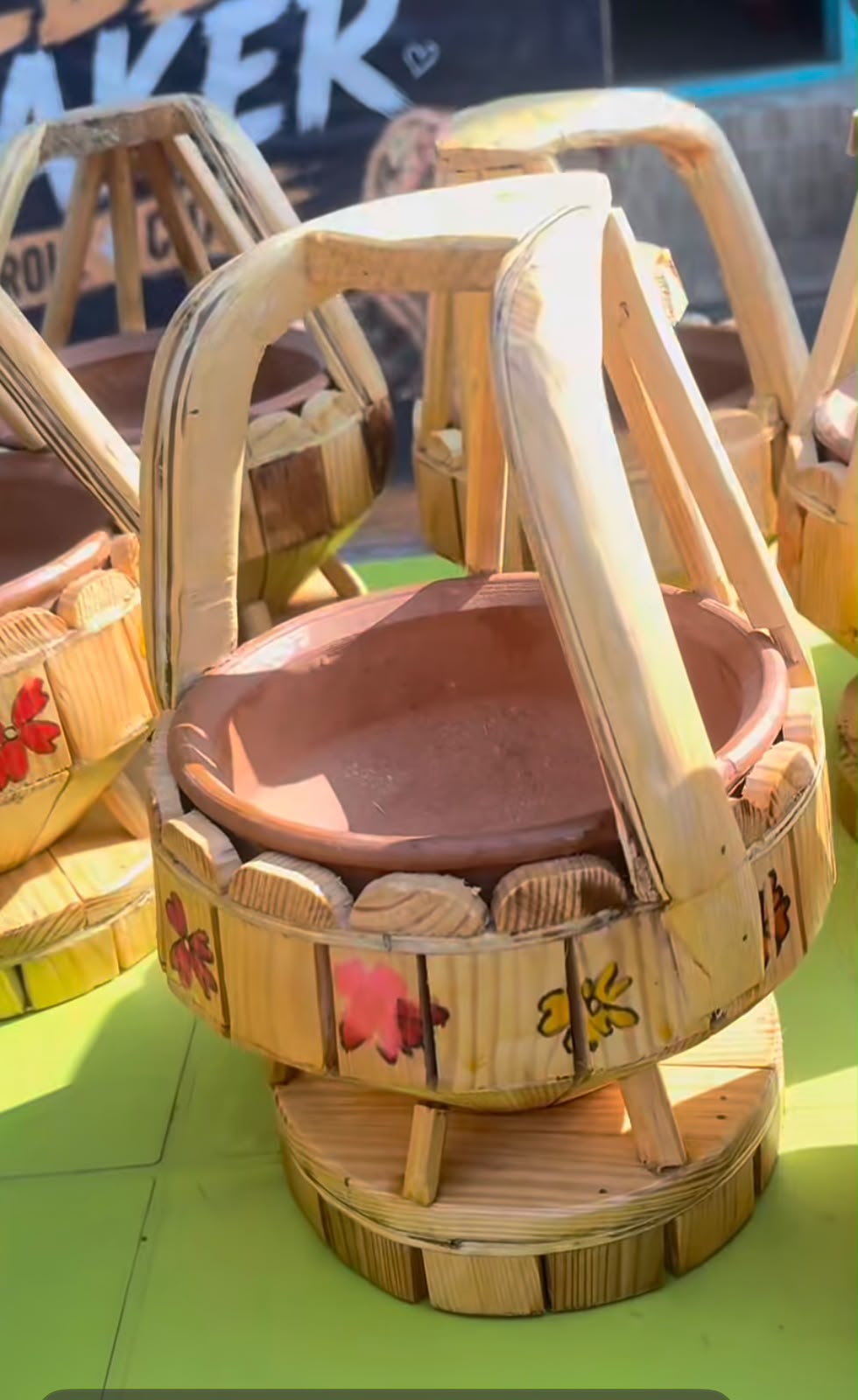
Srinagar: Forget willow wicker, traditional Kangri has got a wooden makeover.
However, the new look has divided the internet. While many are loving the new look, others are criticizing the maker for meddling with the aesthetics of the traditional fire pot.
After a year of experimentation, Zahid Showkat Dar, an artisan from Nowpora village in Sopore in north Kashmir’s Baramulla district, has introduced this Kangri, which is available in various markets of North Kashmir. “We have been working on it for the last two years. This year, our new Kangri made of wood has hit the market, and we are getting a good response,” he said.
According to Dar, the basic structure of the Kangri remains unchanged, including its traditional earthen pot, while the willow-wicker casing has been replaced with wood.
“Wicker was not sustainable. So we made a Kangri which is quite rigid and easy to handle,” he said.
According to Dar, the basic structure of the Kangri remains unchanged, including its traditional earthen pot, while the willow-wicker casing has been replaced with wood.
“Wicker was not sustaining. So we made a Kangri which is quite rigid and easy to handle,” he said.
The innovation has generated contrasting reactions online. While some social media users have appreciated the effort to give the traditional product a new appearance and attract younger buyers, others have questioned the need to alter its familiar design, arguing that the woven willow covering is central to the Kangri’s traditional character. “Kangri should be in its original shape and design. It has sustained over decades, and people love it in its original shape,” posted Farhat Bhat, a Facebook user.
Many hailed the maker for making it more `rigid’. “Wicker Kangri is good, but at some point in time, the wicker comes off. It seems strong and rigid,” posted Asrar Khan, in response to the video on Facebook.
Traditionally, Kangri consists of a bowl-shaped earthen pot, locally known as the kondal, enclosed in a handwoven willow-wicker basket. Filled with glowing charcoal, it is carried under the pheran, the traditional woollen cloak, to provide warmth during winter.
The making of a conventional Kangri involves considerable artisanal skill. Willow twigs are collected, softened, peeled, dried, and woven around the earthen pot to create its distinctive casing and handles. Charar-e-Sharief in Budgam is among the traditional centres associated with Kangri-making.
The Kangri has continued to find a place in Kashmiri households even as electric heaters and other modern appliances have become increasingly common.
The wooden version is not the first attempt to give the traditional Kangri a contemporary makeover.
In an earlier experiment, Mohammad Ismail Mir, a 62-year-old innovator from Watapora village in Bandipora, developed what he called a “Smart Kangri”, seeking to make the traditional firepot safer and more efficient without substantially changing its familiar design.
Mir worked on the modification for more than a year. His design featured two compartments, one for charcoal and another for water, intended to retain heat for a longer period.