

Syed Aaliya
When we talk about Kashmir’s sporting potential, we usually start and end with the athletes. We celebrate the cricketer who reaches the IPL, the footballer who represents the country, or young men and women winning medals at national competitions. But I think there’s another aspect of this sporting story which deserves just as much attention and that is the people who make the equipment our athletes compete with. Kashmir has already shown it can produce sports goods that travel far beyond the Valley. The Kashmir willow cricket bat is perhaps the strongest case in point. It was a largely unbranded cottage industry that slowly morphed into a manufacturing ecosystem. Today, brands like GR8 Sports and KIS Sports have put Kashmir Willow on the map in markets beyond the region.
This is a particularly instructive story of Fawzul Kabiir and GR8 Sports. In 2010 Kabiir decided that Kashmir should not just be a supplier of willow clefts to companies elsewhere who would then sell the finished product under their own labels. After years of investments in technology, research and market development, GR8 became the first Kashmir-based willow bat manufacturer to receive ICC approval in 2021. Later, its bats made their way into international cricket, including the 2021 T20 World Cup, while a GR8 bat was used by UAE’s Junaid Siddique to hit the longest six of the 2022 T20 World Cup. The brand has since gone on to partner with international players and markets, and has even joined hands with Legends League Cricket in 2024 when the tournament came to Srinagar.
But GR8 is not the sole story, The local sponsorship culture in its nascent stage saw players like former India and J&K cricketer Parvez Rasool choosing the brand, which was also promoted by Sheeraz’s KIS Sports, creating a market for Kashmir Willow. That same ecosystem has given birth to other manufacturers, including Alfa Sports, Asia Star, Valley Woods and several smaller brands. Men like Javid Ahmad Parray of Chursoo, who started small and built up to a unit making hundreds of bats a day, show that this isn’t just a story of a few established companies. It is an industry that is based on craftsmen, entrepreneurs, carpenters, polishers, machine operators, willow selectors, designers, packers and salesmen. Even the presence of young entrepreneurs like Saad and Hamad Tramboo of Tramboo Sports on Shark Tank India was a sign that the next generation is now starting to see bat manufacturing as not just a family trade but a modern business.
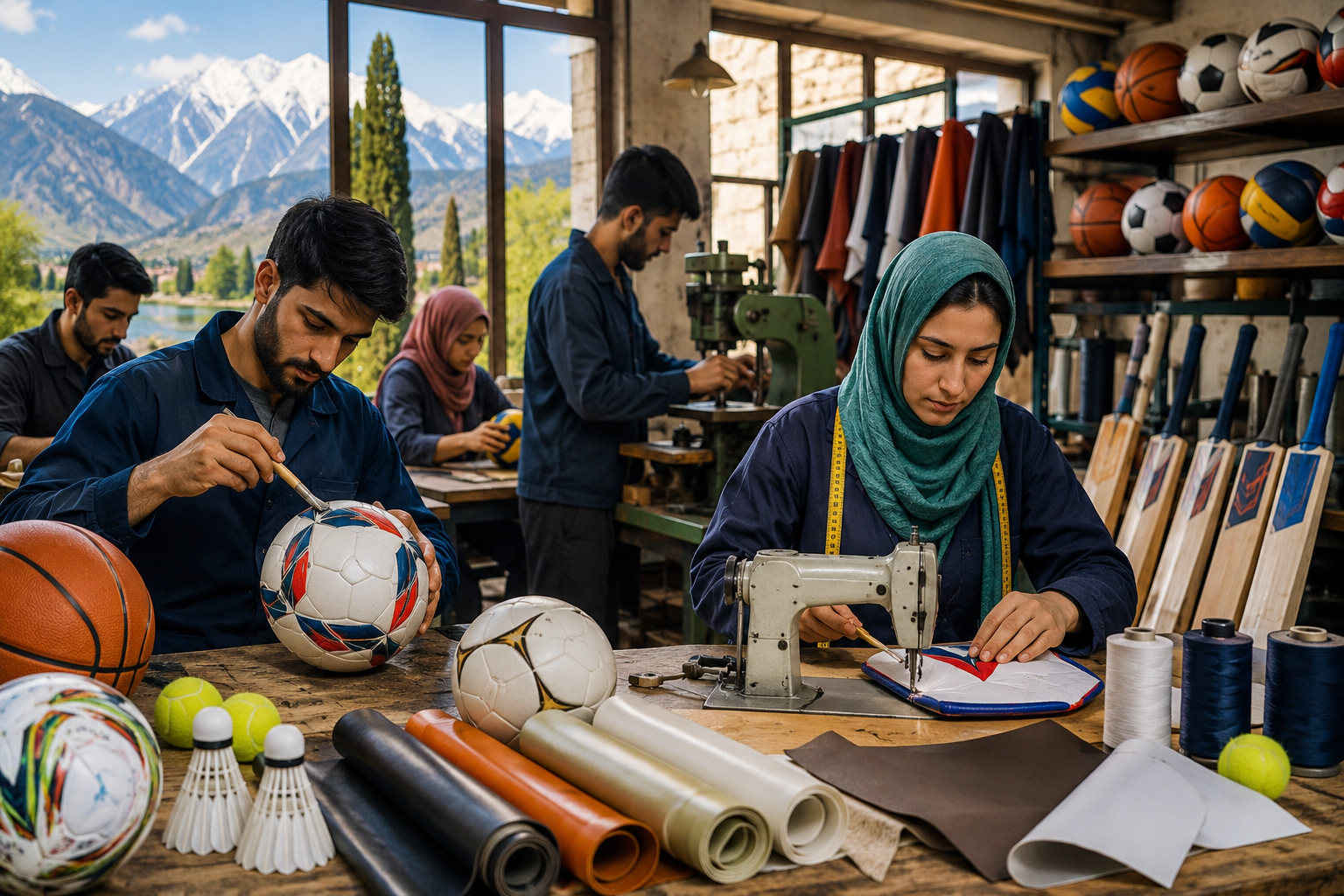
And that’s where I see the larger opportunity for employment. Not every young guy has to be a government staff in a sports manufacturing industry. It builds an employment eco system of different skills. A young person can learn to shape, press, season and finish bats, but opportunities can also be found in product design, machinery maintenance, quality control, digital marketing, e-commerce, packaging, logistics, photography, branding and export management. The existing government cluster assessment itself mentions over 400 bat manufacturing units in the Valley and employment for thousands of skilled, semi-skilled and unskilled workers. “The employment potential is much larger if we can move away from being mainly a producer of one product, to developing cricket balls, protective wear, sportswear, football equipment, hockey equipment, trekking equipment and water-sports equipment.
Some steps have already been taken by the government in this direction which need to be reinforced, not reinvented. The Kashmir Willow cricket bat was formally registered with the Government of India’s handicrafts framework which provides the industry a better recognition in the formal handicraft ecosystem. J&K Trade Promotion Organization has also identified willow bats as a District Export Hub product for Anantnag and has worked with artisans, exporters and manufacturers for GeM onboarding and export promotion. Capacity building, technological intervention, skill development programs, financial support and collaboration with sports associations are specifically suggested in the Anantnag export action plan. The J&K Skill Development Mission already runs programs such as PM Vishwakarma, PMKVY and SANKALP. Its network of ITIs and polytechnics provides an institutional base on which specialized sports-making courses can be introduced.
We also need to recognize the part that local cricket itself plays. Walk into a tournament ground anywhere in Kashmir, and the association is clear. Every local tournament brings with it a need for bats, balls, gloves, pads, helmets, kits and other equipment. When local players start using local brands, bat is no longer a piece of wood, it is an advertisement. Parvez Rasool’s association with KIS was one of the early examples of this transition and growing sponsorship of local players by Kashmir-based manufacturers has contributed to creating a market for indigenous brands. The arrival of big events has amplified the effect. GR8 cashed in on the 2024 Legends League Cricket at Bakshi Stadium, pushing Kashmir Willow and even giving away bats to match performers. These tournaments should be seen not only as sporting events but also as platforms for local manufacturing.
But we should not romanticize the industry. The bat makers of Kashmir suffer from shortage of good quality willow, lack of modern seasoning facilities, poor technology, marketing problems, transportation problems and shortage of trained workers. The Export-Import Bank of India in a study has also pointed out that much of the industry still functions as a backward linkage to manufacturing centers outside J&K, where Kashmir willow can be used in products sold under other brands. The solution is therefore not just to produce more bats. We need modern common facility centers, scientific seasoning and testing labs, sustainable willow plantations, design and product development centers, easier access to credit and machinery, professional branding and dedicated export assistance. The existing Common Facility Center at Sethar needs to be strengthened and modernized. New facilities can be considered wherever clusters have been developed.
I was particularly happy to learn that Chief Minister Omar Abdullah had visited the Hallamulla-Sangam industrial area in July 2026 and assured the government’s support in strengthening the cricket bat industry, and discussed issues of willow plantation, power supply, infrastructure and ease of doing business. This is the type of intervention that can help us take an existing strength and turn it into a larger economic opportunity. “Now we should take the next step and create specialized sports-manufacturing skill courses in our ITIs and polytechnics, connect the trainees directly with the manufacturers, give incubation and credit for young entrepreneurs, set up quality standards and testing facilities and actively connect Kashmiri brands with national and international sporting events.
Kashmir need not be another Meerut or Jalandhar. We can create something that is only ours. The foundation is already there in our willow, our craftsmen, our sporting culture and our young people. What lacks is scale, technology, branding and a deliberate policy push. If we can educate our youth not only to play the game but also to design, manufacture, market and export the requirements of the game, sports can become more than a source of medals for Kashmir. It can be a source of livelihood. GR8, KIS and others have already shown that the bat can travel from a small workshop in South Kashmir to an international cricket ground. Then the challenge is to make sure that the young people standing out there, outside those workshops, can find a career inside them.
(The author can be reached at Aaliyasyedkmr@gmail.com)