

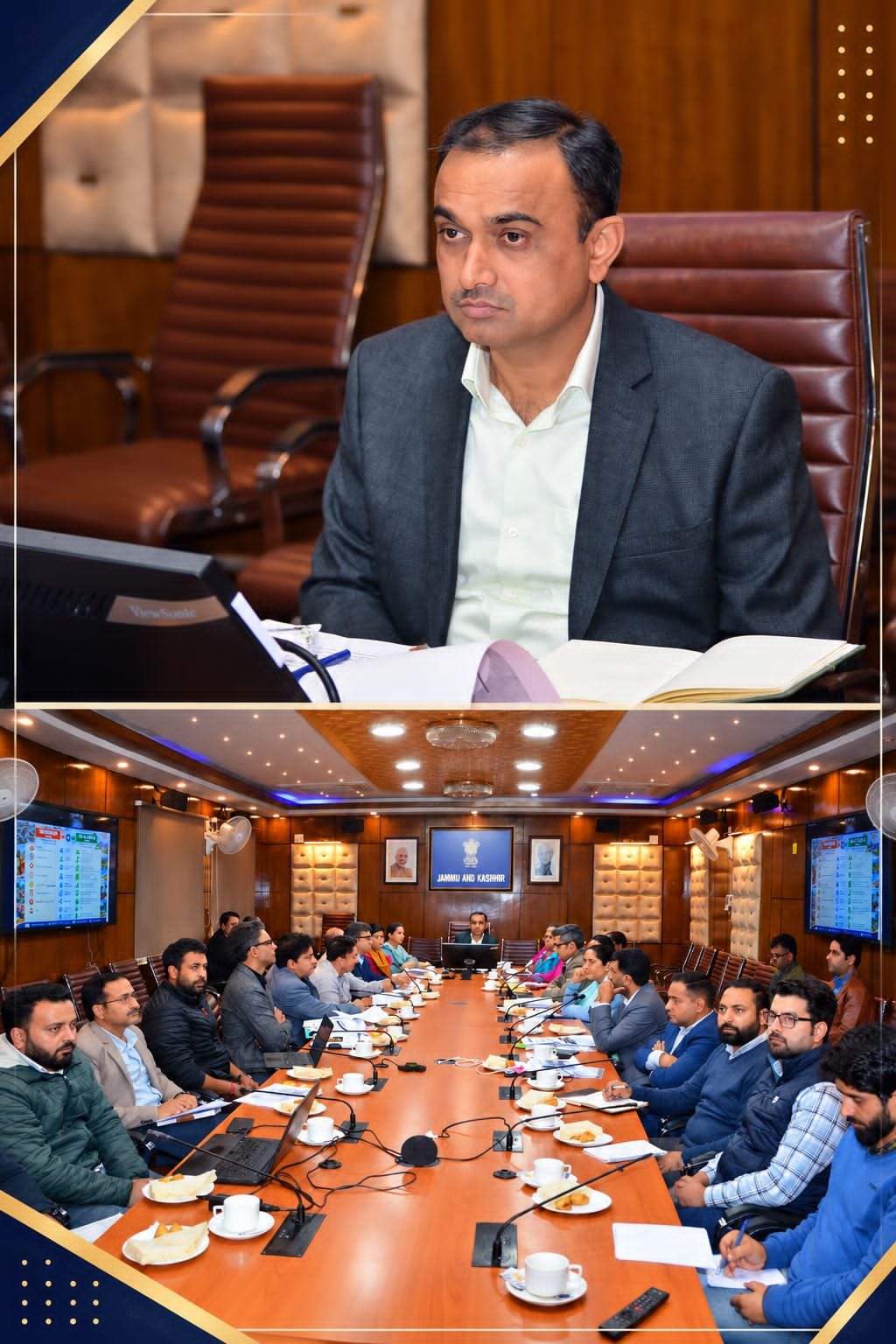
Srinagar: Secretary, Rural Development Department (RDD) and Panchayati Raj, Ramesh Kumar, on Tuesday conducted a comprehensive review of schemes and programmes being implemented by the Department across the Union Territory of Jammu and Kashmir, with a focus on physical progress, financial discipline, timely utilisation of funds and strengthening service delivery in rural areas.
The meeting was attended by Secretary in RDD Rachna Sharma; Mission Director, NRLM, Shubhra Sharma; COO, Himayat, Rifat Kohli; Director, RDD Jammu, Shahnaz Akhtar; Director Finance, Umar Khan; CEO, IWMP, Rajnish Kumar; Joint Director Planning, Kamal Kumar Sharma; Additional Secretary, RDD, Waseem Raja; Joint Director, RDD, Mantasha Binti Rashid; Deputy Director Rural Sanitation, Kashmir, Shabir Ahmed Hakak; Under Secretary Arshad Noomani and other officers.
The Secretary reviewed progress under major programmes, including Viksit Bharat–Guarantee for Rozgar and Ajeevika Mission (Gramin) (VB-GRAM-G), Pradhan Mantri Awaas Yojana–Gramin (PMAY-G), Swachh Bharat Mission–Grameen (SBM-G), Jammu and Kashmir Rural Livelihoods Mission (JKRLM), Rashtriya Gram Swaraj Abhiyan (RGSA), Himayat and the Integrated Watershed Management Programme (IWMP).
Reviewing VB-GRAM-G, the Secretary assessed employment generation, implementation of works and financial progress under the programme. He was informed that 3.21 lakh persons had availed employment, generating 59.19 lakh person-days.
The Secretary emphasised financial discipline, timely processing of wage and material payments, effective monitoring of works and coordination between district and block-level functionaries to ensure that implementation remains on schedule and funds are utilised efficiently.
He observed that although the planning process is digital, errors and discrepancies often emerge at the finalisation stage. He directed the concerned officers to adhere to prescribed timelines, review entries carefully and ensure that Gram Panchayat-level functionaries are fully familiar with the list of permissible works.
The Secretary also emphasised that village plans should reflect local needs, geographical conditions and the specific vulnerabilities of each area. He called for prioritising works according to ground requirements, including water conservation, drainage, protection structures and connectivity in vulnerable and disaster-prone locations.
Reviewing PMAY-G, the Secretary assessed the progress of rural housing under the SECC and Awaas Plus categories. As per the data, 3,27,210 houses had been completed against 3,34,586 sanctioned houses, taking the overall completion rate to approximately 98 per cent.
The Secretary stressed the need to accelerate the completion of pending houses through regular district-level monitoring, close follow-up with beneficiaries and prompt resolution of implementation bottlenecks. He also emphasised proper verification of beneficiary records, timely release and utilisation of available funds, and effective convergence with other schemes to ensure that eligible rural households receive the intended housing benefits without avoidable delays.
Reviewing SBM-G Phase II, Kumar underscored the importance of sustained behavioural change in ensuring long-term sanitation outcomes across Jammu and Kashmir, stressing that the focus must extend beyond infrastructure creation to fostering a lasting sense of responsibility and ownership among people towards sanitation, hygiene and cleanliness.
Reviewing the Jammu and Kashmir Rural Livelihoods Mission under NRLM, the Secretary took stock of initiatives relating to women’s Self-Help Groups (SHGs), institution building, financial inclusion, farm and non-farm livelihoods, and the Lakhpati Didi programme. The review also covered community-managed training centres, capacity-building activities and the integration of the Rural Livelihoods Mission with Mission Yuva to expand livelihood and enterprise opportunities for rural households.
The Secretary stressed the importance of strengthening community institutions, improving the quality of training and ensuring that livelihood interventions translate into sustainable income opportunities. He emphasised effective coordination among implementing agencies, regular monitoring of programme outcomes and financial discipline to ensure that available resources reach beneficiaries and support the intended livelihood objectives.
Reviewing Himayat under the Deen Dayal Upadhyaya Grameen Kaushalya Yojana (DDU-GKY), the Secretary assessed the progress of skill development and placement-linked training for unemployed youth. The departmental presentation showed that, against a training target of 2,248 candidates under the 2025–26 pilot phase, 2,032 candidates had completed training and 1,378 had been appointed. Under the 2025–28 Action Plan, the Ministry of Rural Development had approved a target of 32,480 candidates.
Reviewing the Integrated Watershed Management Programme under the Watershed Development Component of the Pradhan Mantri Krishi Sinchayee Yojana, the Secretary assessed progress in water conservation, soil health improvement, sustainable agriculture and climate resilience. He was informed that 19 projects covering 69,493 hectares had been sanctioned at a total project cost of ₹194.58 crore. Against the ₹155.47 crore in central funds released, cumulative expenditure stood at ₹137.65 crore. For 2026–27, ₹32.47 crore had been allocated, of which ₹16.07 crore had been spent.
The Secretary directed the concerned officers to expedite pending works and improve the overall pace of implementation. He observed that progress in certain areas was below expectations and stressed that every officer must take personal responsibility for achieving the targets assigned to them.
Emphasising the need to strengthen monitoring and coordination, the Secretary announced that regular monthly and quarterly review meetings would be held with the concerned officers and teams.
The Secretary stressed that field-level performance must be assessed through actual verification rather than relying solely on reports and portal entries. He directed district- and block-level officers to undertake regular field visits, monitor the progress of works and ensure that the information uploaded on departmental portals accurately reflected the ground situation. He also underlined the importance of maintaining the quality of development works and cautioned against reporting progress without proper verification.
Reiterating the importance of accountability, the Secretary stated that responsibility would be fixed at every level for delays, poor performance and failure to achieve prescribed targets. The performance of district- and block-level functionaries would be assessed on the basis of their responsibilities and the results achieved on the ground.