

Darakshan Hassan Bhat
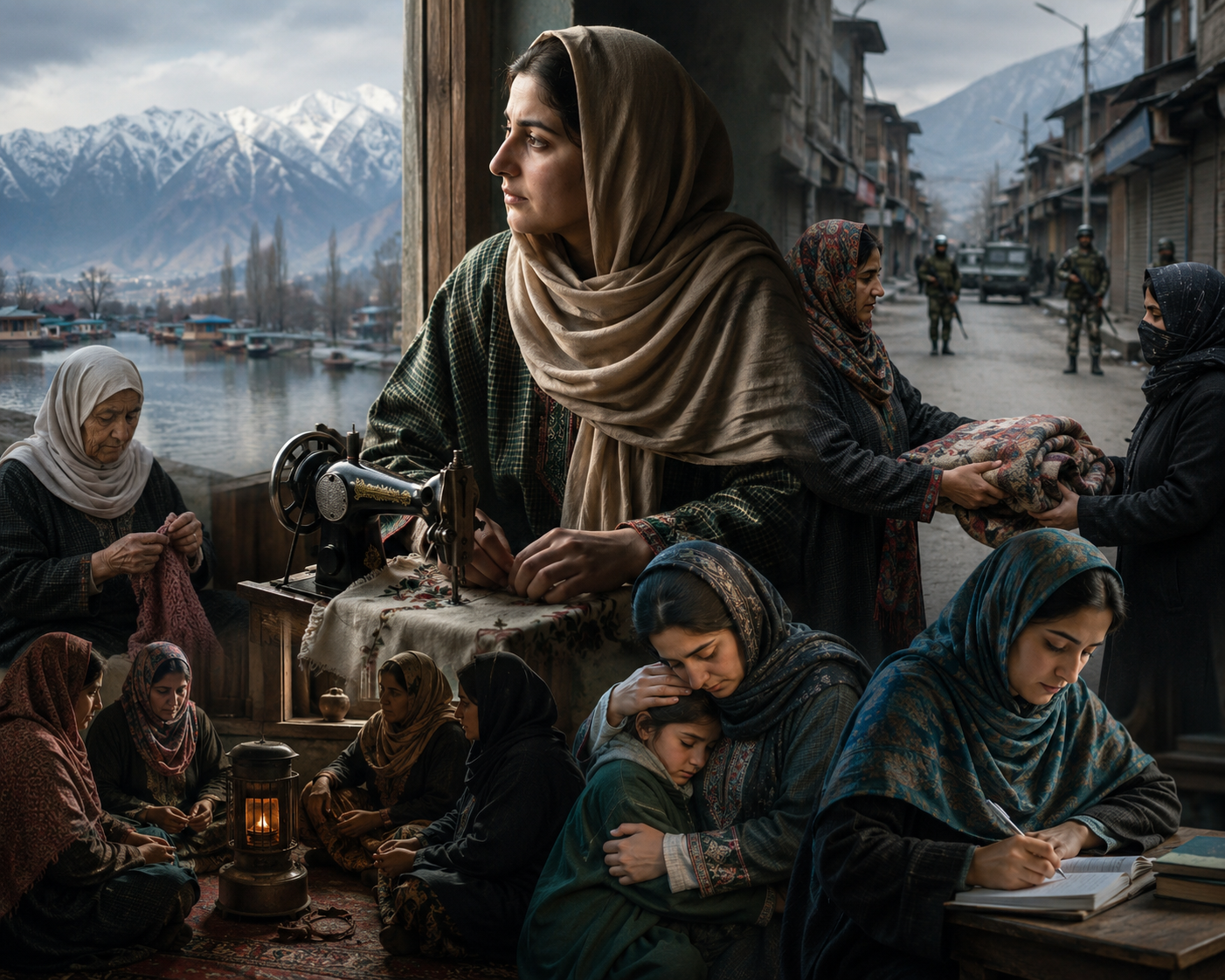
Kashmir has experienced phases of instability, uncertainty, and unrest for over three decades. While conversations about unrest often revolve around political developments, security challenges, and the experiences of men in public spaces, the lived realities of women are often less visible, and the fact is, women experience this differently, often bearing some of its heaviest and longest-lasting burdens.
As a Kashmiri woman who has lived through decades of instability, I have seen that unrest doesn’t just impact women; it reshapes their roles and responsibilities. When there is unrest, men are often on the front lines of confrontations, public engagements, or security situations, while women are forced to take on multiple roles at the same time. They bear the brunt of keeping up appearances in the family.
Women are uncertainty managers in times of instability. They make sure that children feel safe, that elderly family members are cared for, and that life goes on despite disruptions. The unrest may be taking place outside, but women are often the ones who suffer emotionally and practically from it inside their homes. They become the first responders to fear, anxiety, and trauma experienced by family members.
One of the most striking aspects of unrest is that it does not allow the luxury of passivity, and it often makes women more vigilant. Women constantly monitor the safety of their families, foresee possible dangers, develop contingency plans, and adjust to rapidly changing conditions. A mother sitting and waiting for her kids to come home safely, or a wife wondering where her family members are, or a daughter taking care of ageing parents- these stressors are constant and very personal. Unlike men, women are often in a silent, long struggle, whereas men might have more visible involvement in the turmoil. They absorb the emotional pain of families while suppressing their own fears. They have to be strong, comforting, and steady even when they aren’t sure themselves. The emotional labor women do in these times is immense, but it’s rarely recognised.
One thing I have noticed in my society is that turmoil and unrest also force women into responsibilities that were traditionally shared with or undertaken by men. When instability disrupts normal life, women often become decision-makers, financial managers, caregivers, educators, and mediators all at once. They must make sure children keep learning, household needs are met, family ties are intact, and community bonds are preserved. In many cases, women are the backbone of family resilience.
This fact shows a paradox. Women are often relegated to a secondary role in peaceful times, but in times of crisis, these same women are expected to take on extraordinary responsibilities. It is these sometimes undervalued roles that are critical to the survival of the family. Conflicts are a test of not only a woman’s endurance but also her leadership, adaptability, and strength.
Mothers are particularly affected. Children in unstable situations need reassurance and guidance from their mothers. A mother has to answer difficult questions, calm fears, and prevent her children from experiencing feelings of hatred, despair, or hopelessness. In this sense, women are peace builders in their own homes. They define the next generation’s understanding of conflict, diversity and coexistence.
Women also have an important role to play in maintaining social harmony in times of hardship. Often their networks of relations in neighbourhoods and communities help to maintain communication and mutual support. Political narratives may divide communities, but women continue to engage, often through shared concerns about family welfare, education, health and community well-being. These connections help to uphold the social fabric that conflict threatens to tear apart.
Women’s experience of conflict is unique in that they carry visible and invisible burdens. The visible burden is the added responsibilities and caregiving. The invisible burden comprises emotional stress, anxiety, uncertainty, and the constant pressure to be resilient for others. And all the while, women have repeatedly shown an incredible strength in the face of all this.
The Kashmiri experience offers a crucial reminder: women are not mere victims of turmoil, but active agents of resilience and stability. In hard times, women tend to be more resourceful, more alert and more involved in protecting their families and communities. Their work may not be in the official records, but it lives in every family that stays together, in every child that keeps on hoping, in every community that preserves its social connections despite hard times.
Seeing conflict from a woman’s perspective exposes aspects that are often overlooked and demonstrates that the true cost of instability is not only in political or security terms, but also in the day-to-day struggles of those who work tirelessly to keep families and communities afloat. At its heart, the story of women in conflict is a story of resilience, of the strength it takes to bear many roles at once, to be a source of stability when the world around you feels unpredictable.
(The author can be reached at darakshanhassanbhat@gmail.com)