

Zeeshan Shagufta
This remains an absolute truth that Pakistan-occupied Jammu and Kashmir ( PoJK) is a heavily militarized zone, an open-air prison, a locked valley, an occupied land, and the world has seen this. Pakistan has left no stone unturned in showing this to the world, and the region has been subjected to unprecedented oppression, suppression, and repression since being occupied by Pakistan, particularly over the past five months. Tragedy, pain, deaths, killings, arrests, and intimidation have become a common sight in the visuals emerging from the valley. It would not be an exaggeration to call PoJK a slaughterhouse, or at least, it has become so.
Why call it a slaughterhouse? Naming it so is something really very sensitive. But what happens in a slaughterhouse? Twenty, thirty, forty, or even more sheep are slaughtered, locked and chained, with no accountability and no fear of being questioned, merely a formality of permission from a local authority. Finally, that is a slaughterhouse, and unfortunately, PoJK has been reduced to the same, if not worse. People are killed in numbers, locked up against their will, their rights are abused, and those who commit these acts are not held accountable. Answers are not sought from them. Their masters have given them a free hand to unleash terror on poor, innocent civilians. Pakistani forces roam freely, unchecked and untamed, with guns and armoury, in the darkness of night and in broad daylight, just like butchers roam freely with big knives around cattle that are to be slaughtered. Does it not reflect or resemble a slaughterhouse? Do PoJK and a slaughterhouse not possess a relevance to each other by and large? Yes! They do.
Now, let me present some numbers to support this claim. It was reported by Al Jazeera that 20 innocent civilians in PoJK were killed by Pakistani forces in a single day on an election day. Recently, a report was published claiming that 91 innocent civilians in PoJK had lost their lives at the hands of the Pakistani establishment. Then there is the death of 8-year-old Shayaan Azhar, who posed no threat to anyone, neither to the Pakistani establishment nor to its forces, nor to a PhD scholar. Owing to the communication lockdown and internet shutdown, this clampdown has restricted the flow of news coming out of PoJK. The actual numbers could be much higher. With 20 deaths reported in a single day, the death toll is certainly not limited to 91 and could be far higher than we can predict. Some of the names of those who were brutally killed, irrespective of their age or background, include Osama Jameel, Jamshed Ashraf, Shayaan Azhar, Atif Khan, Muhammad Haseeb Naqash, Yaqoob Hussain, Mustafa Raheem, Ehtisham ul Haq, Dr Ehsan Salim, Muhammad Hasanin Raja, Tabish Qayum and many more. Those reported among the 20 killed on polling day, according to Al Jazeera, include Usman Nazir, Noman Ishaq, Naeem Butt, Kashif Yaqoob and Faheem Afzal, among others.
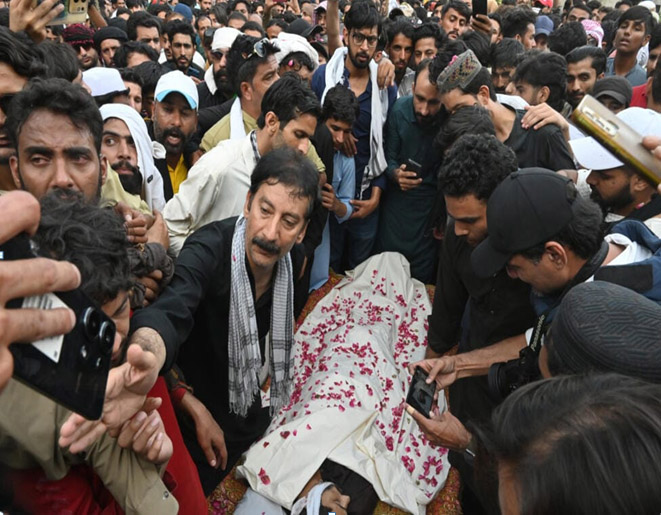
Even reports of attacks on houses have emerged. A grenade blast by Pakistani forces at a house reportedly killed several family members, including women, the elderly, and children. The projection of stability and Pakistan’s love has been exposed by recent incidents in which Pakistani soldiers forcibly entered two schools in PoJK and forced students and staff to chant pro-Pakistani slogans to portray a charade of normalcy and stability, which obviously no one would believe. In the latest crackdown on PoJK by Pakistan, when I say crackdown, I do not mean people being told to stay indoors or normal police announcements being made, but deaths, intimidation, killings, fear, and pain in PoJK. In the latest reports, many people have lost their lives amid this clampdown. I myself have seen visuals of dead bodies, mortuaries, bullets and shells being fired, and smoke and fire engulfing the poor occupied land of PoJK, and I must salute the courage of the brave men and women of PoJK. They stand against this oppression day in and day out. Funerals of those killed by Pakistan were held in large numbers, echoing slogans of accountability, love for the land, and unified voices calling for an end to Pakistan’s occupation.
Now, with the incident numbers, names, and brutal response to basic legitimate demands and protests rolled out before the world, isn’t PoJK a slaughterhouse where you kill and do not worry about being held accountable? Where you fear no consequences for human lives being lost, and no one asks you what and why you did what you did. You do whatever pleases you and whatever floats your boat. You roam around with guns, grenade-loaded jeeps, openly moving around poor, innocent PoJK civilians, who never know what you are going to do to them. That is what PoJK has been reduced to and what is happening in PoJK, by the perpetrators: Pakistan’s military forces and the entire Pakistani establishment, and the world needs to take note before a genocide takes place.
(The author can be reached at zeeshanshagufta@gmail.com)