

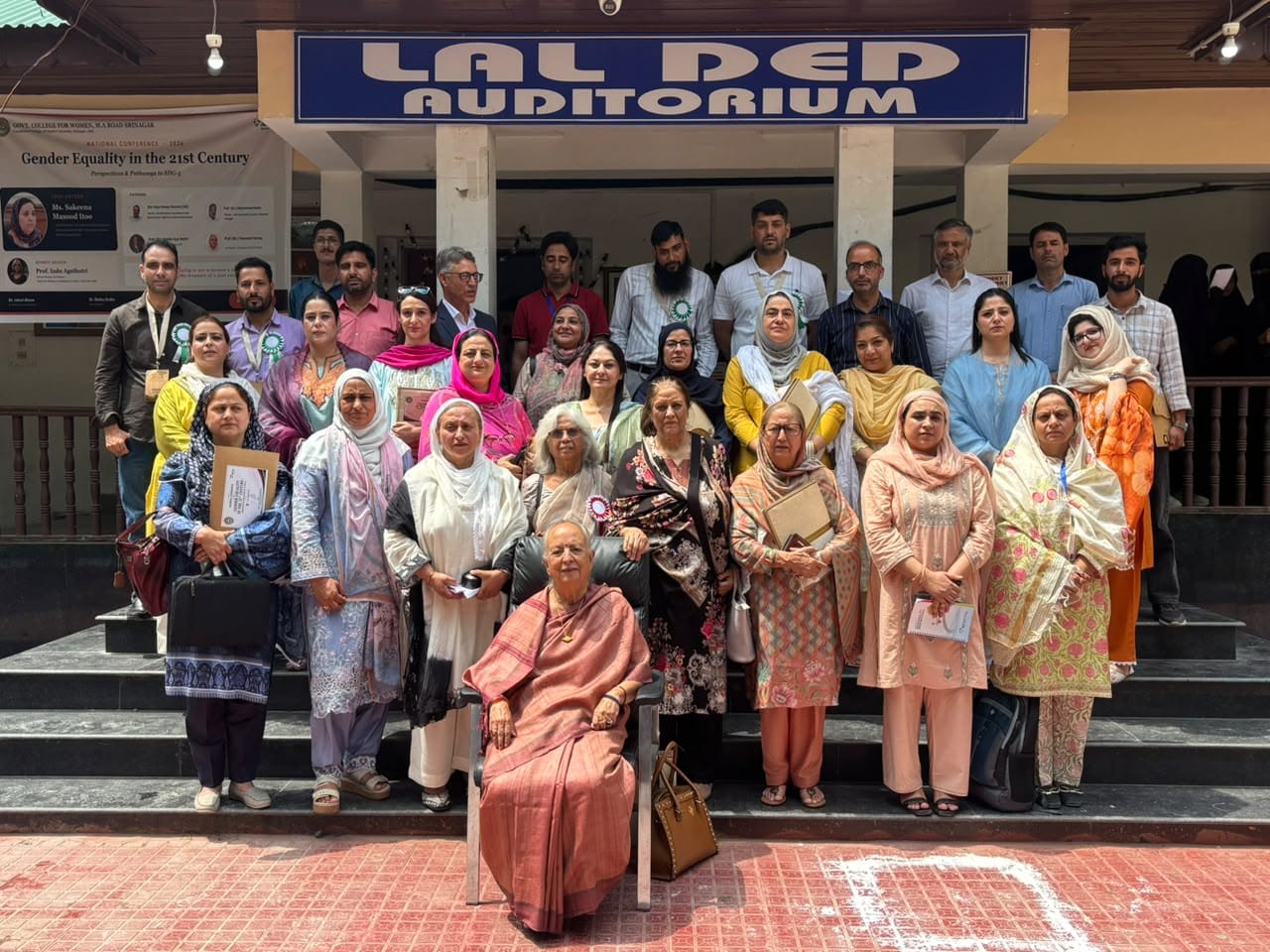
Srinagar: A two-day National Conference on “Gender Equality in the 21st Century: Perspectives and Pathways to SDG-5” commenced on Tuesday at Government College for Women (GCW), M.A. Road, Srinagar, bringing together academicians, researchers and scholars to deliberate on contemporary challenges to gender equality and explore sustainable pathways towards achieving the UN’s Sustainable Development Goal-5.
A two-day National Conference on “Gender Equality in the 21st Century, Perspectives and Pathways to SDG-5” commenced today at Government College for Women (GCW), M.A. Road, Srinagar, bringing together academicians, researchers and scholars to deliberate upon contemporary challenges and strategies towards achieving gender equality.
The inaugural session was attended by several prominent academicians and distinguished guests, including Prof. Indu Agnihotri, noted scholar and former Director, Centre for Women’s Development Studies, New Delhi; Mr. Sudhir Gupta, Executive Director, J&K Bank, which is sponsoring the conference; noted academicians Prof. Neerja Matoo, Prof. Naseem Shafaie and Prof. Masooda Yasin, besides principals of various colleges, senior faculty members, researchers, delegates and students.
Delivering the keynote address, Prof. Indu Agnihotri spoke on the larger dimensions of women’s development and gender equality, stressing the need for informed and sustained interventions to address structural inequalities.
Speaking on gender and the Sustainable Development Goals (SDGs), Prof. Agnihotri said, “Gender is not just one goal of the SDGs. You cannot achieve any of the SDGs without being sensitive to gender. Women have a stake in every aspect of their lives, and it is time we stood up and said that no committee and no aspect of our lives should be addressed without women having a say.”
Highlighting the issue of unpaid work, she said, “One of the fundamental questions before us is unpaid work. Women work in fields, on farms and in homes, yet much of this work remains invisible because women themselves are often not recognised as workers.”
Emphasising the importance of data for effective policy-making, Prof. Agnihotri said, “If we are serious about gender equality, we need better and more sensitive data. We often have excellent micro studies and excellent macro studies, but the links between the micro and the macro are missing.”
Referring specifically to Jammu and Kashmir, she said, “J&K is special to India. If we can achieve the SDGs in J&K, I will rest assured that India will achieve them; if J&K does not achieve them, India will not.”
She expressed hope that the conference would generate meaningful academic and policy inputs towards advancing gender equality.
Earlier, welcoming the guests and participants, Principal of the host college, Prof. (Dr.) Yasmeen Farooq underlined the special significance of the conference theme for the institution, noting that gender equality and women’s empowerment were closely connected with the history, purpose and identity of the college.
She observed that while opportunities available to women today were greater than those available to earlier generations, inequalities continued to persist in access to opportunities, economic participation, representation in decision-making, technology and leadership.
Prof. Yasmeen said the challenge was no longer merely to ask whether women had access to education, but whether education translated into agency, qualifications into opportunities, participation into leadership, and equality guaranteed in principle into equality experienced in everyday life.
Emphasising the role of educational institutions, she said colleges and universities were not merely places for transmitting knowledge, but spaces where assumptions could be questioned, new ideas could emerge and young minds could learn to view society critically and constructively.
She stressed that the responsibility of women’s education extended beyond providing degrees and called for equipping young women with confidence, critical thinking, skills and the ability to make independent choices.
“Education should ultimately enlarge choices,” Prof. Yasmeen said, adding that an educated young woman should be able to choose her profession, articulate her views, participate in decisions affecting her life, become economically independent and contribute confidently to society.
Introducing the conference theme, Dr. Jaleel Ahsan, Conference Coordinator said that the roots of gender inequality could be traced to the very foundations of social organisation, particularly the family, where gender roles, expectations and power relations were first introduced, learned, reinforced and normalised.
He noted that these socially constructed patterns often extended into educational institutions, workplaces, political systems, economic structures and other spheres of social life.
“The question of gender equality is not simply a question concerning women; it is a question of justice, dignity, human rights, social development and the future of society itself,” Dr. Jaleel said, stressing that “a society cannot claim to be truly progressive if opportunities and rights are determined by gender.”
He further observed that SDG-5 represented a global recognition that gender equality was fundamental to sustainable and inclusive development, and called for moving beyond merely addressing discrimination to examining and transforming the structures, institutions, attitudes and practices that perpetuate inequality.
“Achieving gender equality requires collective engagement within families, educational institutions, workplaces, communities, government offices and civil society,” he said, adding that the conference had been conceived as an interdisciplinary platform to critically examine the multiple dimensions of gender equality and explore policy interventions, institutional practices and sustainable pathways towards achieving SDG-5.
Earlier, the conference commenced with the National Song and National Anthem, followed by the traditional Izbund ceremony. The College Tarana was also played on the occasion. An Abstract Book containing papers to be presented during the conference was released, while a poetry recitation by a student added a cultural dimension to the inaugural proceedings.
Prof. Naureen Naseer moderated the inaugural session, while Prof. Shehla Ayoub presented the Vote of Thanks.
The conference will continue tomorrow with technical sessions focusing on diverse academic perspectives on gender equality and its social, economic, political, cultural and institutional dimensions.