

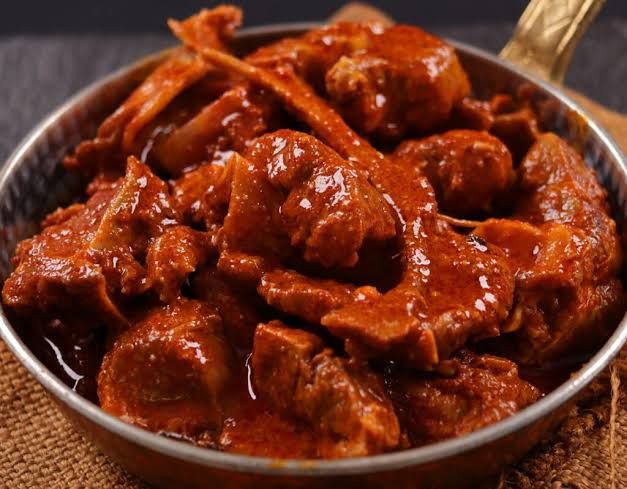
Srinagar: Mutton crisis has hit Kashmir’s food industry, with several restaurants and hotels scaling down non-vegetarian offerings.
Jammu and Kashmir is staring at a major mutton shortage after wholesale mutton dealers launched an indefinite strike and retail meat sellers suspended sales to protest the alleged imposition of hefty unauthorised charges on livestock-carrying vehicles transiting through Punjab.
Kashmir Mutton Dealers Association (KMDA) has suspended the import of sheep and goats into the Union Territory from markets outside Jammu and Kashmir, triggering concerns among consumers, traders and restaurant owners alike.
The association alleges that traders transporting livestock from Delhi, Haryana, Ambala, Rajasthan and other parts of north India are being subjected to unauthorised fee collection and repeated stoppages while passing through Punjab.
As the strike continues, the impact is increasingly being felt in Kashmir’s hospitality sector, where mutton forms the backbone of traditional cuisine.
Sareer Ahmad Khan, who runs a restaurant in Srinagar, said the shortage has forced him to drastically curtail the number of mutton dishes available to customers.
“Out of the 17 mutton dishes listed on our menu, we are currently able to serve only four or five. We are receiving inquiries from customers every day about dishes that are no longer available. Mutton is central to Kashmiri cuisine, and when supplies dry up, it directly affects our business and customer satisfaction,” Khan said.
Popular dishes such as Rogan Josh, Rista, Gushtaba, Daniwal Korma and Tabak Maaz have either become unavailable or are being served in limited quantities in many eateries.
Another restaurant owner, Aijaz Ahmad Bhat, who operates a family restaurant in Tangmarg, said the crisis is inflicting significant financial losses on businesses already grappling with rising operational costs.
“Our sales have dropped sharply because a large section of customers visit specifically for mutton dishes. We are losing revenue every day as we cannot meet demand. Even tourists expect authentic Kashmiri cuisine, but the shortage has left us with very limited options. If the strike continues, many restaurants will face serious financial stress,” he said.
Industry stakeholders fear that a prolonged disruption could affect tourism-related businesses at the peak of the summer season when visitor arrivals traditionally boost restaurant revenues.
Meanwhile, the issue has drawn the attention of the highest levels of government. Chief Minister Omar Abdullah has written to Bhagwant Mann seeking immediate intervention to resolve the matter and ensure the smooth movement of livestock destined for Jammu and Kashmir.
KMDA General Secretary Mehraj-ud-Din said traders have been bearing what he described as an escalating burden of unauthorised charges for years.
“Till last year, traders were compelled to pay around Rs 10,000 per truck. We paid about Rs 18 crore as unauthorised transit tax in Punjab last year. Now they are forcing us to pay between Rs 20,000 and Rs 30,000 for every livestock vehicle crossing Punjab. This has become an unbearable financial burden,” he said.
According to the association, the suspension of livestock imports will continue until authorities address their concerns and ensure that transporters are not subjected to illegal collections and repeated delays.