

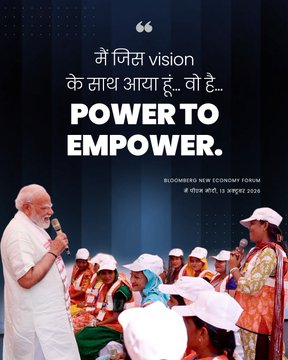
New Delhi: Prime Minister Narendra Modi today addressed the Bloomberg New Economy Forum in New Delhi. Acknowledging Michael Bloomberg’s earlier remarks, the Prime Minister celebrated the forum’s unprecedented debut in India. He praised the platform’s ability to unite the world’s brightest minds to deliberate on key global themes, including the economy, technology, energy, and international affairs. “I congratulate Bloomberg and his entire team; you have chosen the right place at the right time,” remarked Modi.
Addressing the summit’s core focus on emerging global powers, the Prime Minister highlighted a monumental paradigm shift in the 21st century’s third decade, where technology, data, knowledge, and innovation have become the ultimate metrics of power. He challenged the audience to reconsider the fundamental purpose of this power, questioning whether it should elevate a select few or actively democratize opportunities for millions, emphasizing a shift from controlling to enabling and from competing to collaborating. “Moving beyond the power to succeed to the power to help others succeed, the vision with which I have come here today is Power to Empower,” asserted Modi.
Grounding this philosophy in ancient cultural wisdom, the Prime Minister quoted traditional Sanskrit texts emphasizing that the true value of knowledge, wealth, and power is determined entirely by how ethically they are utilized. He stressed that understanding this profound purpose of power is absolutely essential for navigating today’s complex global dynamics. “Meaning, the true value of Power lies in its Purpose,” affirmed Modi.
Translating these ancient ideals into modern administration, the Prime Minister stated that the concept of ‘Power to Empower’ is not a mere global sermon but a deeply ingrained cultural tradition actively applied to the nation’s governance and work culture. He announced his intention to illustrate this transformative philosophy using concrete examples of the nation’s progress. “Therefore, I will take my point forward using examples from India itself,” noted Modi.
Showcasing the vibrant dynamism of the ‘Mother of Democracy’, the Prime Minister proudly listed the nation’s massive linguistic diversity, its 80,000 publications, and over a thousand television channels. He emphasized that in the modern social media era, the nation’s half-a-billion YouTube and Instagram users engage in robust, open debates, proving that digital power is actively fueling democratic discourse. “In present times, what has played a major role in this is digital power,” observed Modi.
Recounting the aggressive battle against digital exclusion, the Prime Minister noted that just over a decade ago, mere access to mobile phones and the internet was considered an elite privilege. He explained that since 2014, the government deliberately slashed data prices to ensure that everyone, from small-town students to village shopkeepers, could instantly access knowledge and markets. “Meaning, Connectivity in India has not just connected people; it has also connected opportunities,” asserted Modi.
Highlighting the extraordinary scale of financial inclusion, the Prime Minister invited international guests to witness a seamless digital payments ecosystem where a humble street vendor and a massive car showroom utilize the exact same technological platform. He framed this radical financial democratization as the ultimate proof of inclusive technology at work. “This is the strength of Inclusive Technology,” affirmed Modi.
Emphasizing the nation’s commitment to international technological solidarity, the Prime Minister declared that domestic digital capabilities are continuously shared with the Global South and other partner countries to help them build their own Digital Public Infrastructure. He cited the open-source CoWIN platform, deployed during the pandemic, as a prime example of domestic innovation actively unlocking global possibilities. “Meaning, our capability should empower humanity,” asserted Modi.
Championing the massive democratization of innovation, the Prime Minister celebrated the nation’s explosive startup growth, which skyrocketed from a few hundred in 2014 to over 2.5 lakh today. He proudly pointed out that nearly half of these startups originate from smaller cities and that over 45 percent feature female leadership, proving that the power to solve problems is reaching all segments of society. “Meaning, opportunities for Innovation are reaching more people,” noted Modi.
Pivoting to the core philosophy of public administration, the Prime Minister stated that governmental authority must never aim to create systemic dependency, but must instead focus on rendering citizens entirely capable and empowered. He credited this empowerment-driven governance model for successfully lifting 25 crore people out of poverty over the last decade. “And India is walking on this very path,” affirmed Modi.
Detailing the systemic eradication of corruption, the Prime Minister highlighted the deployment of the JAM Trinity and Direct Benefit Transfer systems to deliver government assistance directly into citizens’ bank accounts. “This has reduced corruption, increased the convenience of the country’s citizens, and established a direct relationship between Government and Citizen,” observed Modi.
Illustrating this empowerment philosophy on the global stage, the Prime Minister recalled the critical vaccine shortages during the COVID-19 pandemic and questioned whether life-saving manufacturing power should have been hoarded by a few nations. He expressed pride that India chose a humanitarian path by supplying vaccines to over 100 countries. “Our Manufacturing Capability became a medium of assistance for other countries as well,” asserted Modi.
Presenting a unique example of inclusive foresight, the Prime Minister mentioned a recent domestic AI Impact summit that expanded the dialogue beyond human applications to discuss how artificial intelligence could benefit animal welfare. He used this anecdote to prove that an increasingly capable nation will continually generate broader benefits for the entire world. “The more capable India becomes, the more beneficial it will be for humanity, for the world,” affirmed Modi.
Calling for a balanced global order, the Prime Minister argued that while competition, innovation, and national strength are vital, they must be paired with compassion and a commitment to solving global challenges like climate change, water governance, and the responsible use of emerging technologies. He insisted that the world needs powers that actively create new, shared opportunities. “Power is not just the ability to move ahead; it is also the ability to empower others to move ahead,” asserted Modi.
Demonstrating the nation’s commitment to climate action, the Prime Minister recalled the 2015 Paris Agreement pledge to achieve 40 percent installed electricity capacity from non-fossil sources by 2030. He announced that India surpassed this target in November 2021, nine years ahead of schedule, becoming the first G20 country to do so. “This was not just about fulfilling a commitment; it was also a sign of India’s changing Energy Journey,” noted Modi.
Quantifying this green energy pivot, the Prime Minister stated that the nation’s renewable energy capacity has increased from 75 gigawatts in 2014 to approximately 300 gigawatts today. He highlighted this four-fold expansion as a major achievement in the country’s sustainable development.
Explaining the grassroots economic benefits of this energy transition, the Prime Minister detailed how the PM Surya Ghar and PM-KUSUM schemes are empowering households and farmers to generate their own solar power and reduce input costs. He noted that these initiatives have added over 30 gigawatts of capacity, reducing carbon emissions by over 30 million tonnes annually while protecting nature and enriching citizens. “And it is also empowering people,” affirmed Modi.