

Tousif Raza
Contemporary Urdu poetry has consistently engaged with questions of female subjectivity, existential anxieties, identity formation, and the socio-cultural roles imposed upon women. Ruby Nisa’s poem “Main Arifa Nahin Hoon” (I Am Not Arifa) emerges as a significant contribution to this discourse. Though deceptively brief in its structure, the poem unfolds a complex landscape of inner anguish, identity crisis, and the quest for self-realization. Its greatest artistic achievement lies in its ability to articulate profound psychological and philosophical concerns through a language that is remarkably simple, accessible, and rooted in everyday experience.
The poem opens with the lines:
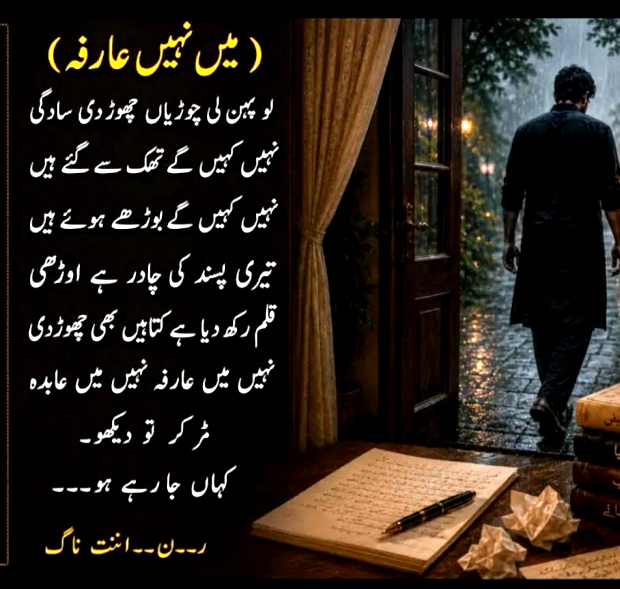
“I have worn the bangles now,
Abandoned simplicity.”
Within the symbolic framework of the poem, bangles transcend their status as mere ornaments. They become emblems of socially prescribed femininity and of those conventional expectations through which a woman’s identity is often defined and regulated. The speaker appears to suggest that she has fulfilled every external requirement imposed upon her by society. She has embraced all those attributes traditionally celebrated as markers of womanhood. The phrase “abandoned simplicity” signifies a departure from the authentic self and an entry into a socially manufactured identity. At another level, it functions as a subtle critique of a culture that continues to measure femininity through adornment and appearance, exposing a deeply embedded yet largely unquestioned social ignorance.
The poem then proceeds:
“I have draped the shawl
Of your choosing.”
The phrase “your choosing” is particularly significant. It extends beyond the realm of an individual beloved or spouse and gestures toward all those social, cultural, and ideological forces that impose their preferences upon the individual. In the symbolic vocabulary of South Asian culture, the shawl carries associations of honor, modesty, identity, and social conformity. By wearing a shawl selected by another, the speaker reveals how she has subordinated her own desires, preferences, and aspirations to the expectations of others. Her identity has gradually been fashioned according to external standards rather than emerging from an authentic sense of self. The subsequent lines deepen this existential predicament:
“I have put away the pen,
Left the books behind as well.”
The pen and the book are not merely instruments of learning; they symbolize consciousness, intellectual autonomy, creative freedom, and self-construction. Their abandonment signifies the silencing of the individual’s intellectual and imaginative capacities. The speaker points toward a recurring tragedy in the lives of many women: the expectation that they sacrifice their intellectual agency and creative identity in order to perform socially sanctioned roles. What appears to be a simple act of renunciation thus becomes a powerful metaphor for the suppression of female subjectivity.
The poem reaches its philosophical and emotional climax in the declaration:
“No—
I am not Arifa.
I am not
Abida.”
These lines constitute the conceptual center of the poem. Although Arifa and Abida appear as personal names, within the poetic context they function as symbolic identities, social labels, and predefined roles. By rejecting these names, the speaker refuses all externally imposed definitions of selfhood. This act of negation is not merely a denial; it is a profound existential assertion. It marks the moment when the individual begins to transcend inherited identities and embarks upon the difficult journey of discovering an authentic self beyond social categorization.
From a formal perspective, the poem belongs to the tradition of free verse. Its short lines, strategic repetitions, understated diction, and symbolic resonance contribute significantly to its aesthetic appeal. Rather than relying on elaborate metaphors or dense philosophical abstractions, Ruby Nisa draws upon ordinary objects and familiar experiences, enabling the poem to communicate directly while retaining remarkable interpretive depth.
If the concluding lines—
“Turn back and look,
Where are you going?”
—are considered part of the poem, the text acquires an even broader horizon of meaning. The address is no longer confined to a lover or intimate companion. Instead, it becomes an appeal to society, to human relationships, and perhaps to humanity itself. The poet seems to ask a troubling question: in our relentless pursuit of socially sanctioned identities and roles, how far have we drifted from our essential selves? Ultimately, “I Am Not Arifa” is a compelling poetic meditation on inner suffering, social coercion, self-alienation, and the recovery of identity. Its power derives from the delicate balance it achieves between simplicity and profundity. The poem narrates not merely the story of a woman, but the universal struggle of every individual seeking to reclaim an authentic self from the pressures of conformity. It invites readers to interrogate their own identities, their social roles, and the often invisible structures that shape their understanding of who they are. Such an invitation to self-reflection remains one of the highest achievements of poetry.
(The author is an English literature student. Hailing from Tangmarg, he can be reached at tousifeqbal555@gmail.com