

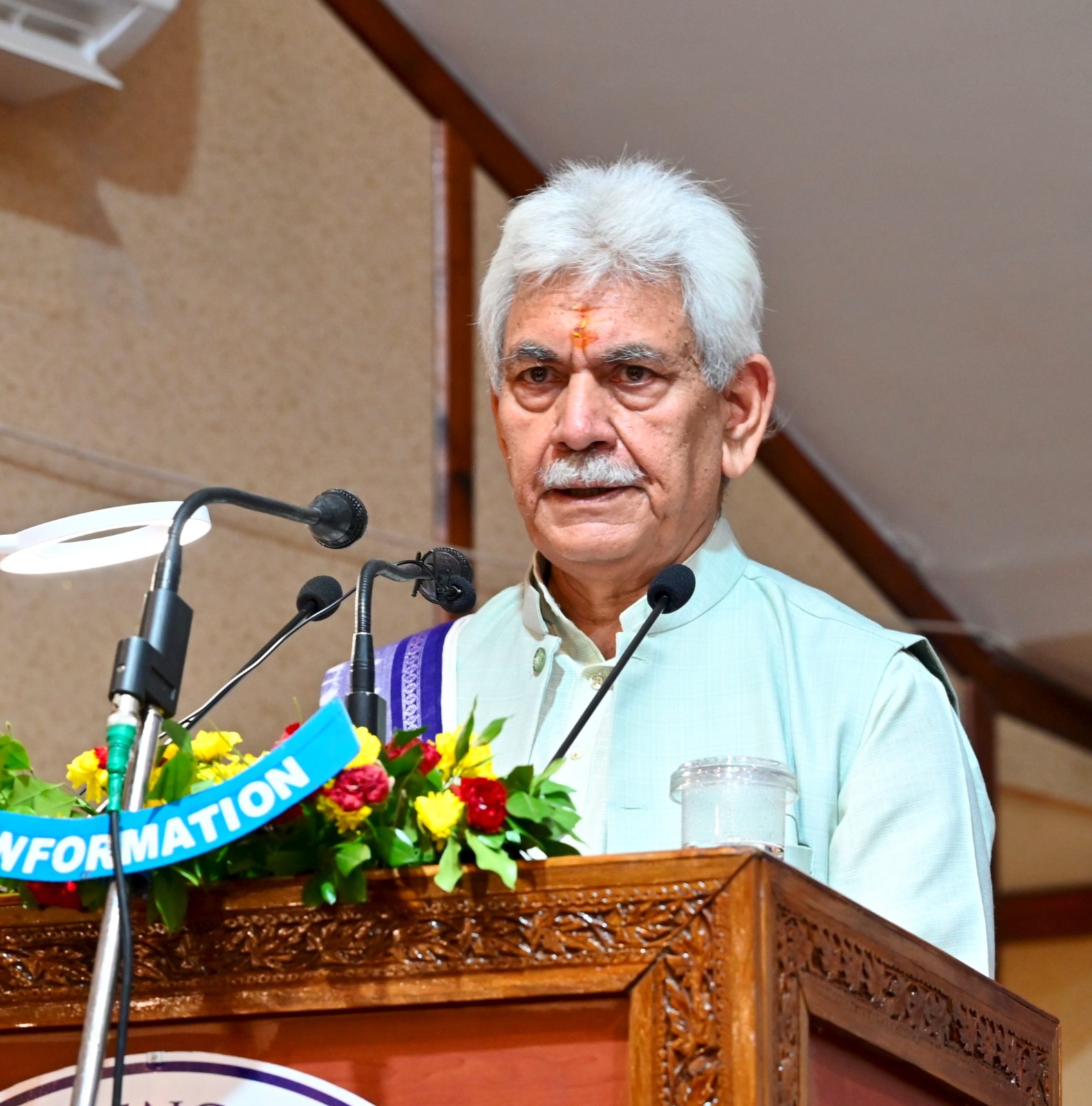
SRINAGAR: Lieutenant Governor Manoj Sinha on Monday called for placing Nature-Based Solutions (NbS) at the heart of development planning to strengthen climate resilience across the Himalayan region, stressing that sustainable development and environmental conservation are complementary and essential for securing the future of Jammu and Kashmir.
The Lieutenant Governor made these remarks while addressing a conference on “Strengthening Climate Resilience and Livelihoods in the Himalayan Region through Nature-Based Solutions” organised by the Islamic University of Science and Technology (IUST). During the event, he also inaugurated the Civil and Mechanical Engineering Block, the Law School, and the university’s Larmoo Campus, while congratulating IUST for its academic initiatives and appreciating its policy brief on the Nasha Mukt Jammu Kashmir Abhiyan.
Highlighting the growing impact of climate change in the Himalayas, Sinha said the region witnessed an alarming frequency of natural disasters, noting that between January and August last year, the Himalayas experienced almost one natural disaster every day. He said Jammu and Kashmir has suffered repeated flash floods and cloudbursts, causing extensive damage to roads, water supply schemes, power infrastructure and other public assets.
Emphasising the importance of protecting natural ecosystems, the Lieutenant Governor said nature itself serves as vital infrastructure. He explained that watersheds help control floods while ensuring water purification and irrigation, wetlands act as natural reservoirs by storing excess monsoon water and releasing it during dry periods, and dense forests prevent landslides by stabilising mountain slopes.
Warning against the destruction of natural resources, he said degrading forests, wetlands and watersheds amounts to compromising future generations, while conserving and restoring these ecosystems represents a long-term investment in environmental security and sustainable development.
Calling upon scientists, engineers and policymakers to integrate Nature-Based Solutions into mainstream planning, Sinha presented six major recommendations. He advocated the use of advanced technologies, including Artificial Intelligence (AI), remote sensing and geospatial mapping, for monitoring glacier retreat, spring discharge, forest cover and soil health to guide future development projects.
He further urged that Nature-Based Solutions be incorporated into project budgeting, appraisal and monitoring mechanisms. Stressing community participation, he said farmers, shepherds, orchardists and tribal communities should be treated as equal stakeholders, as their traditional knowledge of mountains, forests and rivers remains invaluable for environmental conservation.
The Lieutenant Governor also proposed that annual budget reviews should assess whether forests and ecosystems are improving or deteriorating to ensure accountability for environmental wealth. He called for long-term collaboration between scientists, policymakers and local communities and urged authorities to restore floodplains and wetlands alongside conventional engineering structures for effective disaster mitigation.
Addressing the academic community, Sinha encouraged universities to develop Nature-Based Solutions as a multidisciplinary field encompassing ecology, hydrology, engineering, economics, disaster management and indigenous knowledge systems. He said future professionals must understand the interconnected relationship between ecosystems, technology, society and economic development.
Recalling the Green Jammu Kashmir Drive launched in 2020, the Lieutenant Governor said the initiative had contributed to raising the Union Territory’s forest cover to nearly 55 per cent, while reiterating the need for sustainable lifestyles and environmentally responsible governance.
He envisioned a resilient Himalayan region where healthy watersheds, thriving wetlands and naturally flowing rivers continue to sustain biodiversity, livelihoods and cultural heritage. He said safeguarding the Himalayas requires a balanced approach that combines modern technology, traditional wisdom and active public participation.
On the occasion, the Lieutenant Governor released a special edition of IUST’s monthly magazine “Times Echo”, dedicated to the 100-Day Anti-Drug Campaign, along with a Policy Brief on the Nasha Mukt Jammu Kashmir Abhiyan prepared by experts from Jammu and Kashmir. Certificates were also distributed among trainees under the Pradhan Mantri Kaushal Vikas Yojana (PMKVY).
The conference was attended by Justice Sanjeev Kumar, Acting Chief Justice of the High Court of Jammu & Kashmir and Ladakh, Prof. Shakil A. Romshoo, Vice Chancellor, IUST, Prof. Shamim Ahmad Shah, Registrar, IUST, Prof. Javed Hussain Mir, Convener of the Conference, besides eminent scientists, experts, senior officials, faculty members and students.