

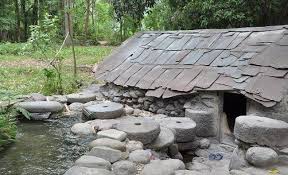
Srinagar: The wooden wheel creaks briefly inside a small stone-and-timber structure in Guiwa village of Baramulla. Seventy-two-year-old Abdul Rashid Bhat taps the mill gently as he collects freshly ground rice flour.
“It used to run all day. Now there are days when there isn’t enough water to turn the wheel,” he said.
For generations, the traditional water mill, locally known as a Gharat’e, was the heartbeat of rural Kashmir. Villagers carried sacks of maize, rice and wheat along narrow footpaths to these mills, where flowing water powered wooden turbines that ground grain into flour.
The mills, which provided an affordable service, stand abandoned, courtesy pollution and water scarcity
“Our village was known for Gharat’e (flour mills). Now hardly any Gharat’e functions. We had water in abundance back before 2000 due to which mills used to function round the year. As the stream dried, Gharat’e have fallen silent gradually,” Bhat said.
Although official figures are not available, local estimates suggest the number of functioning water mills in Kashmir has declined sharply over the decades. From several hundred operating across the Valley in the 1980s, fewer than 50, as per SKUAST-Kashmir, are believed to remain in service today, mostly in remote mountainous villages.
Residents and mill owners across several districts said streams that once flowed strongly throughout the year are becoming increasingly seasonal. Reduced snowfall, erratic rainfall and changing weather patterns have altered water availability in many mountain-fed channels.
In the village of Dargam, another mill owner pointed to a narrow stream trickling through rocks. “Twenty years ago, children could barely cross this stream in spring,” he says. “Now you can walk across it without getting your feet wet.”
Owners of traditional water mills said the competition has steadily eroded their customer base. While electric mills can process larger quantities of grain in less time, Gharat’e operators argued that the traditional grinding method produces flour of superior quality.
“The grain is ground slowly between stone millstones, which helps preserve its texture and taste,” says Abdul Rashid Bhat. “People who still come here believe the flour is better than what they get from electric mills.”
Several mill owners also contend that traditional water mills were more energy-efficient, relying entirely on flowing water rather than electricity or fuel. They described the centuries-old system as an environmentally sustainable technology that served rural communities long before modern infrastructure arrived.