

Irshad Mushtaq
Kashmir is passing through a quiet but serious social and economic change. Our streets are busy, food outlets are crowded, cafés are full, and young people are spending more and more time on mobile phones. At first glance, this may appear like progress. It may look as if people are spending, businesses are running, and society is active.
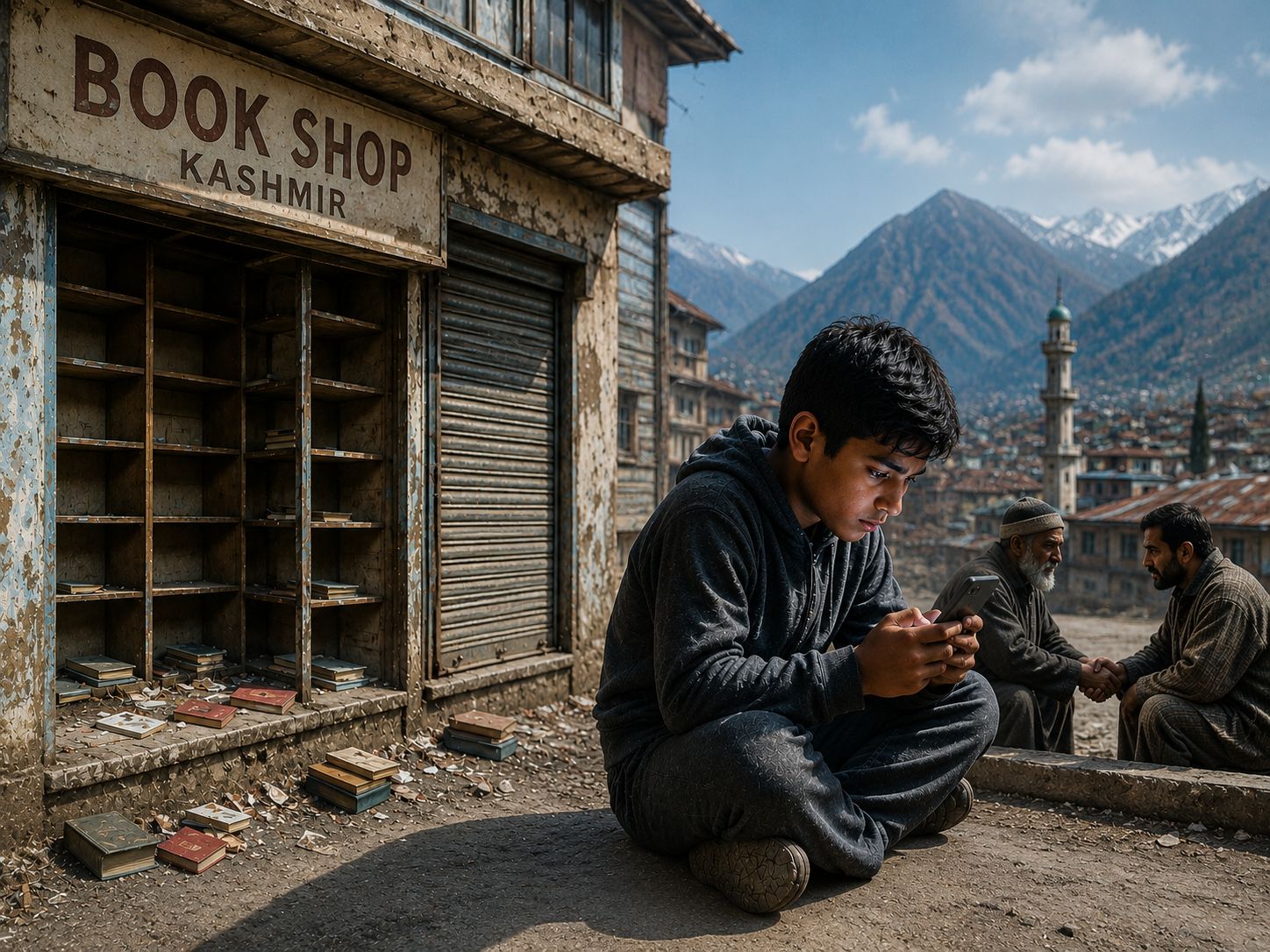
But if we look carefully, another side of the story becomes visible. Bookshops are becoming weaker. Reading habits are declining. Children are spending more time on screens than with books. Families are spending more on fast food and entertainment than on learning, health, and savings. At the same time, many workers, service providers, small contractors, drivers, designers, and labourers complain that people take work from them but do not pay on time.
This is not only a cultural issue. It is an economic issue. A society does not become strong only because markets are crowded. A society becomes strong when its people are educated, healthy, honest, disciplined, and trustworthy.
Kashmir has energy, but much of that energy is being spent in the wrong direction.
Empty Bookshops Are a Warning Sign
A bookshop is not just a shop. It is a place where people meet ideas. A student may find confidence there. A teacher may find new knowledge. A writer may find inspiration. A young person may find direction. When such places become weak, society loses more than a business. It loses a part of its thinking culture.
Government data also shows why this issue matters. The Ministry of Culture informed Parliament that India had 46,746 public libraries based on data collected by the Raja Rammohun Roy Library Foundation, while Jammu and Kashmir had only 129 public libraries in that record. This means reading spaces must be treated as serious social infrastructure, not as old-fashioned institutions.
The Ministry of Education’s Samagra Shiksha guidelines provide library grants from ?5,000 for primary schools to ?20,000 for senior secondary schools, showing that even government policy recognises school libraries as important for learning.
Kashmir has always had respect for knowledge, poetry, language, and wisdom. Our elders valued words and promises. They may not have had modern facilities, but they had seriousness, honesty, and commitment. Today we have more technology, but we must ask whether we have the same depth.
Crowded Food Streets Are Not Always Progress
There is nothing wrong with food businesses. A young person running a tea stall, café, bakery, barbecue point, or fast-food shop is also working hard and creating a livelihood. Such work deserves respect.
The problem begins when society spends too much time and money on short-term pleasure and too little on long-term improvement. A busy food street may show consumption, but it does not always show development. A mobile screen may show activity, but it does not always show learning.
If families regularly spend on junk food, sugary drinks, late-night snacks, mobile upgrades, and entertainment, they may slowly reduce spending on books, health, sports, skill courses, and savings. This weakens the household over time. The effect may not be visible immediately, but slowly it affects education, health, and financial stability.
Small habits create big results. If our daily habits are weak, our future also becomes weak.
Official Health Data Should Worry Kashmir
India’s Economic Survey 2023-24 clearly warned that social media, screen time, sedentary habits, and unhealthy food are a “lethal mix” that can damage public health, productivity, and India’s economic potential.
The Economic Survey 2025-26 also warned that obesity is rising as a major public health challenge in India because of unhealthy diets, sedentary lifestyles, and ultra-processed foods. It reported that NFHS 2019-21 data shows 24% of Indian women and 23% of Indian men are overweight or obese.
For Jammu and Kashmir, the NFHS-5 fact sheet is even more concerning. It shows that 29.3% of women and 31.6% of men in J&K were overweight or obese, and 9.6% of children under five were overweight, which means a simple thing: if our food habits and screen habits do not improve, families will spend more on doctors, medicines, and tests in the future. Poor health is not only a medical problem. It is a financial problem.
A child who spends too much time on screens may lose concentration. A young person who eats unhealthy food every day may face obesity, diabetes, high blood pressure, and low stamina later. A worker with poor health and weak focus cannot give their best. A family with rising medical bills loses savings.
Digital Addiction Is Now an Official Concern
The Economic Survey 2025-26 also highlighted digital addiction among children, saying it can hurt academic performance and workplace productivity through distraction, sleep debt, and reduced focus. It also noted that digital addiction erodes social capital, which means it weakens real human relationships and community life.
This is exactly what we see around us. Many children are physically at home but mentally inside the mobile phone. Many young people sit with their families but are busy scrolling. Many students open books but quickly return to reels, gaming, or random videos.
Technology is not bad. Mobile phones are not bad. But if technology controls the mind instead of helping the mind, it becomes a problem. A smartphone should be a tool, not a master.
Youth, Jobs, and the Cost of Weak Habits
Kashmir’s economic future depends heavily on its youth. This is why health, skill, reading, and discipline matter so much.
A government reply in Rajya Sabha stated that the unemployment rate among persons aged 15-29 years in Jammu and Kashmir was 18.3% during July 2020-June 2021, based on PLFS data. Even if employment conditions change over time, this figure reminds us that youth employability is a serious issue.
For a common Kashmiri family, employability does not mean only having a degree. It means having communication skills, reading ability, digital skills, honesty, health, punctuality, and confidence. A degree without discipline does not create income. A phone without skill does not create a career. Time spent only on entertainment does not create employability.
If our youth read less, sleep late, eat poorly, scroll more, and avoid skill-building, they will face more difficulty in jobs and business. The market rewards value, not excuses.
Delayed Payments and Broken Trust
Another serious problem in our society is the delay in payments. Many people take work from others but do not pay them on time. Some avoid phone calls after the work is done. Some make workers, designers, drivers, labourers, small contractors, or service providers wait for their own money.
This is not a small issue. It hurts dignity.
When a worker is not paid on time, his whole family suffers. His children’s school fees may be delayed. His rent may be delayed. His grocery bill may be delayed. His medicine may be delayed. For the person who has taken the work, it may look like a small delay. But for the worker, it can disturb the whole household.
Delayed payment destroys motivation. It makes honest people bitter. It creates mistrust in the market. A society where people do not trust each other cannot grow smoothly.
Trust is the foundation of every business. If trust breaks, people start demanding advance payment. Workers become suspicious. Customers become doubtful. Employers become defensive. Business becomes slow and stressful.
Kashmir needs to rebuild trust in daily dealings.
Learning from Our Elders
Our elders had fewer resources, but they respected commitment. If they gave their word, they tried to honour it. If they promised payment, they remembered it. If someone worked for them, they respected that person’s effort.
Today, we speak of modern business and modern lifestyle, but modern life without honesty has no value. A person may have a good phone, a good car, an office, and a social media image, but if he does not keep his promise, he is not truly successful.
Real development is not only about income. It is also about character.
Ego and Insecurity Are Also Problems
We also need to talk about ego and insecurity. Sometimes we reject good ideas because they come from someone else. Sometimes people create problems for a talented person because they fear he may grow. In offices, shops, and institutions, some people pull others down only to protect their own position.
This is harmful for society. If someone knows more, we should learn from him. If someone works better, we should appreciate them. If someone has a good idea, we should give it a fair chance.
The more we teach others, the more we learn. The more we support others, the stronger society becomes. Knowledge does not become less when it is shared.
Life is temporary. Jobs, positions, and money are also temporary. What remains is how we treated people.
Kashmir needs less jealousy and more cooperation.
Respect Between Workers and Owners
A good society cannot be built by blaming only one side. Owners should respect workers, and workers should respect owners. Employers should pay on time, and employees should work honestly. Buyers should honour deals, and sellers should deliver properly.
If a worker gives honest effort, he deserves respect and timely payment. If an owner invests money, takes risks, and creates employment, he also deserves sincerity and responsibility from workers.
Both sides must understand each other. If payment is genuinely delayed, the person should explain clearly. If work cannot be completed on time, the worker should also speak honestly. Good communication can prevent many misunderstandings.
The economy becomes better when relationships become better.
Human Capital Is Kashmir’s Real Wealth
We often talk about tourism, roads, markets, and government schemes. These are important, but Kashmir’s real wealth is its people.
A child who reads is wealthy. A young person who learns a skill is wealthy. A trader who speaks the truth is wealthy. A worker who comes on time is wealth. An employer who pays on time is wealth. A teacher who inspires students is a wealth.
If Kashmir wants a better future, we must invest in good habits. We need more books in homes. We need active libraries. We need sports and healthy routines. We need families to discuss savings, health, and discipline. We need businesses to honour commitments.
This is not only moral advice. It is practical economics. Good habits increase future income. Bad habits increase future costs.
What a Common Kashmiri Family Can Do
Every family can begin with small steps. Keep a small monthly budget for books. Reduce unnecessary screen time. Take children to a bookshop or library. Replace some junk-food outings with sports, walking, or healthy meals. Discuss one useful article or idea at home every week.
Every school can encourage reading beyond textbooks. Every mohalla can think about a small reading room. Every parent can ask children not only about marks, but also about habits, sleep, food, phone use, and discipline.
Every business owner can also take small steps. Pay workers on time. Answer calls. Do not delay someone’s rightful money. If there is a genuine problem, speak honestly. Respect the person who works for you.
Every worker should also show commitment. Come on time. Work honestly. Respect the owner’s investment. Do not misuse trust.
Every young person should remember that life is not only about reels, food, fashion, and comparison. Life is also about skill, discipline, reading, health, savings, and service.
Conclusion: Kashmir Must Return to Trust, Learning, and Discipline
Kashmir’s silent economic crisis is visible in our daily habits. It is visible when bookshops become empty. It is visible when children spend hours on screens. It is visible when families spend more on junk food than on learning. It is visible when workers wait for payment. It is visible when ego blocks good ideas, and insecurity stops talented people from growing.
The official figures are warning us. J&K has serious overweight and obesity numbers in NFHS-5. India’s Economic Survey is warning about screen time, junk food, digital addiction, and productivity. Government records show that libraries and reading spaces need support. PLFS data has reminded us about youth unemployment. These issues are not separate. They are connected.
If a young person does not read, does not build skills, does not protect health, does not respect time, and does not learn trust, his future becomes difficult. If a society spends more on temporary pleasure and less on human capital, its economy becomes weak from the inside.
But Kashmir can still change. Our society has not lost its soul. We have a rich history of knowledge, poetry, hard work, trade, honesty, and commitment. We only need to bring those values back into our daily lives.
Let us bring books back into our homes. Let us make libraries active again. Let us teach children that health, discipline, and character are real wealth. Let us pay workers on time. Let us respect owners and workers alike. Let us honour our promises. Let us reduce jealousy and increase cooperation.
Crowded markets alone will not build Kashmir’s future. Mobile screens alone will not build Kashmir’s future. Fast food alone will not build Kashmir’s future.
Kashmir’s future will be built by honest hearts, healthy bodies, reading minds, skilled hands, and promises that are kept.
The future of Kashmir will not be built by noise. It will be built by character.