

Irshad Mushtaq
The Question Kashmir Must Ask
In Kashmir, a government job has long been treated as more than employment. It has come to represent peace of mind, family honour, financial stability, and a secure future. In a region shaped by uncertainty, shutdowns, disturbed business cycles, and interrupted livelihoods, families naturally moved toward what looked safest.
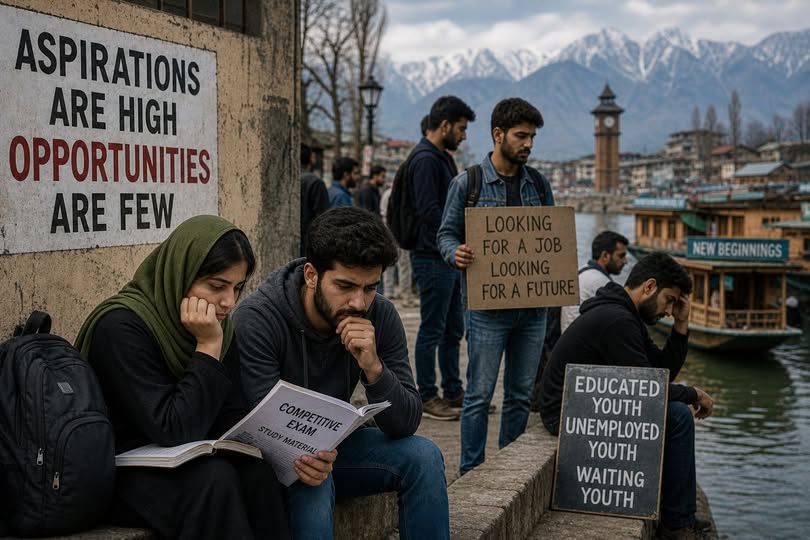
That emotional choice made sense in its time. But when one respectable option becomes the only respectable option, society begins to suffer. Young people start waiting instead of working. Families begin measuring worth through one salary slip. Marriage decisions become narrow. Confidence falls, even among honest, capable, and hardworking youth.
Why This Mindset Became So Strong
This thinking did not appear overnight. It grew from lived experience. Parents who struggled in orchards, shops, transport, or uncertain daily trade wanted their children to sit in stable offices. Mothers and fathers who saw instability naturally desired a fixed monthly income for their children.
That desire was never wrong. The problem began when security turned into social pressure. Many young people now prepare only for vacancies, not for life. Instead of asking, What can I build? They are pushed to ask, When will the next recruitment list come?
The Hard Truth
No administration can provide a government job to every educated young person. The number of aspirants is always far higher than the number of posts. When lakhs of youth compete for limited vacancies, disappointment becomes unavoidable.
Years pass in form-filling, coaching, document verification, and repeated attempts. Age rises, confidence weakens, and many begin to feel that life itself is delayed. This is no longer just an employment problem. It is also a social pressure problem, a mental burden, and a marriage challenge.
Government-Backed Proof
Official and reported data show clearly that Jammu and Kashmir cannot depend only on government recruitment for its future.
- J&K unemployment rate for age 15+ was reported at 6.1 percent in 2023-24, against the national average of 3.2 percent.
- J&K unemployment rate for age 15+ was reported at 6.7 percent in 2024-25, against the national average of 3.5 percent.
- More than 9.58 lakh self-employment and livelihood opportunities were reported as created in J&K from 2021-22 to January 2025 through schemes and support measures.
- The J&K Economic Survey 2023-24 projected real GSDP growth of 7.41 percent and per capita income of Rs 1,46,447, showing that the economy has room for expansion beyond government payrolls.
These facts send a clear message: Kashmir does not lack potential. It needs a broader acceptance of multiple paths to dignity, income, and stability.
The Marriage Burden
One of the most painful effects of this mindset appears in marriage. In many homes, a government job is still treated as the main certificate of suitability. A young person may be disciplined, honest, skilled, financially responsible, and earning through private work or business, yet still be viewed with doubt.
This is unfair to thousands of hardworking youth. Marriage should not be judged only by job type. It should be judged by character, responsibility, income stability, behaviour, family values, and financial discipline. A government salary can offer security, but it does not automatically guarantee maturity, kindness, or wise decision-making.
Private Work and Self-Employment
Private work is not failure. Self-employment is not a weakness. In fact, someone who has survived in business for years has often demonstrated patience, customer handling, risk management, discipline, and resilience in ways that many people never recognise.
A person who has built income from a shop, orchard, services, trade, transport, digital work, consulting, tourism, or handicrafts has already shown courage. Such a person may not hold a government ID card, but often carries real-life strength, adaptability, and earned experience.
Villages and Lost Confidence
A painful shift is now visible in many villages. Young people often avoid fields, orchards, dairy, fisheries, saffron, packaging, food processing, or local trade, not because these sectors have no value, but because society has quietly reduced their dignity.
The office chair has been made to look superior to the orchard. The monthly salary has been made to look superior to a seasonal enterprise. But if everyone keeps waiting, who will cultivate the land, modernise horticulture, build brands, process local produce, market Kashmiri goods, and create employment in villages?
What Parents and Youth Must Learn
Parents have sacrificed deeply for their children, but love should not become pressure. A son or daughter should not feel worthless because a government job did not arrive. Families must begin asking different questions: What skill does this child have? What work can begin now? What local opportunity already exists? Can land, trade, technology, or training be used better?
Young people also need a change in thinking. Preparing for a government exam can remain one path, but life should not be put on hold for it. A form can be filled, and a skill can also be learned. A result can be awaited, and income can also be started. The first earning, however small, breaks fear and builds self-belief.
The Real Direction for Kashmir
Kashmir does not need to reject government jobs. It needs to stop treating them as the only honourable future. The right goal is balance: government service as one respected option, alongside private work, self-employment, skilled trades, agriculture, entrepreneurship, and local enterprise. - Skill before salary.
- Enterprise before endless waiting.
- Dignity of labour before social status.
- Local resources before outside dependence.
- Job creators alongside job seekers.
Conclusion
Kashmir’s attachment to government jobs has deep emotional roots, and those roots deserve understanding, not mockery. Families wanted safety in unsafe times, and that desire came from pain, sacrifice, and lived insecurity. But the future of Kashmir cannot be built by fear alone.
A society grows stronger when it teaches children not only how to wait, but how to work; not only how to seek jobs, but how to create value; not only how to earn, but how to manage money, build assets, and stand with dignity. Kashmir must continue to respect government service, but it must also honour the farmer, the artisan, the trader, the teacher, the private employee, the entrepreneur, and the young person trying to start small with honesty.
The real change will begin when families stop asking only, Did he get a government job? and begin asking, Is this person responsible, skilled, disciplined, and capable of building a life? That day, Kashmir will move from waiting to working, from fear to confidence, and from narrow definitions of success to a stronger, more self-reliant future.