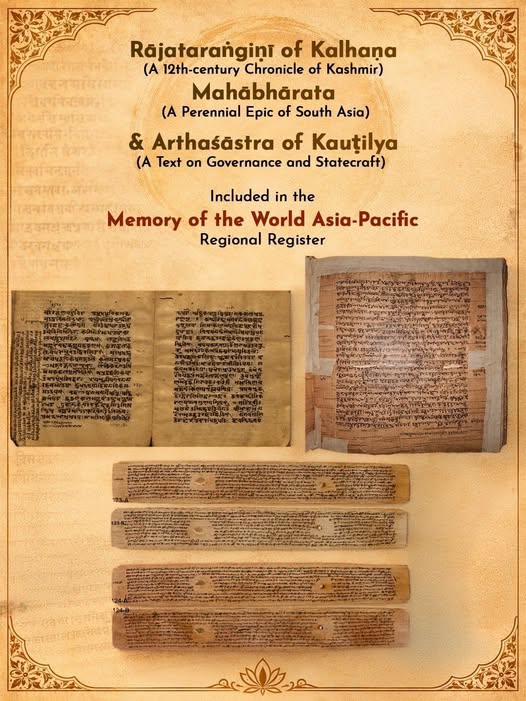
The inscription of Kalhana’s 12th-century chronicle Rajatarangini on UNESCO’s Memory of the World Asia-Pacific Regional Register is a moment of immense pride for Jammu and Kashmir. It is more than an international honour for an ancient manuscript. It is recognition of Kashmir’s rich intellectual, literary and historical traditions and their contribution to the wider understanding of human civilisation. The inclusion of the Rajatarangini, along with the Mahabharata and Kautilya’s Arthashastra, in the prestigious register is an acknowledgement of India’s civilisational heritage. The decision was taken at the 11th Session of the Memory of the World Asia-Pacific Regional Register in Jakarta, Indonesia. With these additions, India’s total entries in the regional register have risen to six. For the union territory of Jammu and Kashmir, however, the recognition of the Rajatarangini carries special significance. Written by Kalhana in the 12th century, it is among the most remarkable historical chronicles of the Indian subcontinent. The chronicle is particularly important because of its emphasis on historical evidence, chronology and critical assessment of earlier accounts. Apart from recording the achievements of kings, Kalhana also wrote about their failures, political conflicts, administrative shortcomings and the consequences of their decisions. His work offers a valuable glimpse into Kashmir’s political, cultural and social life over several centuries. The Rajatarangini reflects the intellectual environment of Kashmir, its literary excellence and its engagement with questions of power, ethics, justice and governance. It provides an important historical foundation for understanding the Valley’s past and its place in the broader history of the subcontinent. The UNESCO recognition should also encourage renewed interest in Kashmir’s literary and cultural heritage. The Valley has a long tradition of scholarship, philosophy, poetry, language and artistic expression. Much of this legacy remains confined to manuscripts, libraries and academic institutions, with limited public engagement. Recognition on an international platform offers an opportunity to bring these traditions to a wider audience across the globe. Lieutenant Governor Manoj Sinha and Chief Minister Omar Abdullah have welcomed the inscription, describing it as a proud moment for Jammu and Kashmir. The inclusion of the Rajatarangini celebrates Kashmir’s intellectual heritage and highlights the responsibility to preserve it for future generations. Universities and research institutions should encourage scholars to undertake fresh studies of the Rajatarangini and other important historical texts. There is a need to introduce Kashmir’s literary and historical heritage more meaningfully into educational institutions. Students should learn about Kalhana, his historical approach and the significance of his work. Museums, libraries and cultural institutions can organise exhibitions, lectures and public programmes to create greater awareness. The recognition also presents an opportunity to promote heritage tourism. Kashmir’s historical sites, ancient temples, learning centres and cultural landmarks can be connected with its literary legacy. Such initiatives can strengthen public understanding while creating opportunities for research and tourism. The inscription of the Rajatarangini is an international acknowledgement of Kashmir Valley’s contribution to knowledge and history. The UNESCO honour should now become a starting point for greater efforts to protect, study and share Kashmir’s extraordinary historical heritage.
Kalhana’s Legacy