

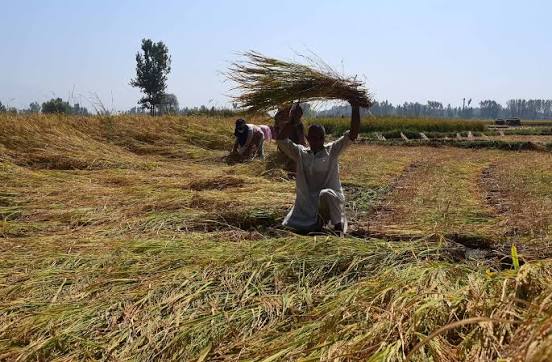
Srinagar: Farmers’ landholding in Jammu and Kashmir has shrunk to 0.593 hectares or about 1.47 acres in the last 10 years.
As per the official records, the average operational landholding previously was recorded at 0.595 hectares in Jammu and Kashmir in the year 2015. The Agriculture Census measures an “operational holding” based on the land actually operated by a farmer rather than land ownership, making it an indicator of the scale at which agricultural activity is being carried out.
One of the clearest signs of this transformation, experts suggest, is the shift from paddy and other field crops to horticulture and commercialisation.
Official figures reveal that the Valley has lost nearly 34,000 hectares of cultivable farmland between 1996 and 2023.
The decline has coincided with rapid expansion in horticulture, especially apple cultivation, which offers substantially higher returns than traditional food grains.
Official data showed that the area under major horticultural crops in J&K increased from 3.42 lakh hectares in 2021-22 to 3.44 lakh hectares in 2024-25. The increase of about 2,000 hectares came even as traditional agricultural land, particularly land under paddy, remained under pressure.
According to the NITI Aayog’s Roadmap for Horticulture Development in the UT of Jammu and Kashmir @ 2047, the area under fruit cultivation, including fresh and dry fruits, expanded from 1.31 lakh hectares in 1980 to 3.44 lakh hectares in 2022, while fruit production increased more than fivefold from 5.63 lakh tonnes to 27.22 lakh tonnes over the same period.
Experts said the growth in the family size of marginal farmers and commercialization have mostly contributed to the shrinking of average operational landholding of farmers.
“Families of agricultural communities have expanded. A land which was owned by a single farmer gets divided into many. Similarly, commercialization is another factor which reduced the agricultural land. People build houses and other commercial establishments on the land which was being used for agriculture,” said Mohammad Iqbal Chaudhary, former director of the agriculture department.
Officials said that urbanisation was putting pressure on agricultural land. They said the administration is monitoring cases where agricultural land is diverted for non-agricultural purposes.