

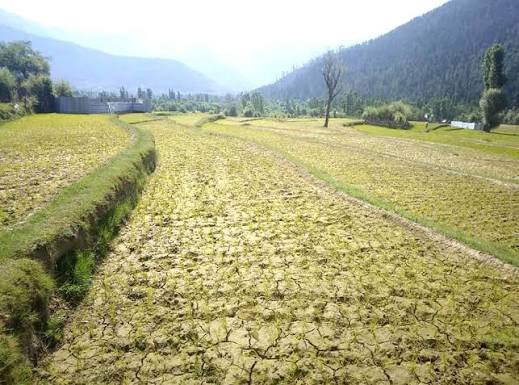
Srinagar: Home to streams, rivers and springs, Jammu and Kashmir continues to face an irrigation deficit of 58 percent.
According to government data, Jammu and Kashmir’s net irrigated area stood at about 3.10 lakh hectares in 2023-24, accounting for only 42% of the net sown area. This indicates that a majority of farmland remains outside assured irrigation coverage, making agricultural output vulnerable to erratic precipitation and prolonged dry spells.
The latest Regional Digest of Statistics shows that the Union Territory had a net irrigated area of 1.10 lakh hectares through canals, springs, wells and other sources in 2024-25, while gross irrigated area exceeded 2.16 lakh hectares.
Data from the Economic Survey indicates stark regional disparities. In Kashmir Valley, districts such as Srinagar, Ganderbal, Budgam and Anantnag have more than 60% of their net sown area irrigated, while several hilly districts in Jammu division remain far below that level.
Agriculture experts said that irrigation was becoming increasingly important as climate change alters rainfall patterns in Kashmir. “The Valley’s paddy cultivation, which covers over two lakh hectares, remains highly dependent on timely water availability during the kharif season. Delayed rains or reduced stream flows directly affect yields and farm incomes,” said Irshad Aziz, a botanist and an agriculture expert.
To bridge the gap, the government has accelerated investment in irrigation infrastructure. The J&K Economic Survey 2025-26 stated that 151 irrigation projects completed during 2025-26 stabilised irrigation across 5,364 hectares, while 396 surface minor irrigation schemes sanctioned under the Pradhan Mantri Krishi Sinchayee Yojana (PMKSY) are expected to create or stabilise irrigation potential over nearly 97,500 hectares.
The government recently also informed that the Jal Shakti Department has taken up desilting of 1,377 irrigation canals and khuls in Kashmir during 2026-27 in convergence with the Jal Shakti Department, while 984 additional desilting and upgradation works identified in Jammu division are yet to be taken up.
Pertinently, Kashmir has been repeatedly facing growing irrigation-water stress during the peak paddy cultivation season. A prolonged shortfall in water availability, declining flows in irrigation channels, and uneven distribution force farmers in several paddy-growing areas to rely increasingly on groundwater pumping or wait for canal supplies, increasing cultivation costs and the risk of crop stress.