

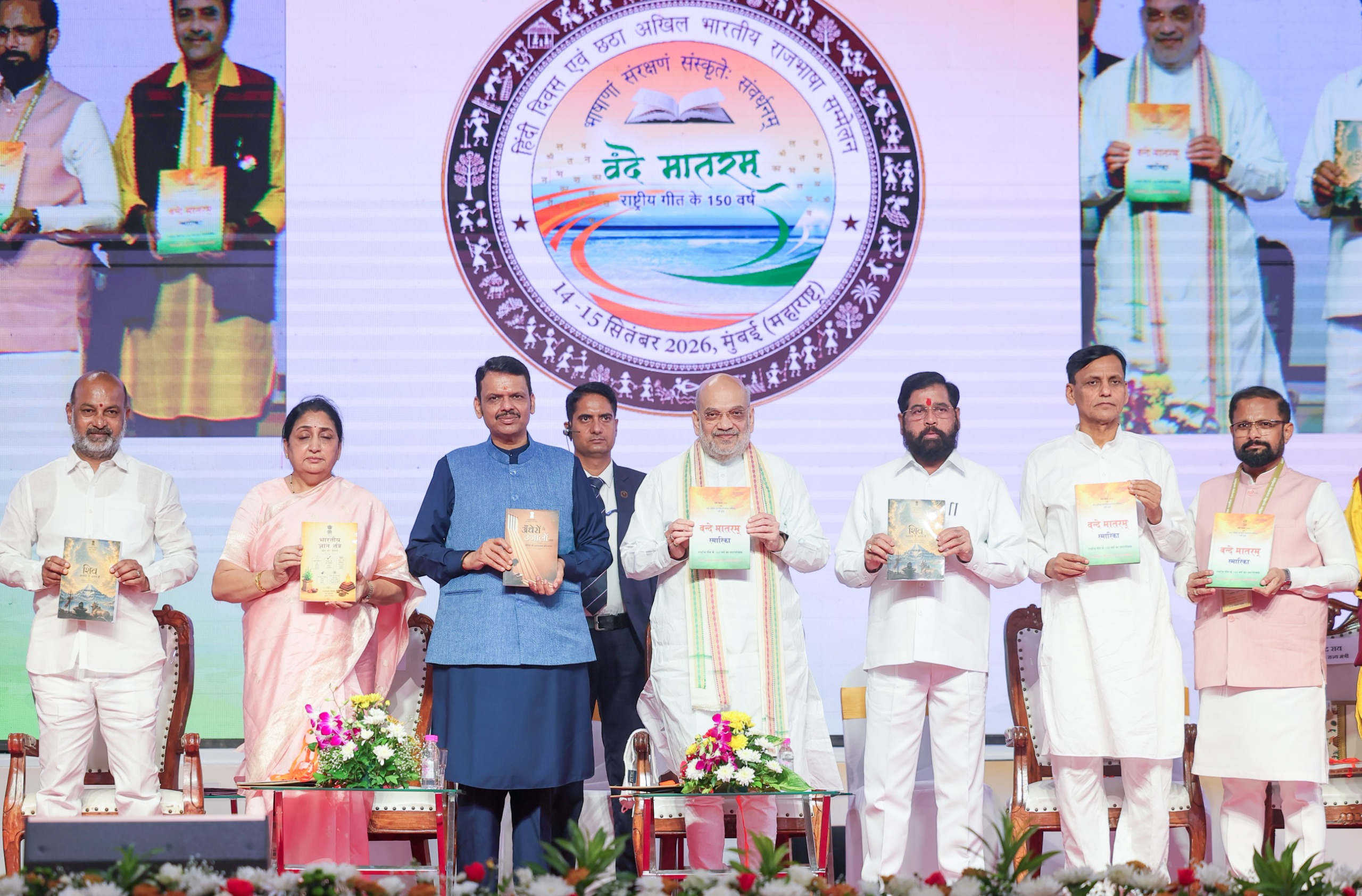
Mumbai, Sept 14: Union Home Minister Amit Shah on Monday said India’s many languages may represent different voices, but the country’s collective voice must remain one, rooted in patriotism and a shared cultural identity.
Addressing Hindi Diwas 2026 and the 6th All India Official Language Conference in Mumbai, Shah said linguistic diversity was one of India’s greatest strengths and that no language should be viewed in opposition to another.
“There is no objection to having many languages. The sentiment must remain Indian. There may be many dialects, but India’s voice must remain one,” he said.
Shah said Hindi has an important role as the Official Language in connecting people across the country, while regional languages should continue to flourish and receive equal respect.
He said the government’s objective was not to replace Indian languages but to enrich them and connect them with one another. He cited the example of Maharashtra, which he described as one of the country’s most multilingual states, where Marathi, Konkani, Gujarati, Sindhi, Hindi, Kannada, Warli and other languages have developed and received recognition.
The Home Minister said the country’s linguistic diversity had deep historical and cultural roots. Referring to Rabindranath Tagore, he said India’s regional languages could be compared to the petals of a lotus, with each language contributing to the beauty of the whole.
Shah said the promotion of Indian languages was also important for education and governance. He highlighted the National Education Policy and said students should learn their mother tongue as well as another Indian language.
He said learning the mother tongue helps children develop their ability to think, analyse and make decisions, while learning another Indian language can strengthen their connection with the broader idea of “Ek Bharat, Shreshtha Bharat”.
The Home Minister said efforts were being made to make Indian languages languages of governance and science and to strengthen their use in education and technology.
He said competitive examinations such as JEE and NEET were now being conducted in 13 languages, giving students greater access to education in Indian languages.
Shah also highlighted technological initiatives aimed at promoting Indian languages. He said the “Hindi Shabd-Sindhu” dictionary, which began with 51,000 words, had grown to around eight lakh words, with more than 50,000 words from local languages incorporated into it.
He said the government was also using artificial intelligence to promote language learning and translation through platforms such as LILA Rajbhasha, LILA Pravah and “Bharti – Bahubhashi Anuvad Sarathi”.
The Home Minister said more than five lakh government employees had been trained in the Official Language and the AI-based “Kanthasth 2.0” platform had been expanded for foreign users.
Shah also stressed the importance of moving beyond political differences over languages. He urged people to focus on strengthening all Indian languages and ensuring that linguistic diversity remains a source of unity rather than division.
The event also saw the presentation of Rajbhasha Kirti Awards and Rajbhasha Gaurav Awards. Several publications, including works related to “Vande Mataram” and Indian knowledge traditions, were also released.
Shah said the All India Official Language Conference had been taken beyond Delhi since 2019 and was being organised in different states on a rotational basis.
He said the broader goal was to strengthen Indian languages while preserving the unity of the country, adding that India could have many languages and dialects, but its cultural and national spirit must remain united.