

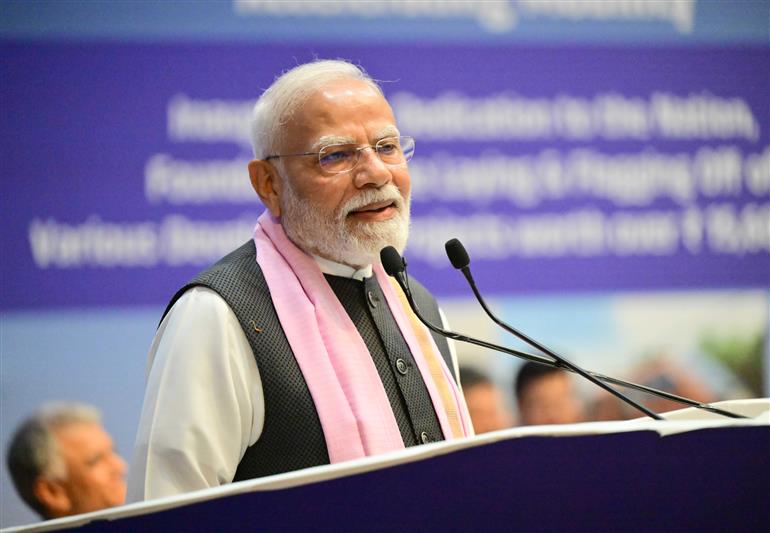
Bengaluru, Nov 13: The ongoing conflict involving Iran and the Gulf region has highlighted the importance of energy security, Prime Minister Narendra Modi said, asserting that India was able to withstand the challenges due to steps taken over the past decade to strengthen its energy infrastructure.
Addressing a gathering in Bengaluru, Karnataka, Modi said the country had expanded petrol, diesel and LPG production, increased crude oil storage capacity and diversified its energy sources through solar, hydro and wind power. Near-total railway electrification and the expansion of metro networks had also helped reduce dependence on conventional fuels.
“India weathered this challenging period firmly due to steps taken over the past decade, expanding petrol, diesel, and LPG production, crude oil storage, solar, hydro, and wind energy, near-total rail electrification, and metro networks…,” he said
The Prime Minister inaugurated, dedicated to the nation, laid the foundation stone and flagged off development projects worth over Rs 15,600 crore in Bengaluru.
Highlighting three energy-related projects in Karnataka, he said the Mangaluru LPG project would add 80,000 metric tonnes of storage capacity, while the Devangonthi Marketing Terminal would streamline the supply of petrol, diesel and aviation fuel. The Bengaluru compressed biogas (CBG) plant will produce 13 tonnes of biogas daily.
“This will improve waste management and money spent on the import of natural gas will also be saved,” Modi said.
He also highlighted India’s progress in renewable energy, stating that the country’s renewable energy capacity had crossed 300 gigawatts.
Referring to the PM Surya Ghar Muft Bijli Yojana, Modi said more than 60 lakh households across the country, including over 40,000 families in Karnataka, had installed rooftop solar plants with government assistance of around Rs 80,000 per family.
Under the PM KUSUM Yojana, more than eight lakh solar pumps were being used to support farmers in Karnataka, helping reduce electricity costs and create additional income opportunities.
“Meaning, the Annadatas of Karnataka are now also becoming Urjadatas,” he said.
The Prime Minister also stressed the importance of reliable electricity generation as India expands its presence in emerging technologies, including artificial intelligence, semiconductors, data centres and quantum computing. He said the country was also expanding its nuclear power capacity to meet clean energy goals.
On infrastructure development, Modi said the newly inaugurated Bengaluru Metro Pink Line would improve connectivity to IIM Bengaluru, educational institutions and major business and technology hubs.
He noted that Namma Metro had expanded from 17 kilometres in 2014 to over 100 kilometres, making Bengaluru the third Indian city after Delhi-NCR and the Mumbai Metropolitan Region to cross the 100-kilometre mark.
The Prime Minister also highlighted railway modernisation, including the development of Amrit Bharat stations and the expansion of Vande Bharat services. He said Karnataka had received four Amrit stations and two railway doubling and electrification projects.
A new Vande Bharat train connecting Karnataka with Goa was also flagged off, providing passengers along the coastal route, including Mangaluru, with semi-high-speed rail connectivity.
Modi said the development projects would strengthen Karnataka’s infrastructure, create employment opportunities and support the vision of a developed India through a developed Karnataka.
He also highlighted measures aimed at increasing middle-class savings, including income tax exemption on annual income up to Rs 12 lakh, changes in TDS rules and next-generation GST reforms.
“Our effort is that the savings of the middle class increase, their purchasing power becomes strong, and along with fulfilling the dreams of their family, they also become partners in the economic progress of the country,” he said.