

DARAKSHAN HASSAN BHAT
When the Digital India Mission was launched on 1st July 2015, its objectives were to transform India into a digitally empowered society and knowledge economy. The mission sought to provide digital infrastructure as a core utility, deliver government services electronically, and improve digital literacy. When we analyse how this mission catalysed the transformation in services and lifestyle, we find Jammu& Kashmir’s restricted opportunities turning into active platforms, especially for women. Digital India mission gradually became a catalyst for educational, economic, and social transformation.
For women, opportunities are shaped by circumstances beyond their control; if we don’t have good roads, travelling long distances can become a barrier for education or a complete reason for dropout. Likewise, employment opportunities were largely confined to a few sectors; artisans depended heavily on middlemen, and access to banking, healthcare, and markets remained limited. Although women possessed talent and resilience, they also needed safe, decent, and accessible platforms to showcase their skills beyond the Valley.
Over the decades, the expansion of broadband connectivity, BharatNet, Common Service Centres (CSCs), digital banking, UPI, DigiLocker, e-Sanjeevani telemedicine, PM Gramin Digital Saksharta Abhiyan (PMGDISHA), and e-commerce platforms has begun changing this reality. I am listing some of the inspiring women advantaged by digital technology.
One of the most inspiring examples is Mariya Reshi, founder of Pride by Mariya Reshi and Saood Wani. Starting as a small entrepreneur, Mariya used digital platforms and social media to market authentic Kashmiri handicrafts, especially Pashmina, apparel, and lifestyle products directly to customers across India. Rather than relying solely on traditional retail channels, her enterprise leveraged digital payments, online marketing, and e-commerce to build a national customer base. Today, Pride by Mariya and Saoodwani has become one of the Valley’s recognised women-led brands, creating employment opportunities while promoting Kashmir’s rich cultural heritage.
Kashmir is famous for its wazwan, especially served in weddings, and the way weddings are organised from there comes another remarkable example: Iqra Nazir, a postgraduate in Information Technology who launched Dawat Book, a platform designed to simplify and digitize traditional Kashmiri wedding and event planning. The most remarkable and groundbreaking change we see here, historically, the physical demands of preparing wazwan kept women restricted to home cooking rather than large-scale banquest preparations. Today this paradigm is shifting, young inspiring women of the valley are are forming the first ever all female wazaa (chef) squads braving the societal biases and this event and example reaches other women as an example so that they can also be encouraged and can step forward without shying away from work demonstrating how Digital India can empower women not only as entrepreneurs but also as knowledge leaders shaping public discourse.
Digital technology has also transformed opportunities for women artisans through government-supported initiatives. Thousands of women associated with UMEED Self-Help Groups, which today engage over 7 lakh women across nearly 80,000 SHGs in Jammu & Kashmir, increasingly use smartphones for digital banking, online bookkeeping, and marketing their products through WhatsApp Business, Facebook, Instagram, and e-commerce platforms. Digital payments have reduced dependence on intermediaries, enabling women to receive payments directly and manage their finances independently.
Healthcare is another area where Digital India has made a significant difference. Through the e-Sanjeevani National Telemedicine Service, women in remote districts such as Kupwara, Bandipora, Gurez, and Kishtwar can consult specialist doctors without travelling hundreds of kilometres. For pregnant women, elderly patients, and those requiring regular follow-up care, digital consultations have reduced both travel costs and delays in accessing medical advice, particularly in geographically challenging regions.
Education has similarly witnessed a transformation. The expansion of digital classrooms, online learning platforms, and virtual coaching has enabled girls from remote districts to prepare for national competitive examinations without leaving their homes. Mir Sehrish from the remote village of Lone Harie Kralpora, Kupwara, qualified for the highly competitive National Defence Academy NDA exam and emerged as one of only 24 girls selected across the entire country. The celebration is about her coming from a frontier valley; she relied heavily on focused preparations and utilizing available digital/ educational resources to achieve her childhood dream of entering aviation and defense space.
Initiatives such as Atal Tinkering Labs, digital STEM laboratories, and Skill India Digital programmes have exposed young women to robotics, coding, artificial intelligence, and innovation. At the University of Kashmir, women have consistently outperformed many of their peers academically, with female students securing a large majority of university gold medals in recent convocations, reflecting how greater access to educational resources is translating into higher achievement.
Financial inclusion has further strengthened women’s economic independence. Through the integration of Pradhan Mantri Jan Dhan Yojana, Aadhaar, mobile banking, and Direct Benefit Transfer (DBT), women now receive benefits under schemes such as Pradhan Mantri Matru Vandana Yojana (PMMVY) directly into their bank accounts. This has reduced dependence on intermediaries while increasing transparency and financial autonomy.
Digital India has also enabled Kashmiri women to reclaim their own narratives. Young content creators, educators, travel bloggers, entrepreneurs, and artists now use YouTube, Instagram, LinkedIn, and podcasts to showcase Kashmir’s culture, tourism, entrepreneurship, and everyday life to national and global audiences. These platforms have allowed women to become storytellers, innovators, and ambassadors of a changing Kashmir.
The journey, however, is still evolving. Continued investment in digital literacy, cyber safety, affordable internet, AI education, and women-led technology incubation will determine how fully Kashmiri women benefit from the digital economy. Greater participation on platforms such as the Government e-Marketplace (GeM), ONDC, Amazon Karigar, and One District One Product (ODOP) can further connect women entrepreneurs directly with national and international markets.
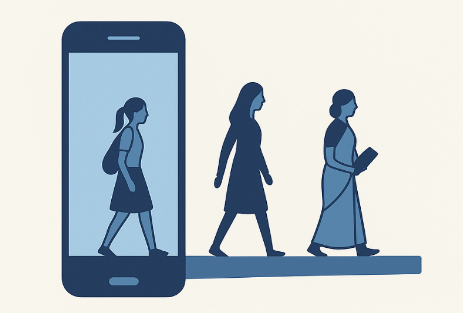
A decade after its launch, Digital India has done more than improve internet connectivity in Jammu and Kashmir. It has expanded aspirations. A generation ago, many women hoped primarily for access to education and secure employment. Today, increasing numbers aspire to become entrepreneurs, civil servants, innovators, researchers, digital creators, and business leaders. Their stories demonstrate that technology is not merely changing how people communicate—it is transforming what they believe is possible. For Kashmiri women, Digital India has become an important bridge between talent and opportunity, enabling them to contribute meaningfully to both the development of Jammu and Kashmir and India’s broader growth story.
(The author can be reached at darakshanhassanbhat@gmail.com)