

Irshad Mushtaq
A truly mature child is not only one who earns. A mature child understands the dignity of parents, the responsibility of family, and the importance of an honest income built with discipline. In Kashmir, parents quietly carry financial pressure for years. A father may need medicine, but stay silent. A mother may say, “I am fine,” when she is not. That silence is dignity — and protecting it is the duty of every mature son and daughter. Financial literacy for our youth is therefore not just a money topic; it is a family, emotional, and responsibility topic.
Why Young People Must Learn Money Early
Our young generation is talented and ambitious — studying, freelancing, running shops, supporting families. Yet many begin earning without learning to manage money. Salary comes, and within days it disappears in mobile bills, fuel, online shopping, and lifestyle pressure. The real problem is rarely low income; it is a lack of planning. Even ?100 saved daily becomes ?3,000 a month and ?3,60,000 in ten years — without any return calculated. Little money is not small when discipline is strong.
Parents’ Dignity Is a Financial Duty
Children often say, “I love my parents.” But love must move from words into planning. A mature son or daughter should keep a fixed monthly amount aside for parents’ comfort — medicines, daily needs, and old-age peace. It may be ?1,000, ?2,000, ?5,000, or whatever ability allows. The figure is not the point; the habit and the respect are. Parents should never feel like a burden in the home they built with their lives.
Start Early — Time Is the Biggest Asset
A young person of 22 has something a 35-year-old cannot buy: time. Time lets money grow through compounding — your returns start earning their own returns. Like a chinar tree, small at first but shading a whole mohalla in patient years, money grows with time. Starting early matters more than starting big.
CAGR in Simple Language
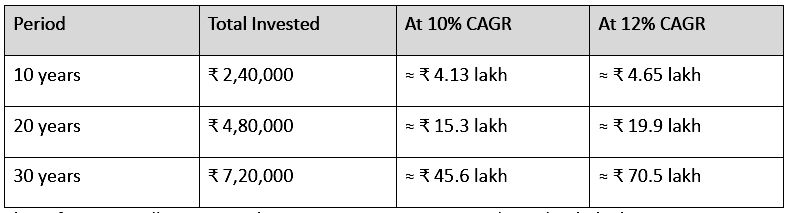
CAGR means Compound Annual Growth Rate — a single average yearly figure describing how an investment grew over a period. Real markets do not grow equally every year; some years are positive, some negative. CAGR smooths the journey into one honest number. A small hypothetical example — a SIP of ?2,000 per month, for illustration only:
These figures are illustrative only. Returns are not guaranteed. Market-linked investments rise and fall, and actual returns can be higher, lower, or even negative over some periods. The lesson is simple: regular, patient investing — chosen with proper suitability — can build meaningful wealth over time.
SIP Is Discipline, Not a Shortcut
A Systematic Investment Plan is not a magic formula. It is a habit — a small, regular amount invested monthly with a clear purpose. From my own experience as a mutual fund distributor in Kashmir, one truth repeats itself: a SIP without a goal stops easily, but a SIP tied to parents’ medical care, a child’s education, marriage, or retirement carries emotion — and emotion brings discipline. Match every SIP to a real goal.
Build Your Own Source of Income
Do not depend on a single income if you can avoid it. This does not mean every youth must become a businessman — it means improving earning ability. Learn a professional skill, take up freelancing or digital work, modernise the family shop, save from salary, and avoid wasteful spending. Financial freedom begins where income, savings, and discipline meet.
Avoid Show-Off Spending
A big danger for young earners is show-off spending — costly phones, branded clothes, loan-based bikes, parties to impress others. Before any big spend, ask honestly: is this a need, a comfort, or a show-off? A ?50,000 phone on EMI brings a few days of happiness and many months of stress. Money should first protect the family, then improve lifestyle — never the other way round.
Beware of Scams and Fake Promises
Be wary of anyone promising guaranteed high returns, “double your money,” fixed stock-market profit, or “secret tips.” Warning signs include pressure to invest fast, transfers to a personal account, and claims of “no risk, only profit.” Market-linked returns can never be guaranteed. Verify registration, read documents, and ignore WhatsApp rumours. The rule is simple: if you do not understand it, do not invest in it.
Emergency Fund and a Simple Money Formula
Before investing aggressively, build an emergency fund — ideally three to six months of basic expenses set aside for illness, job loss, or family needs. It prevents panic borrowing. A simple budget formula also helps:
50% for household and personal needs
20% for savings and investments
10% for parents’ comfort
10% for emergency fund
10% for personal enjoyment
Adjust the percentages to your situation. Every rupee should have a purpose.
Financial Literacy Begins at Home
This learning cannot wait for an office or a market. It begins at home — parents teaching saving, families discussing goals openly, colleges holding sessions on budgeting, scams, debt, and investing. A family that plans together grows together.
Conclusion
Kashmir’s youth do not lack talent. What they need is direction, discipline, and awareness. Start small. Start early. Save first. Spend wisely. Invest with understanding. Protect your parents’ dignity. A small SIP today can become tomorrow’s family support. A small lesson today can protect an entire generation from big mistakes. Parents spent their lives building children; mature children must now build the financial strength that lets parents live with comfort and respect. This is not just financial planning. This is gratitude in action.
(The author is a Jammu and Kashmir-based financial market intermediary, financial educator, columnist, and founder of M I Securities.)
Disclaimer
This article is for educational and informational purposes only. Mutual fund investments are subject to market risks; please read all scheme-related documents carefully before investing. Returns are not guaranteed. The CAGR and SIP figures used are hypothetical and illustrative only. Investors should choose products according to their own goals, risk profile, time horizon, and suitability, and follow applicable regulatory guidelines. Consult a registered advisor or qualified mutual fund distributor before making any investment decision.