

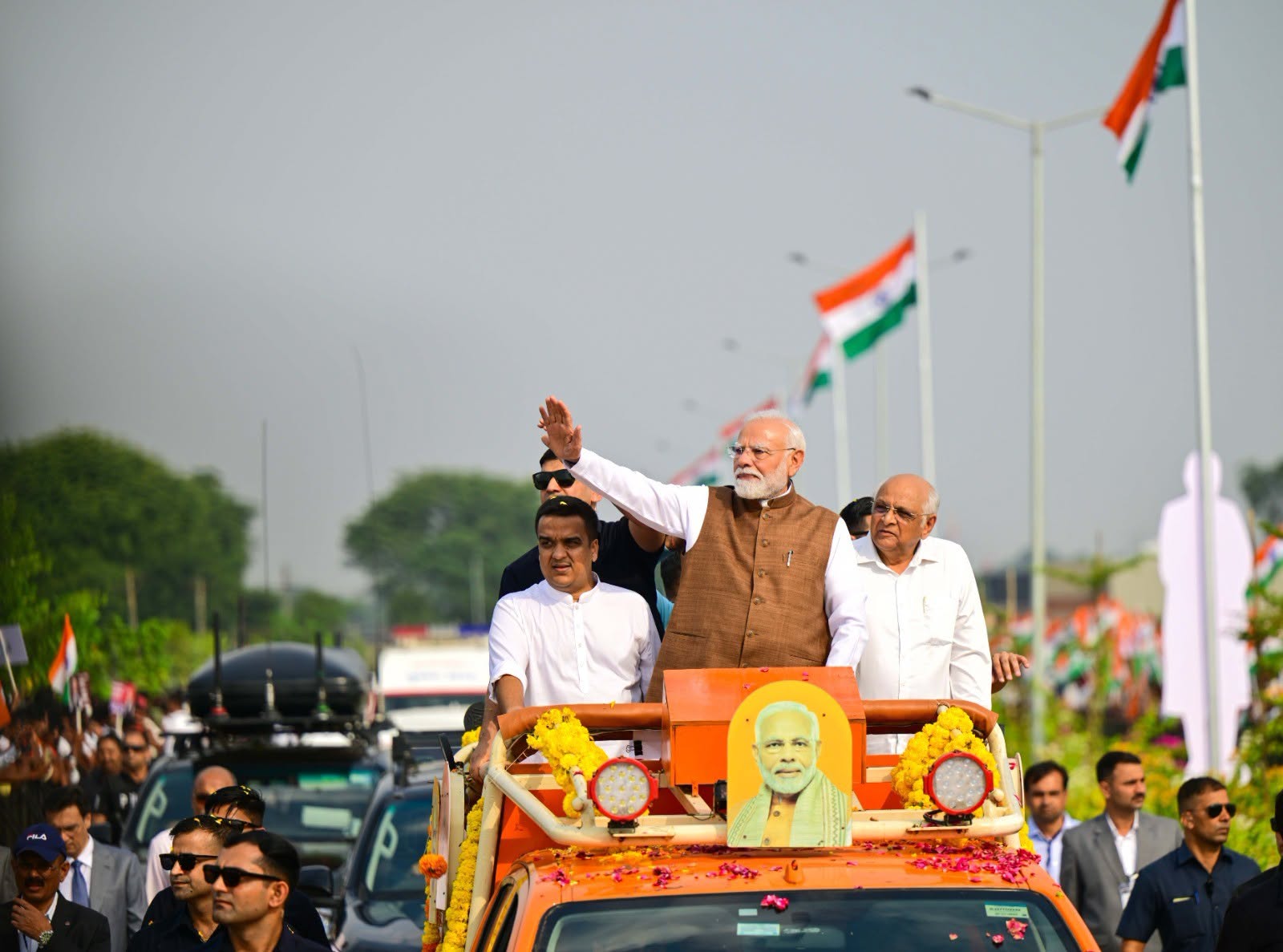
NEW DELHI, Oct 30: Prime Minister Narendra Modi on Friday laid the foundation stone, inaugurated and dedicated development projects worth over Rs 14,000 crore to the nation in Banaskantha, Gujarat.
Speaking on the occasion, shortly after Navratri, he announced several initiatives for women, children, farmers and livestock rearers. He also released a fresh instalment of the PM Kisan Samman Nidhi to millions of small farmers across the country.
Describing farmers as one of the strongest pillars of a developed India, the Prime Minister said the government had consistently prioritised their welfare and empowerment. He noted that the national agricultural budget had increased more than fivefold compared to 2013-14.
Highlighting the impact of the PM Kisan Samman Nidhi, he said over Rs 1,000 crore had been transferred to the accounts of more than 50 lakh farmers in Gujarat, including nearly Rs 50 crore for lakhs of farming families in Banaskantha.
“Today, an amount of more than Rs 18,000 crore has been sent into the accounts of about 10 crore farmers,” Modi said.
Pointing to the government’s support for farmers over the past several years, he said various policies and schemes had delivered benefits or savings worth more than Rs 50 lakh crore. Citing the PM Kisan Samman Nidhi, he said nearly Rs 4.5 lakh crore had been directly transferred into the bank accounts of small farmers.
He observed that small farmers constitute more than 85 per cent of the farming community and said the scheme had provided them with much-needed financial assistance.
Referring to the sharp rise in international fertiliser prices amid global uncertainty, Modi said the government had protected farmers from the impact of the price hike by spending around Rs 16 lakh crore.
He also highlighted the government’s commitment to Minimum Support Price (MSP), stating that wheat and paddy farmers had received more than Rs 24 lakh crore in MSP payments over the past 12 years.
On crop insurance, he said farmers had received over Rs 2 lakh crore in compensation under the PM Fasal Bima Yojana during the last 10 to 12 years.
The Prime Minister also highlighted the role of the PM-KUSUM scheme in reducing irrigation costs. He said nearly 12 lakh solar pumps had been distributed, helping generate additional electricity and saving farmers the expense of purchasing over 80 crore litres of diesel.
He said the benefits and savings from these five major schemes and decisions had strengthened farmers’ incomes and enhanced the capacity of Indian agriculture.
Emphasising the importance of science and technology in agriculture, Modi said the government had taken several steps over the past 12 years to modernise farming and animal husbandry.
He cited the Soil Health Card scheme as an important initiative that had helped farmers determine the appropriate type and quantity of fertilisers required for their fields. More than 26 crore Soil Health Cards, he said, were now with farmers across the country.
Acknowledging the challenges posed by changing weather patterns, he said the government was making continuous efforts to provide climate-resilient seed varieties to farmers. Around 3,000 new varieties of seeds had been made available in recent years, he added.
Highlighting animal husbandry as an important component of the rural economy, particularly for women, Modi stressed the need to integrate modern science and technology into the dairy and livestock sector.
He said improved animal breeds could increase milk production, while timely vaccination and medical treatment could prevent losses caused by diseases.
Referring to the Rashtriya Gokul Mission, the Prime Minister said the newly established research centre in Banaskantha would strengthen efforts to conserve and scientifically improve indigenous livestock breeds.
The facility will focus on breeds such as Gir, Sahiwal and Kankrej cows, as well as Mehsana, Murrah and Jaffarabadi buffaloes. It will also serve as the country’s first such facility for the Kankrej breed.
He explained that modern technologies such as in-vitro fertilisation (IVF) could help farmers pass on desirable qualities, including higher milk yield, better health and lower maintenance requirements, to future generations of livestock.
The Prime Minister also highlighted the nationwide free vaccination drive to protect livestock against diseases such as foot-and-mouth disease. He said around 150 crore vaccine doses had been administered so far, covering the livestock of more than 8 crore farmers.