

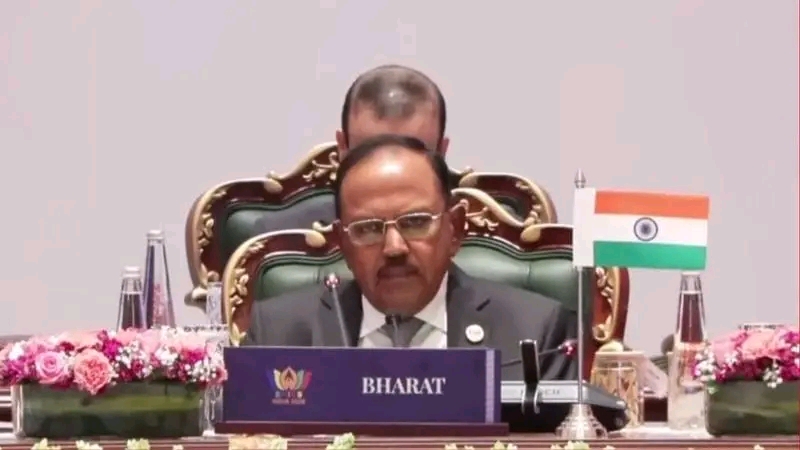
New Delhi: National Security Adviser (NSA) Ajit Doval called for stronger international cooperation to address the growing spectrum of non-traditional security threats while chairing the BRICS National Security Advisers’ Meeting in New Delhi.
The high-level meeting, attended by National Security Advisers and senior security officials from BRICS member countries, focused on the theme “Non-Traditional Security Challenges Confronting the World Today.” Discussions centered on the rapidly evolving nature of global security threats, including terrorism, cybercrime, misuse of emerging technologies, information warfare, and other transnational challenges.
During the deliberations, Doval emphasized the need for coordinated global efforts to tackle emerging security risks that transcend national borders. He underlined the importance of strengthening cooperation among BRICS nations in counter-terrorism, cyber security, and the secure use of information and communication technologies.
The meeting also reviewed the outcomes of the recently held BRICS Joint Working Groups on Counter-Terrorism and Security in the Use of Information and Communication Technologies. Participants exchanged views on evolving security dynamics and explored ways to enhance collective resilience against emerging threats.
On the sidelines of the conclave, Doval held a series of bilateral meetings with senior officials from member countries, including discussions with Chinese Foreign Minister Wang Yi and Iranian security official Ghadir Nezamipour. The talks focused on regional security developments, bilateral relations, and broader geopolitical challenges facing the international community.
India is hosting the BRICS National Security Advisers’ Meeting as part of its 2026 BRICS Chairship, guided by the theme “Building for Resilience, Innovation, Cooperation and Sustainability.” The gathering is seen as an important platform for advancing dialogue and cooperation on key security issues among emerging economies.
The BRICS grouping currently comprises Brazil, Russia, India, China, South Africa, Egypt, Ethiopia, Iran, Indonesia, Saudi Arabia, and the United Arab Emirates, and serves as a major forum for addressing contemporary regional and global challenges.