

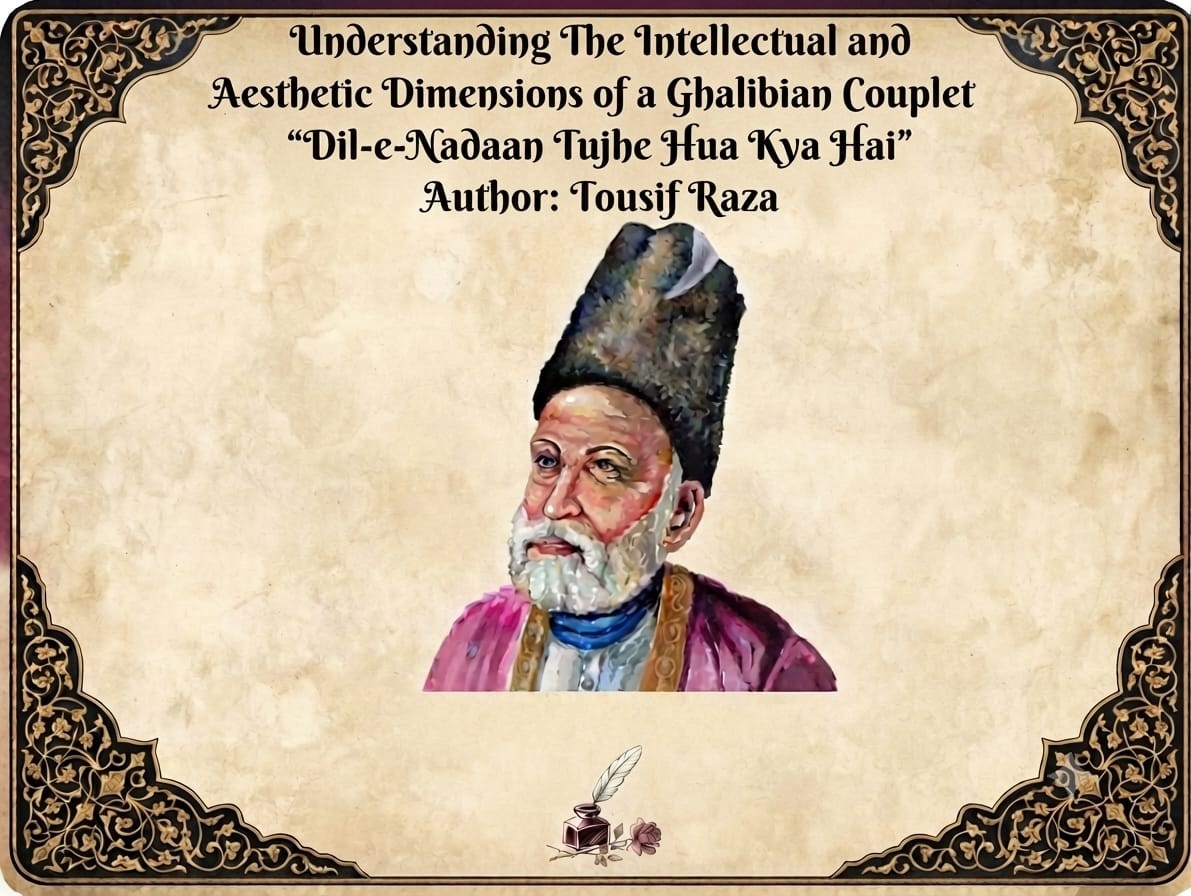
Tousif Raza
Mirza Asadullah Khan Ghalib’s poetry represents one of the highest achievements of the Urdu ghazal: a poetic tradition in which the verse does not remain merely an articulation of emotion but becomes a site of philosophical inquiry, psychological introspection, metaphysical speculation, and existential questioning. Let’s see this celebrated couplet:
“Dil-e-nadaan tujhe hua kya hai
Aakhir is dard ki dawa kya hai”
In the first reading, it appears to be a simple dialogue between the poet and his own heart. Yet beneath this apparent simplicity lies a remarkable architecture of thought. The couplet transforms an intimate emotional experience into a universal inquiry into the nature of human restlessness, desire, suffering, and the elusive possibility of cure. The opening expression, “Dil-e-nadaan”, constitutes the first major key to the couplet. Ghalib does not merely say “heart”; he calls it “nadaan”—naïve, unknowing, or incapable of fully comprehending itself. This epithet is not ornamental. It invests the heart with an independent consciousness and thereby creates an instance of personification (tashkhees). The poet addresses his own heart as though it were another being. In doing so, he divides the self into two interlocutors: the rational consciousness that asks the question and the emotional self that remains incapable of supplying an answer. The verse consequently becomes an extraordinary instance of inner dialogue.
The phrase “tujhe hua kya hai” intensifies this psychological dimension. Ghalib is not simply asking what has happened to the heart; he is expressing bewilderment before a transformation occurring within himself. The question carries the shades of wonder, complaint, helplessness, and self-interrogation. The poet seems to stand before his own interiority as a stranger, attempting to understand a disturbance whose origin remains obscure even to him.
The second hemistich introduces the powerful conceptual polarity of “dard” and “dawa”—pain and remedy. This is one of the couplet’s most effective antithetical structures (tazaad). The entire semantic architecture is organised around a medical metaphor: the heart becomes the patient, pain becomes the ailment, and “dawa” becomes the imagined cure. Yet Ghalib deliberately refuses to identify the remedy. His question is not merely what is the remedy? but “Aakhir is dard ki dawa kya hai?” The indeterminacy is precisely what enlarges the poem.
The “dard” of the couplet should therefore not be confined exclusively to romantic longing. It may signify the pain of separation, unfulfilled desire, emotional restlessness, or the anguish of love. Yet it can equally be read as the more fundamental unease of human existence—the inability to attain complete fulfilment, the anxiety of selfhood, the loneliness of consciousness, or the perennial human desire to discover meaning. In this sense, “dawa” becomes an open-ended metaphor. It may signify union with the beloved, forgetfulness, patience, knowledge, self-realisation, spiritual illumination, or even transcendence. Ghalib’s refusal to prescribe a definitive cure allows every reader to enter the couplet through a different existential door.
From a Sufi or mystical perspective, the “dard” may be interpreted as the soul’s longing for an ultimate reality, while the “dawa” may suggest ma‘rifah—spiritual knowledge—or proximity to the Divine. In such a reading, the pain is no longer merely an affliction; it becomes evidence of spiritual yearning. Nevertheless, such an interpretation should be presented as a possible mystical reading rather than as an unequivocal statement of Ghalib’s intended meaning.
Philosophically, the couplet approaches what modern thought might call an existential question: what can cure the inexplicable restlessness embedded within human existence? Is the remedy love, knowledge, fulfilment, self-knowledge, transcendence—or is there, perhaps, no final remedy at all? Ghalib does not resolve the question. He preserves it. This is one of the defining characteristics of his intellectual poetry: the question frequently acquires greater metaphysical significance than the answer.
Psychologically, the couplet can be understood as an exquisite representation of self-dialogue. The poet recognises an emotional disturbance within himself but cannot fully comprehend its source. The rational self interrogates the emotional self, yet the emotional self remains enigmatic. In modern psychological terminology, the “dil-e-nadaan” may even be approached as a poetic representation of the unconscious—the part of the self whose impulses are experienced before they are intellectually understood. This intellectual restlessness resonates with Ghalib’s wider poetic universe. Consider: “Hasti ke mat fareb mein aa jaiyo Asad Aalam tamaam halqa-e-daam-e-khayaal hai” in this couplet, Ghalib interrogates the apparent solidity of existence itself and suggests the possibility that the perceived world is entangled within the web of imagination. Similarly: “Bas ke dushwaar hai har kaam ka aasaan hona, Aadmi ko bhi mayassar nahin insaan hona”
Again, the poet moves beyond the immediate statement towards a profound meditation upon human existence and the difficulty of attaining authentic humanity. Thus, the couplet “Dil-e-nadaan…” belongs to the same intellectual universe. Whether the subject is love, existence, identity, or metaphysical uncertainty, Ghalib persistently refuses to remain at the surface of experience. His poetry converts emotion into thought and thought back into emotion.
From the perspective of Ilm-e-Bayaan, personification and metaphor constitute the principal artistic mechanisms of the couplet. “Dil-e-nadaan” transforms the heart into a speaking, thinking entity, while “dard” and “dawa” construct an extended metaphorical field. From the perspective of Ilm-e-Badee‘, the contrast between “dard” and “dawa”, the recurrence of “kya hai”, and the sustained interrogative mode create both semantic tension and musical coherence.
Ultimately, the greatness of the couplet lies not in the remedy it provides but in the question it leaves unresolved. Ghalib does not prescribe a medicine for the heart; instead, he places the reader before the mystery of the heart itself. The lover reads it as the language of longing, the philosopher as an existential inquiry, the mystic as a sign of spiritual thirst, and the ordinary human being as an articulation of an inexplicable inner restlessness.
Perhaps, therefore, “Dil-e-nadaan” is not Ghalib’s heart. It is the human heart itself—perpetually desiring, perpetually questioning, and perpetually searching for a remedy whose true nature it cannot quite comprehend:
“Aakhir is dard ki dawa kya hai?”
Beyond all this, the greatest virtue of this couplet is that it is not merely a technical specimen of Ilm-e-Badi‘, but a masterpiece of poetic aesthetics that, like a rainbow, gathers within itself innumerable colours of meaning and emotion. The delicate fusion of personification, antithesis, metaphorical construction, and suggestive imagery gives the couplet a remarkable poetic unity in which thought, emotion, questioning, and wonder coexist in perfect harmony. In a few seemingly simple words, Ghalib creates an entire universe of the human interior, where every word transcends its immediate meaning and opens the door to another realm of significance. This is precisely where Ghalib’s genius moves beyond mere verbal artistry into the higher realm of meaning-making; and this is why the couplet reveals a new colour, a new dimension, and a new depth of meaning each time it is read.
Within this poetic architecture, the sequence of wonder and questioning is equally profound. The couplet begins with a question, yet by the time we arrive at the second hemistich, that very question has transformed into a state of wonder, in which the poet appears incapable of reaching its ultimate answer. The question, therefore, ceases to be merely a search for an answer; by descending into its own depths, it gives birth to wonder. In the subsequent couplets of the ghazal, this order assumes a different form: wonder precedes the question, and the question emerges from the womb of that wonder. Thus, Ghalib’s ghazal ceases to be merely a collection of independent couplets and begins to assume the character of a natural and inwardly unfolding narrative.
The nature of human consciousness itself follows a similar trajectory: when confronted with a reality before which it finds itself helpless, the human mind begins to question; the question, in turn, generates restlessness, and restlessness impels the mind towards an unending quest. A subtle progression therefore emerges: wonder gives birth to questioning, questioning gives rise to restlessness, and restlessness leads to inquiry. As the question expands, the possibility of a definitive answer gradually contracts. Thus, in Ghalib’s poetic universe, restlessness becomes the imam, while questioning becomes the muqtadi that follows behind it. Perhaps this is one of the most profound achievements of Ghalib’s poetry: he does not lead us towards an answer; rather, he leads us into a realm of questioning where the quest itself becomes an enduring poetic and intellectual experience.
(The author is an English literature student. Hailing from Tangmarg, he can be reached at tousifeqbal555@gmail.com)