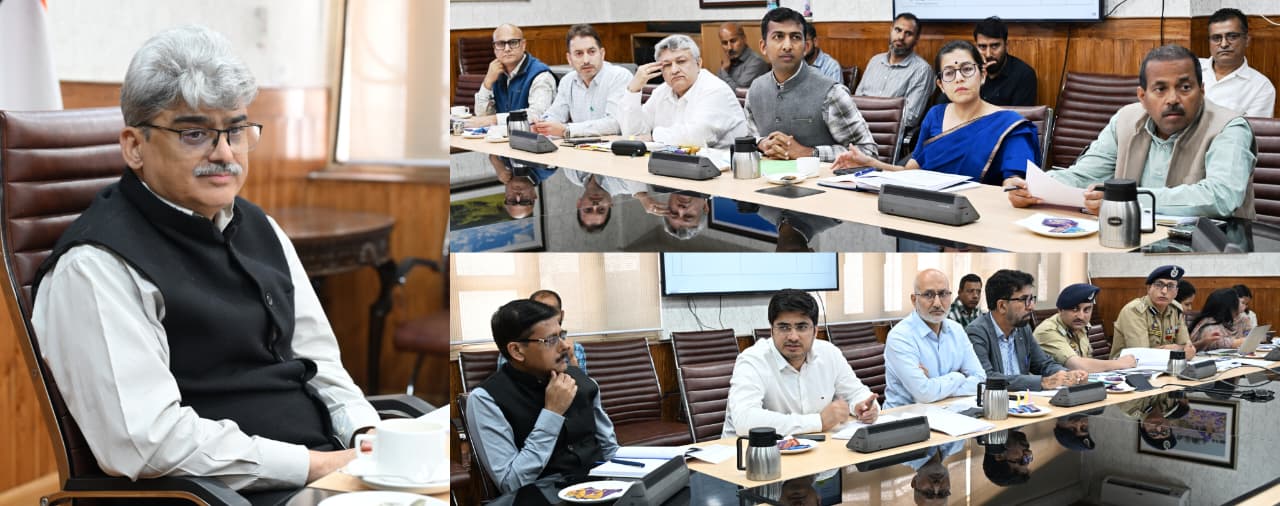
SRINAGAR: Chief Secretary, Atal Dulloo chaired the 5th meeting of the Multi Disciplinary Committee (MDC) on Traffic Management System to review the implementation of a comprehensive action plan aimed at easing traffic congestion and improving mobility in the twin cities of Jammu and Srinagar.
The meeting was attended by senior administrative and police officers, including Additional Chief Secretary, Public Works Departments; Principal Secretary, Home; Commissioner Secretary, Housing & Urban Development Department (H&UDD); Divisional Commissioner, Jammu/Kashmir; Inspector General of Police, Traffic; Secretary, Transport; Deputy Inspectors General of Traffic, Jammu/Kashmir; Commissioner, Municipal Corporation, Jammu/Srinagar; Senior Superintendents of Police, Traffic, Srinagar/Jammu; Vice-Chairman, Srinagar Development Authority (SDA); Director, Urban Local Bodies, Kashmir/Jammu; besides officers from other concerned departments.
The Chief Secretary highlighted the significance of the recommendations put forth by the committee headed by the Principal Secretary, Home, and called for a time-bound action plan for their effective implementation.
The Chief Secretary also reviewed progress on identification and rectification of black spots, widening of major roads, creation of rotaries and junction improvements in both cities.
He stressed the need for clearly identifying funding sources for all the proposed works, noting that these interventions are aimed at providing much-needed relief to the general public by improving ease of mobility in the twin cities and other urban centres of the UT. He directed the Housing & Urban Development Department (H&UDD) to take up the matter with the Finance Department to ensure smooth and timely execution of these projects across Jammu and Kashmir.
During the review, the Chief Secretary took a detailed appraisal of the measures undertaken by different departments for decongestion of major traffic corridors, augmentation of parking facilities, improvement of road infrastructure, streamlining of public transport and strengthening of intelligent traffic management systems in both the capital cities.
It was informed that several diversion routes have already been identified and operationalised in Jammu and Srinagar to reduce congestion on critical stretches and ensure smoother vehicular movement. In Jammu city, 10 diversion routes are being utilized for traffic decongestion. Similarly, five diversion routes have been made operational in Srinagar to reduce pressure on heavily congested city stretches.
The meeting was informed that dedicated e-rickshaw zones have also been notified to regulate traffic movement and improve last-mile connectivity. Six e-rickshaw zones have been established in Jammu while multiple operational, free and restricted zones have been identified in Srinagar city with some already implemented and others under consideration in consultation with stakeholders.
Reviewing traffic regulation measures, the Chief Secretary was apprised that one-way traffic systems have been introduced at several key locations in both cities, while proposals for additional no-vehicle zones in crowded commercial and hospital areas are under implementation after consultations with stakeholders and local authorities.
The meeting further discussed the implementation of Smart City Command and Control Response Systems (SCCoRS), installation of Intelligent Traffic Management Systems (ITMS), creation of Automated Traffic Management System (ATMS) junctions and procurement of modern enforcement and surveillance equipment.
It was informed that Traffic Police and allied departments have procured motorcycles, interceptor vehicles, cranes, body-worn cameras and ambulances for better traffic enforcement and emergency response.
In order to improve road safety and enforce traffic discipline, action has also been taken against habitual offenders across Jammu and Kashmir. The meeting was informed that action has been initiated against more than 39,000 habitual offenders, resulting in suspension and cancellation of driving licences and registration certificates besides seizure and blacklisting of vehicles.
It was informed that several projects including Canal Head–Bohri, Jewel–Canal Head and Satwari–Belicharana road stretches in Jammu have already been completed, while other projects are at different stages of execution. In Srinagar, widening proposals and road safety interventions are under progress, including installation of metal beam crash barriers and preparation of DPRs for identified black spots.
The Chief Secretary also reviewed the status of no-parking zones, IT-based parking systems, on-street parking management, parking policy formulation and development of dedicated vending zones. It was informed that GIS-based mapping for parking management is underway in Srinagar while several parking sites in Jammu have already been tendered and partially operationalised.
The meeting also discussed regulation of banquet halls and schools lacking adequate parking facilities. The Municipal Commissioners informed that notices have been issued to non-compliant establishments and parking management plans are being enforced to prevent roadside congestion.
Besides, the progress on installation of traffic signages, creation of no-honking zones, development of new roads, construction of rotaries and upgradation of bus stands in Jammu and Srinagar was also reviewed in detail.
The Chief Secretary further called for expediting all pending works, removing bottlenecks hampering project execution and ensuring visible improvement in traffic flow and commuter convenience across the twin cities at the earliest.
CS reviews comprehensive traffic decongestion plan for Jammu, Srinagar Cities