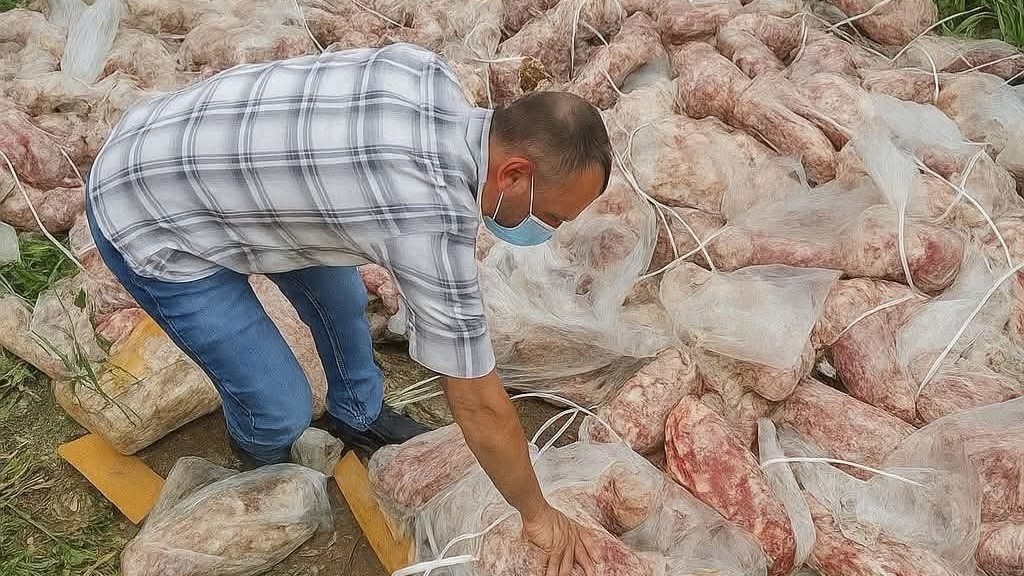
Authorities in Kashmir valley have stepped up enforcement against the sale of rotten and unsafe meat and chicken across several districts. Over the past few days, more than 3,500 kilograms of decayed meat have been seized during surprise inspections. In some areas, dealers resorted to illegally dumping the spoiled products, including instances where discarded meat was found in public spaces. The issue was also raised in Friday sermons in several mosques across the Valley. In Srinagar’s Safakadal and Parimpora localities, enforcement teams confiscated 2,500 kebabs that had been processed using frozen meat mixed with prohibited food colouring. These items were destroyed on-site to eliminate any risk to public health on Thursday. Food Safety Officers collected samples of the seized products for analysis and further legal proceedings. In Ganderbal’s Nagbal area, around 250 kilograms of meat had to be destroyed due to signs of spoilage resulting from poor handling and storage. Officials also sealed two premises in the district after unhygienic storage practices were observed. In Pulwama’s Kakapora and Srinagar’s Khandey Colony, more incidents of illegal meat dumping were recorded. The Food Safety Department has reiterated its zero-tolerance approach toward such violations and confirmed that legal action will be initiated against food business operators found in breach of the law. The department also urged all food handlers, especially those selling high-risk items, to follow the Food Safety and Standards Act, including proper labeling and hygiene standards. Consumers have been encouraged to report any irregularities or unsafe food practices by calling the department’s helpline. Doctors have warned that consuming rotten or adulterated meat poses serious health risks, especially in the current weather conditions where bacterial growth is rapid. Such meat can lead to food poisoning, severe gastrointestinal infections, and in some cases, long-term damage to the liver or kidneys. Eating such unhygienic food can even cause cancer in the long run as per doctors. Vulnerable groups like children, the elderly, and individuals with compromised immunity are at an even greater risk. Medical professionals have strongly advised the public to avoid purchasing meat from unverified or unhygienic sources and to immediately report any suspicious-looking or foul-smelling products. The health consequences, they caution, can be grave and even life-threatening if contaminated food is consumed. In response to the ongoing violations, Minister for Food, Civil Supplies & Consumer Affairs, Satish Sharma, has directed enforcement teams to intensify their efforts across Jammu and Kashmir. He reviewed the department’s ongoing operations during a meeting with senior officers from FCS&CA, Legal Metrology, and the Enforcement Wing. The Minister emphasized the importance of timely inspections and strict penalties for those selling substandard meat. He also called for stronger coordination among municipal bodies, health departments, and law enforcement agencies to improve oversight and accountability. While the public has been advised to remain alert, the responsibility remains with authorities to ensure that spoiled meat does not enter the valley in the first place. Much of the unsafe meat is brought in by trucks, raising concerns about the lack of a robust quality control system at the point of entry.
Crackdown Intensifies