

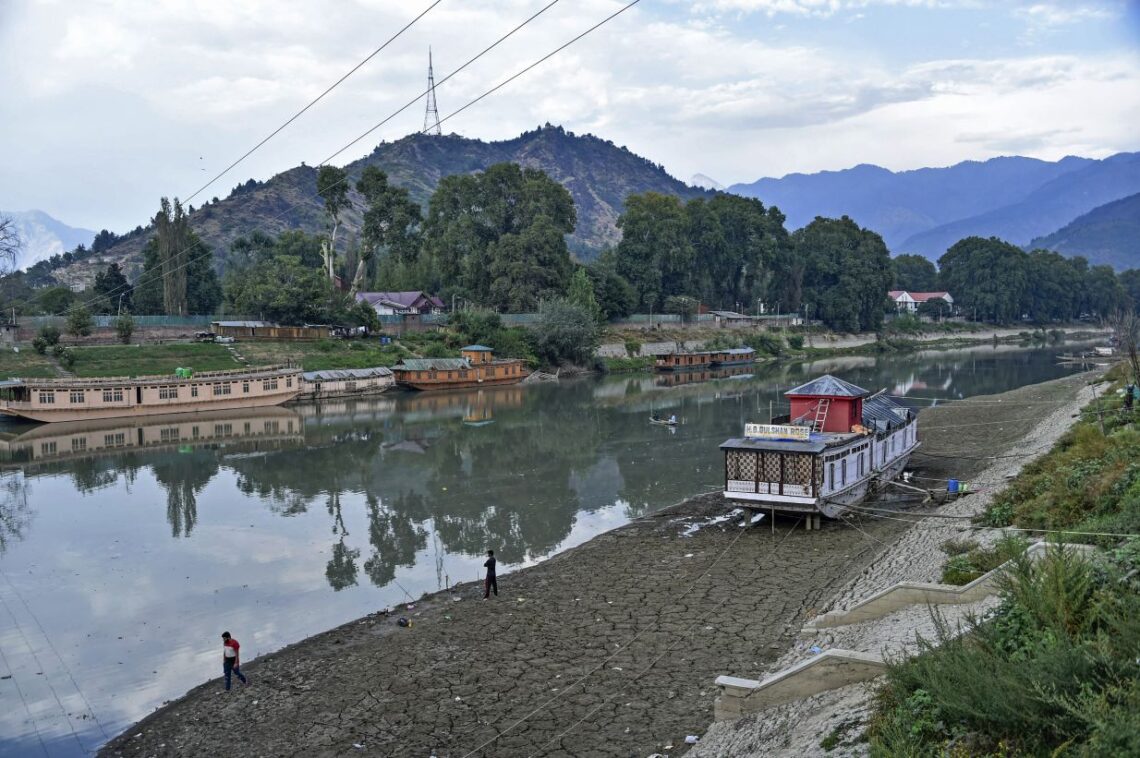
Srinagar, Jan 09: Amidst the melting of glaciers, River Jhelum, the lifeline of Kashmir, is witnessing one of its all-time lowest water levels this season, raising alarms about the growing impact of climate change on the region.
According to the details, the Jhelum at Sangam Point is currently flowing at a distressing level of -0.75 feet, while at Ram Munshi Bagh, the water level stands at 3.73 feet and Asham at 1.08 feet.
These measurements indicate a severe drop in water flow, which is unprecedented for this time of the year.
Similarly, Lidder Nallah and Rambiara Nallah, are also facing critical lows, with the former flowing at -0.38 meters at Batkote and the latter at -0.47 meters at Wachi.
A top official of the Irrigation and Flood Control department said, “The River Jhelum is witnessing below zero flow. The main source of Jhelum are glaciers but unfortunately, these are losing sheen due to Kashmir witnessing prolonged dry spells.”
He said, “The various water supply schemes are being hit across Kashmir due to Jhelum becoming dry. It’s a cause of concern.”
Experts have warned that these figures are symptomatic of a larger environmental crisis fuelled by erratic climate patterns and prolonged dry spells.
Independent Weather Forecaster, Faizan Arif Keng said, “The current dry spell, which has persisted since October, has further aggravated the situation. The Jhelum had already recorded a historic low of -1.0 feet earlier this season.”
“Over the past five years, Jammu and Kashmir has experienced below-normal precipitation during the critical winter months of December to February, which has significantly hampered the replenishment of glaciers that feed the river,” he added.
“Rising temperatures throughout the year have accelerated the melting of glaciers while reducing their overall size. Summer and winter months have seen below-normal rainfall, exacerbating the problem as water sources continue to dwindle,” Keng said.
He warned that this trend of higher-than-average temperatures and irregular precipitation patterns is likely to continue, threatening the region’s water security.
Another expert said, “Jammu and Kashmir have lost nearly 30 percent of glaciers in the past 60 years, and if the same trend continues 70 percent of them will recede by the end of this century.”
“There are 18000 glaciers in Jammu, Kashmir, and Ladakh, but all of them are melting. The glaciers are melting in the entire Himalaya including J&K,” he added.
It may be recalled that Dr. Irfan Rashid, who is working as an Assistant Professor at the Department of Earth Sciences, the University of Kashmir, said that research has been done, which states that Kashmir’s biggest glacier, Kolahoi glacier has melted around 25 percent since 1960s. “From 1962-2022, it has melted around 25 percent. It has been receding 35 meters every year,” he had said, adding that Kolahoi glacier is the biggest glacier in Kashmir, and at the same time, is the fastest melting glacier as well.”
“According to research there will be a 4-7degrees increase by the end of this century, and therefore the melting cannot be stopped,” he added. (With KNO inputs)