

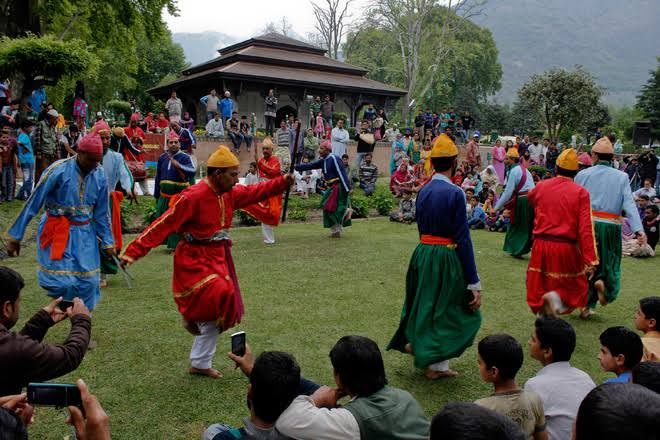
Palhalan: Drum beats, folk songs and satirical performances that once echoed through this north Kashmir village have fallen silent.
Folk artists struggle to keep the centuries-old tradition of Bhand Pather alive. Declining audiences, changing entertainment habits and dwindling livelihood opportunities have sounded the death knell for the art form
For generations, Palhalan in Baramulla district was known across Kashmir as a centre of Bhand Pather. Its artists travelled from village to village, entertaining audiences while conveying messages on social issues through humour and storytelling.
Today, however, the art form is losing ground as younger generations move away in search of stable livelihoods, leaving only a handful of ageing performers to carry forward the centuries-old tradition.
Among them is Sanaullah Bhat, 57, who spent most of his life performing Bhand Pather. Unable to sustain his family through art, he now sells cosmetic items to make ends meet.
Sanaullah recalls a time when folk artists enjoyed both respect and financial security.
“This is the most depressing phase of my life. I travel long distances but make little money,” he said.
He remembers the 1980s and 1990s as the golden period for Bhand Pather artists.
“In those days, we would perform regularly in villages across Kashmir. I used to earn nearly Rs 3,000 a month from various shows, which was a good income then. On many occasions, people would even give us food grains and other gifts. We were respected wherever we went,” he said.
According to Sanaullah, Palhalan once had dozens of active performers and several troupes that remained busy throughout the year. Weddings, harvest celebrations, community gatherings and government-sponsored awareness campaigns provided regular opportunities for artists.
“There was a time when almost every household here had someone associated with this art. Young boys would eagerly learn the craft from their elders. Today, hardly anyone wants to join,” he said.
The decline of the art form is reflected in Sanaullah’s own family.
His son, Aijaz Ahmad Bhat, 28, attempted to continue the family’s artistic legacy and joined a Bhand Pather troupe two years ago. But he soon realised that performing alone could not provide a reliable source of income.
“I wanted to continue what my father had dedicated his life to. I learned the performances and participated in several programmes, but soon realised this wasn’t a career I could depend on,” Aijaz said.
He now works part-time as a labourer in apple orchards to support himself.
“There are days when there are no programmes for weeks. I have responsibilities and need a stable income. That’s why I started working in orchards,” he said.
His experience mirrors that of many young people in Palhalan, where economic realities are increasingly outweighing cultural traditions. Several former performers have shifted to occupations such as shopkeeping, driving, manual labour and other small businesses.
“I had a passion for this art but left soon before exploring it completely. Even our young generation don’t know what it looked like. They can’t play any instrument, nor can they perform an act. This village has lost its relevance now, ” said Muhammad Yousuf Bhat, another artist turned shopkeeper.