

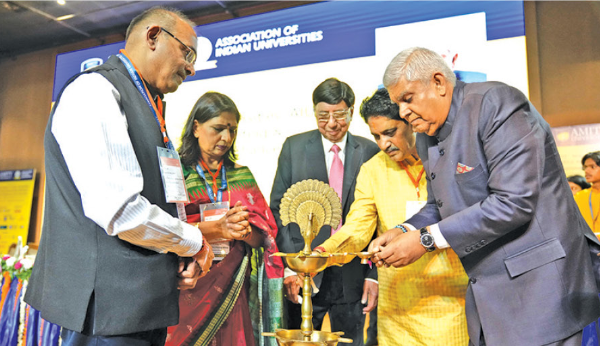
New Delhi, June 23: Vice President Jagdeep Dhankhar today said Article 370 and Article 35A bled Jammu and Kashmir and deprived people of basic human rights.
“We suffered from Article 370 for too long. It bled us and the state of Jammu and Kashmir. Article 370 and the draconian Article 35A deprived people of their basic human rights and fundamental rights. We have a visionary Prime Minister, Narendra Modi, and a Home Minister. Article 370 does not exist now in our Constitution. It was abrogated on 5th August 2019, and the legal challenge to the Supreme Court failed on 11 December 2023. I, therefore, cannot be at a more befitting place than this to pay tribute to one of the finest sons of our soil. My tributes to him,” he said.
Dhankhar today paid homage to Dr. Syama Prasad Mukherjee., “It’s a great day in the history of our nation. One of the finest sons of our soil, it is his Balidan Diwas today. He gave the slogan — Ek Nishan, Ek Vidhan, and EK Pradhan. He said so during the campaign in the state of Jammu and Kashmir in 1952,” he said.
Dhankar was addressing the inaugural session of the 99th Annual Meet and National Conference of Vice Chancellors (2024–2025), organised by the Association of Indian Universities (AIU), at Gautam Buddha Nagar, Uttar Pradesh.
I have firmly believed — education is a great equalizer. Education brings about equality as no other mechanism does. Education decimates inequities. Education gives life to democracy.”
Applauding India’s national progress, the Vice-President said, “India has emerged as a land of opportunity, of entrepreneurship, of startups, of innovation, of unicorns. In every parameter where growth and development can be gauged, we are rising.”
On the role of universities, the Vice-President emphasized, “Our universities are not meant to just hand out degrees. The degrees must carry great weightage. Universities must be sanctuaries of ideas and ideation, crucibles of innovation. These places have to catalyse big change.”
“That responsibility lies on the Vice-Chancellors in particular and the academia in general. I appeal to you, there must be space for disagreement, debate, dialogue, and discussion. That is how the mind cells are activated. Abhivyakti, Vaad Vivaad, Anant Vaad — these are inalienable facets of our civilisation, of our democracy.”
Highlighting India’s potential to lead in knowledge domains, he said, “When you look around the world, you’ll understand its significance. The state of education defines not only the state of academics but also the state of the nation. We cannot remain perpetual students of Western innovation when our demographic dividend position says, as the world’s knowledge epicenter.”
“And when we look back in our ancient history, we are reminded of our rich past. It is time Bharat must build world-class institutions, not just to teach, but to pioneer. These are not mere disciplines. These are levers of assurance of our sovereignty in all times to come.”
Calling for equitable expansion of higher education, the Vice-President observed, “A lot of our institutions have remained brownfield. Let us fall in line with the global groove — let’s go green. Greenfield institutions alone bring about equitable distribution. There is clustering in metros and Tier 1 cities. Many regions remain untouched.”